
Starting a hardware startup is exciting until you actually have to build the thing. Most founders head straight to Shenzhen (electronically speaking) because they’ve heard it’s the only place where you can turn a sketch into a smart gadget in weeks.
But here is the reality: Shenzhen is a high-speed machine that doesn’t care about your “disruptive vision” unless you know how to talk its language. For a startup, the electronics markets like Huaqiangbei are both a playground and a minefield.
If you’re trying to source smart home devices, IoT tools, or wearable tech, here is how the process actually works on the ground—minus the hype.
Can you really find “Smart” products sitting in a market stall?
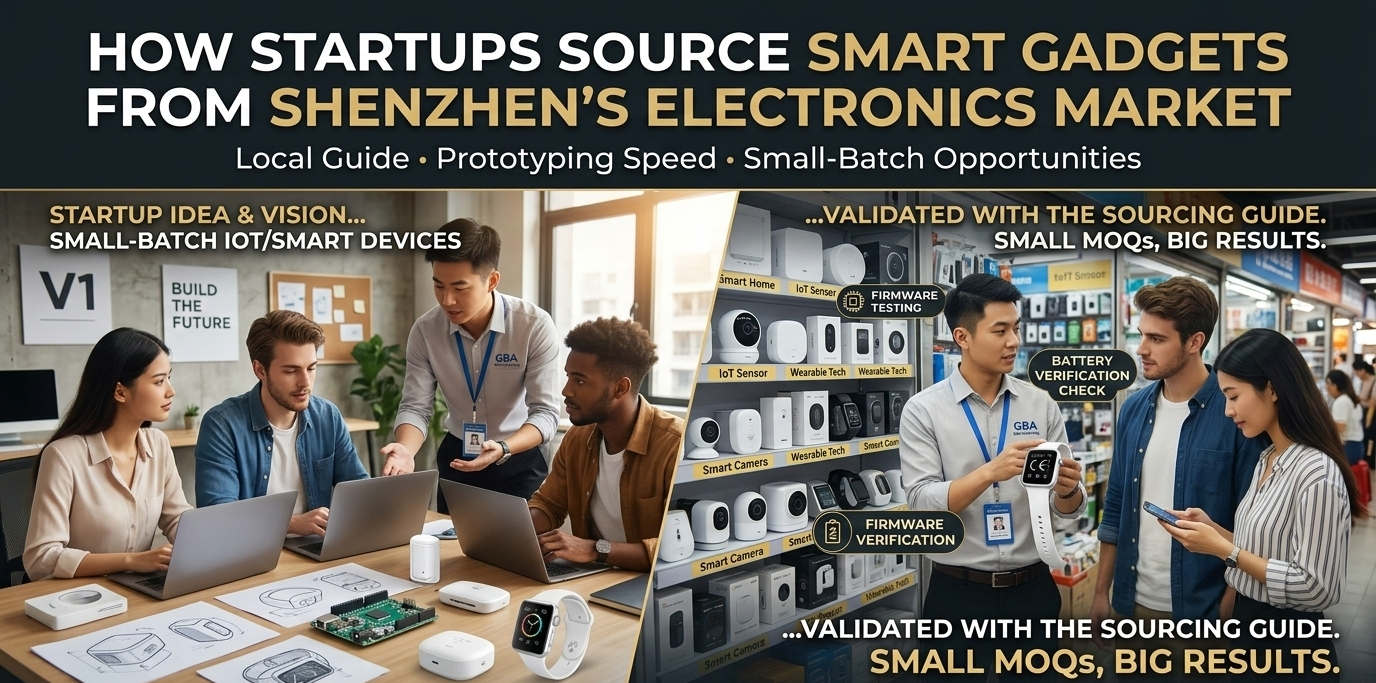
If you walk into the SEG Plaza or Futian electronics markets, you’ll see thousands of “smart” gadgets—smartwatches, AI cameras, IoT sensors. But here’s the catch: most of these are “Public Mold” products.
This means the plastic casing and the basic circuit board are used by 50 different “brands.” As a startup, you can buy these white-label products, slap your logo on them, and be in business tomorrow. However, if you want something truly unique, the market is just your starting point for research. You use it to see what’s possible, check component prices, and find which factories are actually making the hardware inside.
How do you handle small-batch orders (MOQ) as a startup?
This is the biggest hurdle. Big Shenzhen factories want orders of 10,000 units. Startups usually want 200 to test the market.
When you work with a sourcing agent, our job is to find the “middle-sized” factories in districts like Bao’an or Longhua. These are hungry shops that are willing to do small-batch manufacturing because they hope you’ll become the next big thing.
- The tradeoff: You will pay a higher per-unit price.
- The reality: It is better to pay $15 for 200 units that work than $8 for 5,000 units that sit in a warehouse.
Why do you need someone to check the “Smart” part of the gadget?
With basic electronics (like a lamp), if it turns on, it’s usually fine. With smart gadgets, the hardware is only half the story. The software—the firmware—is where things break.
We’ve seen startups order “smart” plugs that work perfectly in a Shenzhen office but fail immediately when connected to a European or US Wi-Fi router because of frequency or security protocol differences. A local agent doesn’t just look at the box; we:
- Test the App/Firmware: Does the Bluetooth pair every time? Does the app crash?
- Check the Battery: Startups often get stuck with “Grade B” lithium batteries that lose half their life in three months. We verify the battery cell brand.
- Certification: We make sure the “CE” or “FCC” logo on the back isn’t just a sticker but is backed by a real test report.
Is “Shenzhen Speed” real for prototyping?
Yes, but only if you are here. If you are emailing a factory from California, “Shenzhen Speed” is a myth. You’ll wait three days for every reply.
When you have a local partner in Guangdong, we can go to a PCB (Printed Circuit Board) shop in the morning, get a prototype board by the evening, and have it soldered the next day. This iteration—fixing a bug and re-testing—is what allows startups to launch in 3 months instead of 12.
FAQ: Hardware Startup Sourcing
Q: Should I go to Huaqiangbei myself?
A: If you have the time, yes—it’s an education. But don’t buy your main stock there. Stalls in the market are retailers or small traders. Use them for “samples,” but go to the factory for your “stock.”
Q: How do I protect my Intellectual Property (IP)?
A: Total IP protection in China is difficult, but you can be smart. Don’t give one factory your entire design. Let Factory A make the casing, Factory B make the PCB, and do the final assembly/software flashing with a trusted third-party partner or your agent.
Q: Can a sourcing agent help with “white-labeling”?
A: Absolutely. This is the fastest way for a startup to get to market. we find a high-quality existing product, help you customize the firmware and the packaging, and handle the Amazon FBA shipping or direct-to-customer logistics.
Q: What is the most common mistake hardware startups make?
A: Over-complicating the first version (V1). Shenzhen is full of “cool” features, but every extra sensor adds a point of failure. Keep V1 simple, get it made, and get it shipped.
The Bottom Line
Shenzhen isn’t a vending machine where you put in money and a perfect startup product comes out. It’s a massive, messy ecosystem.
Success for a startup here comes down to validation. Don’t trust the gold-plated sample; trust the random unit pulled from the assembly line. Having a local team means you aren’t just another “overseas email”—you are a local buyer with a physical presence.
Building something “Smart”? Send us your prototype specs or a link to a similar product. We can tell you within 48 hours if it’s something we can find in the market or if we need to head to the factories in Bao’an to get it built from scratch.