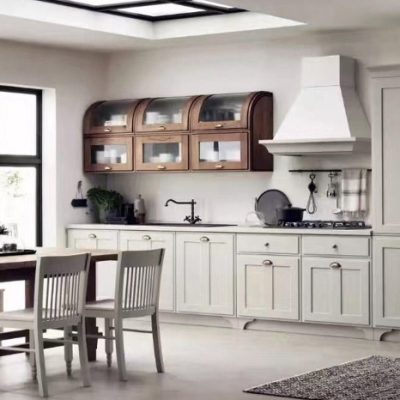


For international real estate developers, hospitality procurement executives, and commercial general contractors, managing a high-volume cabinetry order is a high-risk operational task. Unlike loose furniture, built-in kitchen cabinets must withstand daily physical stress, humidity fluctuations, and varying temperatures over a multi-year occupancy cycle.
In massive real estate developments—such as a 120-unit apartment block or a luxury resort development—relying on basic catalog pictures or unverified factory statements is an invitation for financial loss. A single millimeter of dimensional deviation or a subpar chemical adhesive can stall an entire construction site and force expensive on-site carpentry adjustments. This checklist breaks down the exact technical parameters your on-the-ground team must verify inside the factories of Foshan before loading any containers.
What are the critical raw material specifications you must write into the contract?
The structural integrity of a cabinet depends entirely on the thickness, density, and chemical composition of its raw core boards. When factories submit competitive quotes, they often reduce manufacturing costs by altering the invisible core substrates. Your contract must explicitly specify the following density and environmental thresholds:
1. Standard Carcasses: Melamine Faced Chipboard (MFC)
- Technical Requirement: Thickness $\ge 18\text{mm}$; Density $\ge 720\text{ kg/m}^3$.
- Key Risk Met: Prevents side-panel bowing under the heavy static weight of stone or quartz countertops.
2. Under-Sink Units: Multi-layer Plywood (WBP glue)
- Technical Requirement: Phenolic bond layer with an integrated aluminum foil shield.
- Key Risk Met: Eliminates water absorption and board swelling from plumbing leaks.
3. Carved/Profile Doors: Medium Density Fiberboard (MDF)
- Technical Requirement: Thickness $\ge 18\text{mm}$ or $22\text{mm}$; Class E0 / CARB Phase 2 compliance.
- Key Risk Met: Ensures smooth profiling without fiber tearing; enforces strict chemical emission safety limits.
Substrate Moisture Target
You must mandate that the internal core moisture levels of all wooden panels are dried to strictly between 8% and 12%. If raw boards exceed 14% moisture at the factory in humid Southern China, they will rapidly contract when shipped to drier Western or Middle Eastern climates. This contraction causes hairline cracks, door bowing, and loose hinge screws.
Why does edge-banding technology determine the lifetime of commercial cabinetry?
The weakest point of any melamine or wood panel is its cut edge. If moisture penetrates the unsealed board edges, the internal wood fibers swell, causing irreversible dimensional warping and surface rupture.
The standard adhesive used by budget manufacturers in China is EVA (Ethylene Vinyl Acetate). EVA is a cheap cold glue that reactivates and softens when exposed to steam from ovens and dishwashers, leading to peeling edge strips.
For long-term commercial projects, you must write PUR (Polyurethane) Hot-Melt Edge Banding into your technical contract:
- Chemical Curing: PUR forms an irreversible covalent chemical bond with the wood substrate. It will not re-soften or release when exposed to moisture, steam, or high temperatures.
- Minimal Joint Line: PUR lamination produces an incredibly thin adhesive line, making the joint practically invisible and preventing dirt or grease buildup over time.
- Moisture Lockout: PUR completely blocks ambient steam from entering the board cores, preserving the cabinet’s structural dimensions in high-humidity zones.
What hardware certifications should project buyers demand from manufacturers?
A kitchen cabinet’s functional lifespan is defined entirely by its moving parts. Soft-close hinges and under-mount drawer slides are the most heavily cycled components in a residence. Budget factories cut their pricing by substituting high-grade structural hardware with generic, unbranded zinc alloy slides. These low-grade mechanisms wear down quickly, leading to sagging doors and scraping drawers.
To ensure long-term durability, mandate name-brand hardware (such as DTC or Blum) and demand certified laboratory validation.
The mechanical components must possess a certified performance metric of at least 80,000 to 100,000 open-close cycles under a full static weight load. Furthermore, all metallic hardware must undergo a 48-hour neutral salt spray test to ensure the anti-corrosion coating can withstand highly humid coastal environments.
How does a 1:1 physical mockup eliminate installation bottlenecks on-site?
The most expensive mistake in international cabinetry procurement is releasing mass production based solely on 2D blueprints or 3D digital renderings. No matter how clean a CAD drawing appears, it cannot account for real-world material tolerances and installation clearances.
You must establish a mandatory technical gate: a 1:1 scale physical prototype room constructed directly on the factory floor using the exact specified substrates, finishes, and hardware.
- Appliance Verification: Drop your specified project appliances (ovens, dishwashers, hobs) directly into the prototype openings to test the ventilation channels and prevent on-site overheating risks.
- Plumbing and Electrical Alignment: Physically trace where pipe feeds and electrical wiring pass through the backing panels, allowing you to optimize cutouts before mass production.
- Finish Calibration: View the specified door finishes under standard D65 color-matching lights to ensure color-batch uniformity across different raw material runs.
What physical inspection checkpoints should your on-the-ground QC team verify before loading?
A quality checklist is useless without direct physical oversight during manufacturing and packaging. Once production finishes, your independent QC inspectors must verify several key parameters on the factory floor:
- Dimensional Tolerance: Side panel thickness must be verified using digital calipers down to the millimeter. Acceptable tolerances must remain within $\pm0.5\text{mm}$ of the approved technical drawings.
- Moisture Levels: Pin meters must be inserted into randomized panels to verify that internal wood core moisture sits safely between 8% and 12%.
- Weight Stress Test: Drawer glides must be loaded with weights simulating heavy cookware to verify smooth mechanical travel without grinding.
- Packaging Integrity: Every panel must be wrapped in heavy-duty polyethylene shrink wrap and packed into double-wall corrugated cartons with rigid corner protectors to prevent transit damage.
Key Takeaways
- Carcass Integrity: Never drop below 18mm thick MFC with a minimum density of 720 kg/m³ for base carcasses.
- The PUR Adhesive Standard: Mandate PUR hot-melt edge-banding across all cut panels to prevent water swelling.
- Hardware Lifespan: Require name-brand hardware (like DTC or Blum) certified for over 80,000 active cycles.
- On-Site Fit-out Security: Require a physical 1:1 prototype kitchen to confirm appliance integration before starting bulk production.
Why Choose HSY Sourcing?
HSY Sourcing operates as your dedicated on-the-ground technical procurement office directly inside the Foshan cabinet and building materials cluster. We maintain no factory alliances, accept zero supplier commissions, and work strictly on a transparent service framework to protect your commercial interests.
- Direct Field QC: Our engineers visit production floors to check timber moisture and verify panel tolerances before loading.
- Cross-Category Alignment: We coordinate details between cabinet makers, countertop yards, and appliance lines to guarantee a perfect fit.
- Optimized Consolidation: We stage, pack, and consolidate cabinetry with heavy materials like tiles to reduce shipping costs.
- Enforceable B2B Contracts: We construct technical purchase orders that protect your budget and timeline.
Frequently Asked Questions (FAQ)
How does climate change impact wood panels exported from China?
Foshan has a humid, subtropical climate, whereas your project site might be dry or highly climate-controlled. If raw boards absorb excess moisture during fabrication, they will shrink at the destination, causing warped doors and loose hinges. We solve this by enforcing a target moisture level of 8% to 12% at the factory before packing.
How can we confirm that the factory is using authentic E0-grade timber boards?
We verify board compliance by checking the raw material delivery invoices at the factory intake gate and matching them with batch certificates. Additionally, we check for brand markings on the raw, uncut sheets on the production floor.
Should we order cabinetry pre-assembled or flat-packed?
Flat-pack (Ready-to-Assemble) cabinetry takes up significantly less container space (CBM), lowering your ocean freight bill. However, it requires on-site assembly, which increases local labor costs. We analyze your destination labor rates against ocean freight indexes to recommend the most cost-effective approach for your project.