
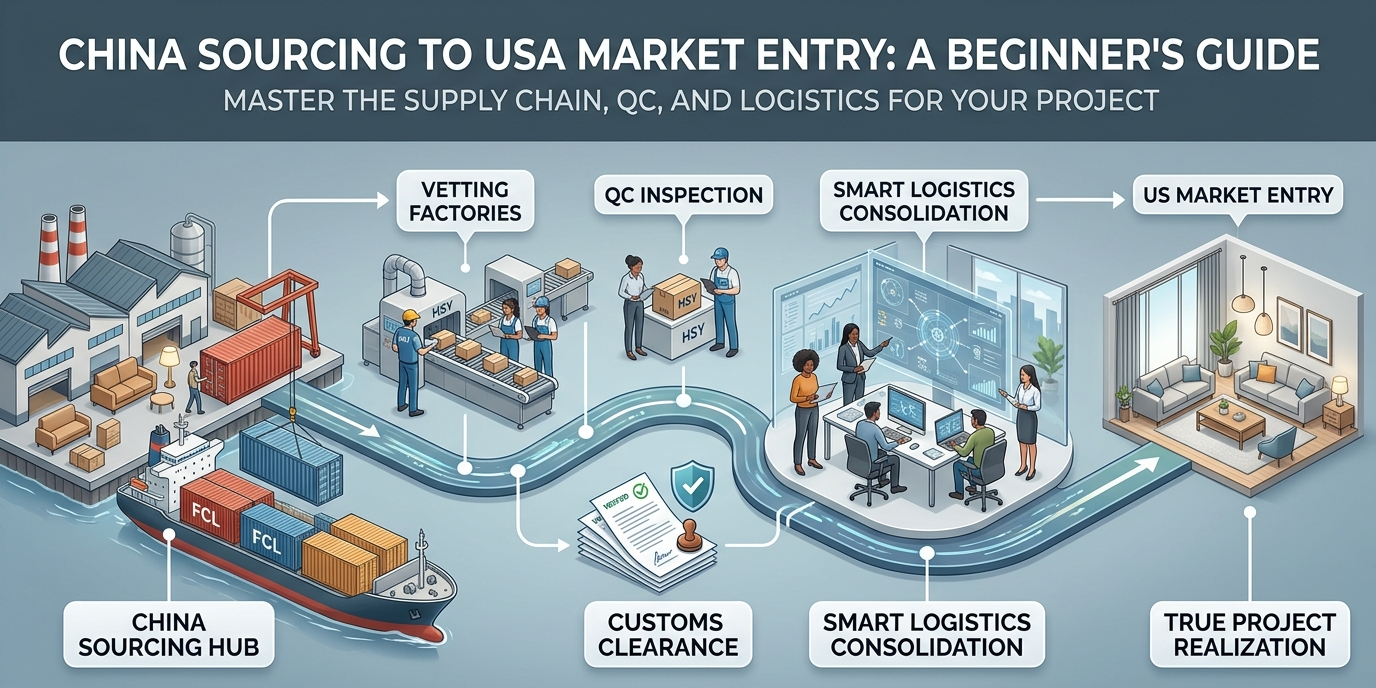
Let’s be honest: the jump from buying a few items on AliExpress to importing a commercial shipment from China to the USA is a massive one. Most beginners treat it like online shopping, but in reality, it’s a legal and logistical operation where a single missing document can cost you thousands in storage fees or result in your goods being seized by US Customs.
If you are looking for a “get rich quick” scheme, this isn’t it. But if you want to build a sustainable supply chain, here is the realistic, step-by-step roadmap for 2026.
How do you select a product that won’t get stuck in Customs?
Before you even talk to a supplier, you need to understand the “compliance” of your product. Some items are easy (furniture, basic apparel), while others are a nightmare for beginners.
- Highly Regulated: Anything that touches the skin (cosmetics), anything with a battery (electronics), or anything for children requires specific FDA or CPC certifications.
- The HTS Code: Every product has a Harmonized Tariff Schedule code. This code determines your duty (tax) rate. If you misclassify your product to save money, US Customs will eventually find out, and the fines are brutal.
Why is a “Gold Supplier” badge on Alibaba not enough?
Alibaba is a search engine, not a guarantee. A “Gold Supplier” simply means they paid for a membership. To truly protect your investment, you must distinguish between a Manufacturer and a Trading Company.
- The Factory: Better pricing, but higher MOQs (Minimum Order Quantities).
- The Trader: Lower MOQs, but they add a margin and have less control over quality. For your first shipment, a trading company might be easier, but as you scale, you need to go direct. Always request a physical factory audit or have a local agent in China visit the site before you send a single dollar.
What legal documents do you actually need to enter the USA?
You don’t necessarily need a specific “import license” as an individual, but you do need two things:
- An IRS Business Number (EIN) or SSN: To identify you as the importer of record.
- A Customs Bond: This is mandatory. It’s essentially an insurance policy that ensures the US government gets its duties and taxes. You can buy a “Single Entry Bond” for one shipment or a “Continuous Bond” if you plan to import more than three times a year.
Which shipping term (Incoterm) should a beginner choose?
This is where most beginners lose their profit.
- DDP (Delivered Duty Paid): The supplier handles everything to your door. It’s the easiest, but you have zero control over the timeline, and the supplier usually hides a massive markup in the shipping cost.
- FOB (Free On Board): The supplier gets the goods to the Chinese port; you (or your freight forwarder) take it from there. This is what we recommend. It gives you control over the costs and allows you to track your shipment accurately.
How do you handle Quality Control before the goods leave China?
Once your goods are on the ocean, you have lost all your leverage. Never pay the final 70% balance until a third-party inspector has walked the factory floor and checked your goods. A standard inspection should check for:
- Quantity and Packaging: Are the boxes strong enough for the long journey?
- Functionality: Does the product actually work?
- Visual Check: Does it match the sample you approved?
Key Takeaways
- Know Your HTS Code: This is the “DNA” of your shipment. Know your tax rate before you buy.
- Get a Customs Bond: You cannot clear goods into the USA without one. Consult a licensed Customs Broker early.
- Inspect Before You Pay: The “70% balance” is your only shield against poor quality. Use it.
- FOB is Your Friend: It may seem more complex than DDP, but it saves money and provides transparency in the long run.
FAQ: Importing for Beginners
Q: Do I need a huge budget to start?
A: Not necessarily, but you need to account for “hidden costs.” Beyond the product price, factor in shipping, ocean freight insurance, customs duties (which can be 25%+ for some Chinese goods), and port handling fees.
Q: How do I avoid getting scammed?
A: Never use Western Union or private bank accounts. Use Alibaba Trade Assurance or a formal Bank Telegraphic Transfer (T/T) to a registered company account. If a “factory” asks you to pay a “personal account,” walk away.
Q: How long does shipping take from China to the USA?
A: For sea freight, expect 30–45 days to the West Coast (LA/Long Beach) and 45–60 days to the East Coast (New York/Savannah). Air freight takes 5–10 days but costs roughly 5x more.
Bridge the Gap: How HSY Sourcing Protects Your First Shipment
The “Step-by-Step” looks simple on paper, but the execution is where the stress lies. At HSY Sourcing, we act as your professional “Import Department” on the ground in China.
We don’t just find suppliers; we manage the risk.
- Local Audits: We visit the factories in Foshan and beyond to make sure they are real.
- Technical QC: We perform the inspections so you don’t have to fly to China.
- Logistics Management: We help you navigate the move from the factory floor to the shipping container, ensuring your documentation is perfect for US Customs.