
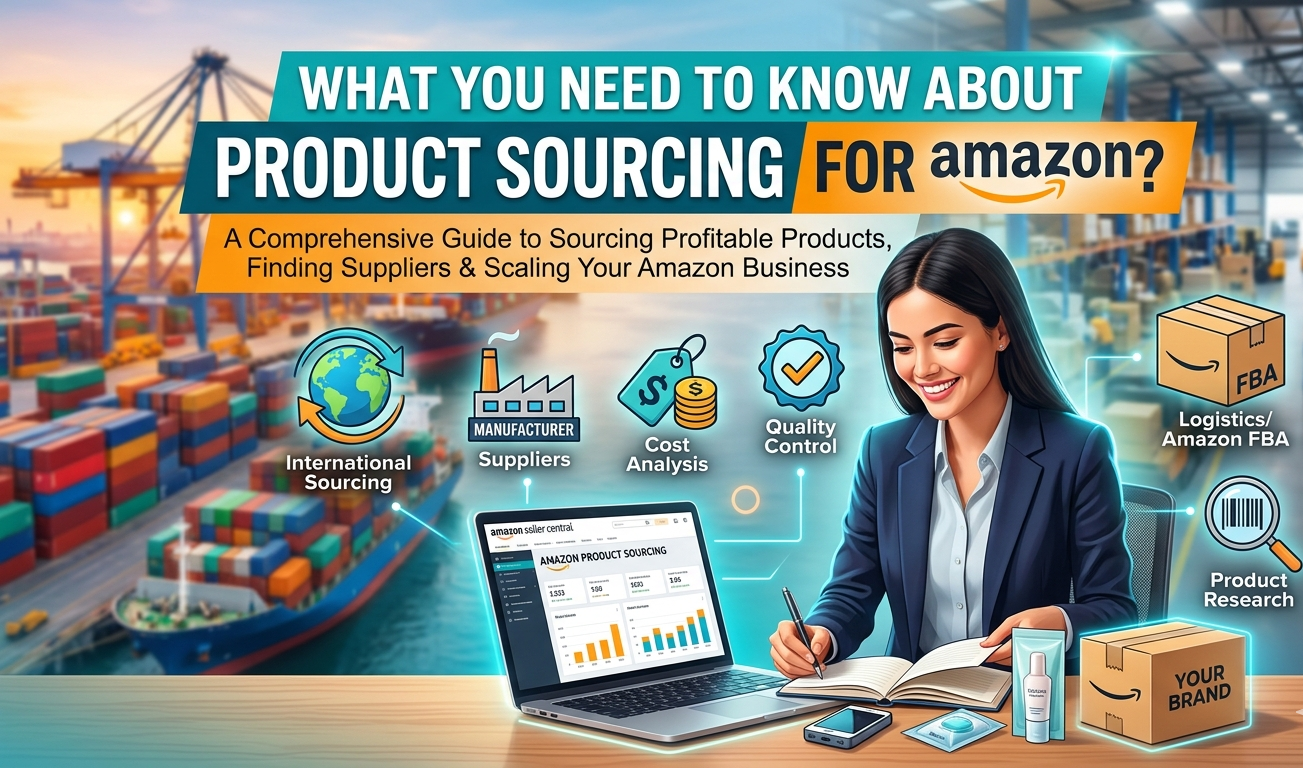
In 2026, the “low price” era of Amazon is over. With the rise of high-efficiency AI search and aggressive competition, an Amazon business lives or dies by its supply chain stability and unit margins. Sourcing is no longer a one-time transaction; it is a mechanical process of ensuring your product survives the FBA (Fulfillment by Amazon) journey and results in five-star reviews.
If you source from China, you are not just buying a product—you are buying a fulfillment-ready unit. If your sourcing process doesn’t account for Amazon’s strict labeling, packaging, and quality standards, your “cheap” order will quickly become a liability in storage fees and returns.
Why does Amazon sourcing require more than just a “cheap” price?
Most new sellers make the mistake of focusing on the factory’s EXW (Ex-Works) price. On Amazon, that number is irrelevant. What matters is the Landed Cost per Unit—the total cost to get that item into an Amazon warehouse, ready for sale.
A “cheap” product often carries hidden risks that kill Amazon margins:
- Dimensional Weight (DIM): A product that is 1cm too large can push you into a higher FBA fee tier, wiping out your profit.
- Returns & Defect Rates: Amazon will penalize or even suspend your listing if your ODR (Order Defect Rate) exceeds 1%. A cheap factory that cuts corners on materials will lead to negative reviews that are impossible to “marketing” your way out of.
- Compliance Gaps: If your product lacks necessary certifications (UL, CE, CPC for toys), Amazon can freeze your inventory without warning.
How can you verify if a factory understands FBA requirements?
A “reliable” factory for a local wholesaler might be a “disastrous” factory for an Amazon seller. You need a supplier that understands the FBA Prep logic. Before hiring a factory, ask these technical questions:
- Do they know GS1 Barcoding? Can they accurately apply FN-SKU labels and Case Labels so Amazon’s scanners don’t reject the shipment?
- Can they handle Carton Requirements? Amazon has strict rules on carton weight (usually under 50 lbs / 22.5 kg) and dimensions. A factory that uses oversized, weak boxes will result in damaged goods and “Inbound Performance” warnings.
- Are they familiar with “Drop Testing”? Amazon packaging must survive the “last mile” delivery. Ask the factory if they can perform a basic 1A or 3A drop test on the final packaging.
What are the real “Margin Killers” in your landed cost?
To stay profitable, you must calculate your Landed Cost with 100% accuracy. This includes:
- Product Unit Price: (The negotiated price with the factory).
- FBA Prep Fees: Labeling, poly-bagging, and suffocation warning stickers.
- Duty and Tariffs: Based on the HS Code (e.g., Section 301 tariffs for US imports).
- Freight: Air (fast but expensive), Sea (slow but cheap), or Matson/ZIM “Fast Sea” shipping.
- Inspection Fees: The cost of hiring a third party to check the goods before they leave China.
Pro Tip: Always build a 5-10% “buffer” into your margin calculations for unexpected shipping spikes or PPC (Pay-Per-Click) advertising costs.
Why is the “First Batch” quality a dangerous metric for Amazon sellers?
Many sellers receive a perfect sample and a perfect first order, only to experience “Quality Fade” on the second or third shipment. Once a factory secures your repeat business, they may swap a high-grade plastic for a cheaper regrind or reduce the thread count in a textile product.
On Amazon, this is fatal. Your older, positive reviews will be contradicted by new, 1-star reviews about “cheap materials.” To prevent this, you must:
- Use a Detailed Tech Pack: Define every material, weight, and tolerance in writing.
- Continuous QC: Never skip the Pre-Shipment Inspection (PSI), even for your “trusted” long-term suppliers.
- Batch Tracking: Ensure your factory uses batch codes so you can trace a quality issue back to a specific production date.
How should you handle logistics and “FBA Prep” in China?
Should you ship directly to FBA or to a 3PL (Third Party Logistics) warehouse?
- Direct to FBA: Saves time and double-handling costs. Requires a factory that is 100% perfect at labeling and FBA-ready packaging.
- Via 3PL (China or Local): If you source from multiple factories (e.g., a yoga mat from one and a carrying bag from another), you need a Consolidation Point in China.
A China sourcing agency can act as this hub, collecting items from various suppliers, performing the final FBA labeling, and shipping them as one optimized container to save on freight.
Key Takeaways
- Landed Cost is Everything: Don’t negotiate for the lowest price; negotiate for the best total cost including shipping and quality insurance.
- FBA Compliance is Non-Negotiable: Incorrect labels or heavy cartons will lead to Amazon fees and delays.
- Prevent Quality Fade: Maintain strict, recurring inspections for every single order, not just the first one.
- Think in Cycles: Sourcing for Amazon is about maintaining a 3-4 month “Inventory Lead Time” to avoid the dreaded “Out of Stock” status.
Why Choose HSY Sourcing?
Amazon sourcing requires a level of detail that general trading companies can’t provide. HSY Sourcing understands the mechanical requirements of the Amazon ecosystem.
- FBA-Ready QC: We don’t just check if the product looks good; we check if the barcodes scan, if the cartons meet Amazon’s weight limits, and if the packaging can survive a drop test.
- Technical Vetting: Based in the Foshan cluster, we physically visit factories to verify their actual production lines. We know the difference between a real manufacturer and a middleman.
- Consolidation & Prep: If you are building a brand with multiple product categories (e.g., Home Decor + Lighting), we consolidate your orders in our warehouse, perform the final FBA labeling, and optimize your container loading.
- No “Quality Fade”: We act as your permanent team in China. We perform rigorous PSI (Pre-Shipment Inspections) on every repeat order to ensure the quality never drops.
Build a resilient Amazon supply chain. Contact the team at HSY Sourcing today.
FAQ
Q1: Can I ship directly from a Chinese factory to an Amazon FBA warehouse?
A: Yes, provided the factory is experienced with FBA labeling and packaging rules. However, it is highly recommended to have a sourcing agent or third-party inspector verify the labels before the container is sealed.
Q2: What is the best shipping method for a new Amazon product?
A: For a “test batch,” Air Express (DHL/FedEx) is fastest for getting data. Once the product is proven, shifting to Sea Freight (LCL or FCL) is essential to maintain a healthy profit margin.
Q3: How do I handle Amazon’s requirement for “Product Certifications”?
A: You must request these from the factory before paying a deposit. Ensure the certificates (like UL or FDA) are in the factory’s name and are currently valid. We can help verify these documents locally.
Q4: How much inventory should I source for my first Amazon order?
A: Typically, enough for 2-3 months of projected sales. Ordering too little leads to “Out of Stock” (killing your SEO), while ordering too much leads to high FBA storage fees.