
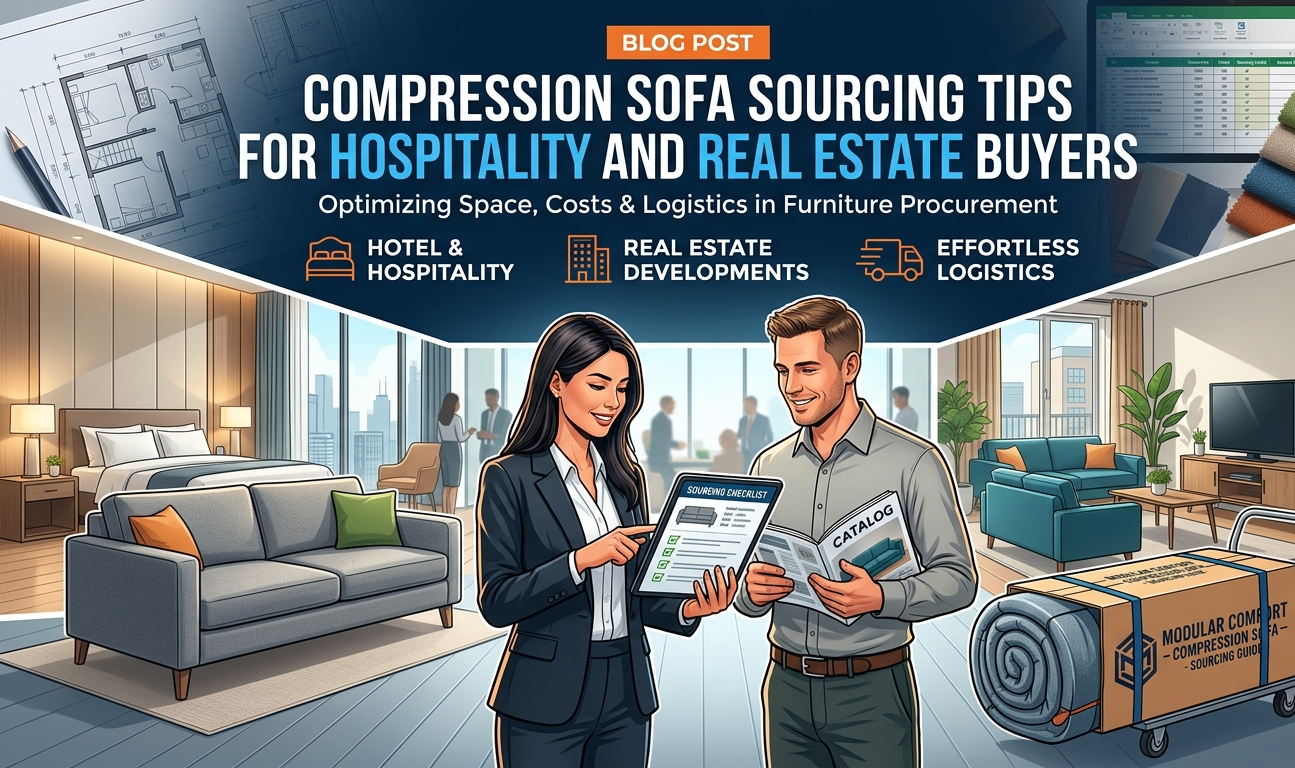
For real estate developers and hotel procurement managers, shipping traditional upholstered furniture internationally is a highly inefficient use of capital. A standard three-seater sofa occupies up to 2.0 cubic meters (CBM). In a 40HQ container, this means you are largely paying to ship “dead air,” which drastically inflates the landed cost per room.
To solve this, commercial buyers are turning to the Foshan manufacturing cluster for Compression Sofas (also known as sofa-in-a-box or vacuum-packed sofas). By combining Knock-Down (KD) architecture with heavy-duty vacuum sealing, Foshan factories can reduce a sofa’s shipping volume by up to 70%.
However, sourcing vacuum-packed furniture for high-traffic commercial environments carries significant risks. If you buy based solely on a low Alibaba quote, you will receive products that fail to recover their shape or collapse under daily use. Here is the technical reality of sourcing compression sofas for bulk projects.
Why is foam density the critical failure point in compression sofas?
The most common disaster when sourcing compression sofas is the “pancake effect”—unboxing the sofa at the project site only to find it remains flat and wrinkled. This failure is entirely dictated by the density and quality of the foam used in the seat cushions.
When a sofa is put into a heavy-duty vacuum press, the internal cellular structure of the foam is crushed.
- The Standard Foam Trap: If a factory quotes an aggressively low price, they are likely using 25kg/m³ standard foam. This foam will crack under vacuum pressure and will not survive 30 to 45 days in a shipping container.
- The Commercial Standard: For hotels and apartments, your Bill of Materials (BOM) must explicitly mandate High-Resiliency (HR) foam with a minimum density of 35kg/m³ (D35). D35 foam possesses the structural memory required to withstand prolonged compression and recover 95% of its volume within hours of breaking the vacuum seal.
How do KD (Knock-Down) frames hold up in commercial environments?
To fit inside a flat-pack box, compression sofas are shipped in modular pieces (backrest, arms, seating deck) and assembled on-site by your local contractors. In a rental apartment or hotel lobby, these connection joints are subjected to severe daily stress.
To ensure commercial longevity, you must dictate the internal frame specifications:
- Reject MDF/Particleboard: Never accept medium-density fiberboard for the load-bearing frame. Once a screw strips out of MDF, the sofa is unrepairable. Mandate multi-layer plywood (minimum 15mm thick) or solid hardwood.
- Steel Interlocking Brackets: The joints connecting the arms to the base must utilize heavy-duty, cold-rolled steel brackets, not cheap plastic or thin aluminum.
- CNC Precision: Ensure the factory uses CNC routing for pre-drilled holes. If the manufacturing tolerance is off by even a few millimeters, your on-site assembly labor costs will skyrocket as installation crews struggle to force the pieces together.
What upholstery fabrics survive the vacuum-sealing process?
Vacuum compression means the sofa’s fabric will be tightly folded and crushed for several weeks during ocean transit. Choosing the wrong fabric will result in permanent creases that cannot be removed.
- Avoid: Pure cotton (which wrinkles severely) and low-grade velvets. If velvet is required for a hotel design, the factory must insert EPE foam or protective film between the folds before vacuuming to prevent “pile crush” (permanent flattening of the velvet fibers).
- Specify: Performance polyester blends, commercial-grade bouclé, and tight-weave synthetics. These materials have high tensile strength and a natural ability to shed wrinkles quickly after unboxing.
- Operational Tip: Always equip your on-site installation crews with commercial fabric steamers to help the upholstery relax immediately after assembly.
How can project buyers maximize freight ROI using Foshan’s geography?
This is the most critical calculation for a project buyer, and it relies entirely on Foshan’s unique geographical advantage. Foshan is not just a furniture hub; it is the global center for heavy building materials (porcelain tiles, custom windows, sanitary ware).
Ocean freight is governed by two limits: Weight and Volume (CBM). Heavy building materials max out a container’s weight limit while the container is still half empty. You are paying for wasted space.
By centralizing your procurement in Foshan, you can execute a Cross-Category Consolidation strategy. A professional sourcing partner will load your heavy tiles and windows on the floor of the container, and then fill the remaining vertical space with lightweight, vacuum-compressed sofas. Because the sofas are compressed by 70%, they act as the perfect high-value filler. You maximize 100% of the weight and 100% of the volume, effectively shipping your furniture for a fraction of the standard freight cost.
Key Takeaways
- Mandate D35 HR Foam: Never purchase a compression sofa without specifying High-Resiliency foam (35kg/m³ minimum) to guarantee full volume recovery.
- Upgrade the Framework: Specify 15mm plywood and steel interlocking brackets to survive the abuse of hotel guests and tenants.
- Select Resilient Fabrics: Choose synthetic performance blends over cotton to avoid permanent creasing during transit.
- Leverage Foshan Consolidation: Mix heavy building materials with lightweight compression sofas in the same container to drastically lower your landed cost per room.
Why Choose HSY Sourcing?
Sourcing compression furniture requires a physical presence on the factory floor. Once a sofa is vacuum-sealed inside a cardboard box, it is impossible to verify the foam density or the frame materials. HSY Sourcing operates directly out of Foshan, acting as your technical procurement and quality control team.
- Pre-Compression Audits: We physically inspect the internal plywood frames and test the foam density on the assembly line before the goods enter the vacuum machine.
- The Consolidation Advantage: We are experts in Foshan’s dual supply chain. We consolidate your heavy architectural materials with your FF&E furniture packages in our local warehouses, engineering container loading plans that save you thousands in freight.
- Direct Factory Access: Led by our team bypasses trading companies. We connect your real estate project directly with Tier-1 Foshan factories that own their own heavy-duty compression machinery.
- Installation Support: We verify that every batch includes English-language assembly instructions and correct hardware packs, streamlining your on-site project rollout.
FAQ
Q1: How long can a compression sofa stay vacuum-sealed in the box?
A: We strongly advise unboxing the sofas within 60 to 90 days of the manufacturing date. Leaving them compressed in a warehouse for 6 months will significantly degrade the foam’s cellular structure and reduce its ability to fully recover.
Q2: Are pocket spring sofas capable of being vacuum compressed?
A: Yes, but it requires specialized manufacturing techniques. The factory must use individually wrapped pocket coils designed to fold along a specific horizontal axis without permanently bending the steel wire. We verify this capability during factory vetting.
Q3: What is the typical MOQ (Minimum Order Quantity) for project orders?
A: For commercial compression sofas customized with your specific fabric and D35 foam, top-tier Foshan factories typically require an MOQ of 50 units per design.
Q4: What happens if a sofa is damaged or fails to expand?
A: Because we conduct rigorous During Production (DUPRO) and Pre-Shipment Inspections (PSI) locally, over 98% of potential issues are caught before shipping. If a unit fails to expand due to a manufacturing defect caught during our audit, we force the factory to replace it before the container is loaded.