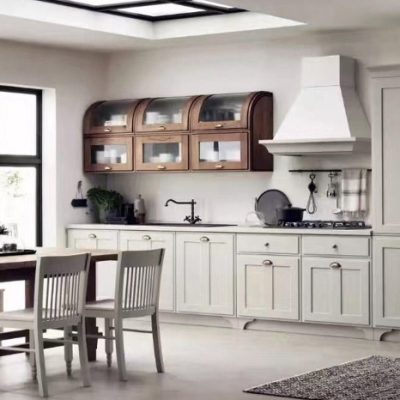


Kitchen cabinetry is one of the most technical custom finishing packages in a luxury villa build. A primary residential kitchen, prep kitchen, and central island setup must balance architectural aesthetic with heavy daily exposure to moisture, heat, and mechanical load.
Purchasing bespoke joinery directly from manufacturing hubs in Foshan and Shunde—the world’s most concentrated cluster for custom cabinetry and furniture—allows builders, developers, and private home owners to access advanced European-grade automated machinery at 30% to 45% lower costs than domestic retail brands.
However, custom joinery is a zero-tolerance engineering product. Ordering remotely requires precise material specifications—covering carcass board grades, edge-banding adhesives, door finishes, and drawer hardware—along with strict CAD shop-drawing approvals and physical pre-shipment inspections.
Key Takeaways
- Carcass Material Standards: Specify 18mm marine-grade plywood or ENF-grade moisture-resistant boards for cabinet structures. Use 304 stainless steel or waterproof aluminum honeycomb bodies for sink cabinets.
- Edge-Banding Technology: Insist on PUR (Polyurethane) or Laser Edge Banding. Avoid standard EVA glue edge banding, which breaks down under heat and humidity, leading to delamination.
- Hardware & Drawers: Require 3D-adjustable soft-close hinges and concealed undermount drawer runners rated for dynamic loads of 30kg to 70kg from tier-1 brands (e.g., Blum, DTC, Hettich).
- Engineering Sign-Off: Never release factory production deposits without signed, millimeter-accurate 2D/3D shop drawings cross-referenced against as-built site opening dimensions and utility plumbing layouts.
Which Core Substrates and Surface Finishes Hold Up Best in Luxury Villa Kitchens?
Selecting cabinet materials requires balancing structural rigidity against long-term moisture resistance. A typical luxury villa often utilizes a dual-kitchen design: a main open show kitchen and an enclosed heavy-cooking prep kitchen.
Cabinet Structural Anatomy:
 ├── Main Carcass: 18mm Plywood (E0/ENF Grade) or High-Density Particleboard
 ├── Wet Sink Module: 304 Stainless Steel or Waterproof Aluminum Honeycomb
 ├── Door Fronts: Natural Wood Veneer, 2K Polyurethane Lacquer, or PET Film
 └── Countertop Integration: 12mm / 20mm Sintered Stone Slabs or Quartz
The table below outlines common carcass and door finish combinations used in high-end villa builds:
| Component | Recommended Technical Spec | Key Performance Advantage | Primary Application |
| Carcass (Body) | 18mm E0 / ENF Marine-Grade Plywood | Superior screw-holding strength, high water resistance | Main kitchen carcasses, island units, heavy drawers |
| Sink Base Unit | 304 Stainless Steel or Aluminum | 100% waterproof, zero risk of swelling or mold growth | Under-sink plumbing zones, wet prep kitchens |
| Lacquered Doors | 2K Polyurethane Matte/Gloss Lacquer | Seamless surface coating, no visible edge seam | Modern minimalist show kitchens, handleless profiles |
| Veneered Doors | Natural Oak/Walnut Veneer on MDF | Natural wood grain aesthetics with dimensional stability | Feature island panels, tall pantry tower units |
| PET Laminate | High-Gloss/Super-Matte PET Film | Anti-fingerprint, high scratch resistance, cost-effective | Heavy-use prep kitchens, pantry storage |
How Do You Prevent Dimensional and Installation Errors Between Factory Drawings and Site Construction?
The single largest risk in importing custom joinery is a dimensional mismatch upon arrival at the project site. Millwork is manufactured to millimeter precision, whereas concrete and masonry walls frequently exhibit plumb and square variations.
Shop Drawing Approval Workflow:
Site As-Built Measurement ──> Factory CAD Conversion ──> Appliance Spec Cross-Check ──> Client Approval ──> CNC Production
1. Site As-Built Verification
Never allow a factory to start production based solely on preliminary architectural floor plans. Production drawings must be based on verified “as-built” site measurements taken after wall plastering, ceiling framing, and sub-floor screeds are completed.
2. Factory Shop Drawing (CAD) Sign-Off
Factories must produce full 2D production drawings and 3D exploded assembly diagrams detailing:
- Filler and Scribe Panels: Providing 20mm to 50mm adjustable scribe fillers at wall-to-cabinet intersections to absorb wall out-of-plumb tolerances.
- Appliance Cutouts & Ventilation: Matching exact cutouts for integrated refrigerators, ovens, hobs, and pop-up downdraft extractors.
- Plumbing and Electrical Outlets: Mapping back-panel cutouts to align with wall-mounted water supply lines, floor drains, and electrical junction boxes.
What Hardware and Mechanical Specifications Should You Demand for Heavy-Use Millwork?
Cabinet hardware dictates the operational feel and longevity of a luxury kitchen. Heavy solid-wood or sintered stone door fronts exert continuous load on hinges and drawer runners.
Hardware Specification Checklist
 ├── Hinges: 110°–155° 3D-adjustable concealed soft-close hinges (Nickel-plated)
 ├── Drawer Runners: Full-extension concealed undermount runners (30kg–70kg load rating)
 ├── Lift Systems: Bi-fold wall cabinet stay lifts (e.g., Blum Aventos HF)
 └── Storage Mechanisms: Stainless steel pull-out larders, blind corner magic baskets
- Hinge Quality: Specify 3D-adjustable soft-close hinges tested to at least 100,000 opening cycles. Stainless steel or anti-rust nickel plating is mandatory for humid or coastal regions.
- Drawer Load Capacity: Standard cutlery drawers require 30kg capacity, but deep pan drawers and pull-out pantry units require heavy-duty runners rated for 50kg to 70kg dynamic loads.
- Trusted Brands: Tier-1 international brands (Blum, Hettich, Grass) or top-tier domestic Chinese OEM brands (DTC, Higold) offer reliable performance warranties and international spare parts availability.
What Are the Critical Production Risks to Watch For When Ordering Custom Joinery Remotely?
Direct factory procurement offers substantial savings, but managing production remotely without technical oversight can create costly quality issues.
1. Inferior Edge-Banding Adhesives
Traditional EVA hot-melt glue edge-banding is sensitive to temperature and moisture fluctuations. In hot or humid environments, EVA glue lines soften, turn dark, and peel over time.
- Solution: Require PUR (Polyurethane) edge-banding or Laser edge-banding. PUR uses a moisture-curing reaction to create a waterproof, heat-resistant, and virtually invisible seam line.
2. Formaldehyde Off-Gassing (Indoor Air Quality)
Low-grade particleboard or MDF uses urea-formaldehyde resins that off-gas continuously inside air-conditioned homes.
- Solution: Enforce strict formaldehyde emission standards: European E0 (emission limit $\le 0.05\text{ mg/m}^3$) or Chinese ENF (emission limit $\le 0.025\text{ mg/m}^3$) certified core boards.
3. Flat-Pack Packaging Failures vs. Pre-Assembled Construction
Shipping cabinetry completely knocked down (KD) saves container volume but drastically increases local assembly labor costs and risk of installation errors on site.
- Solution: For luxury villa builds, ship cabinet carcasses as pre-assembled box units (rigid construction). Pre-assembled cabinets are factory-doweled, glued, and squared under hydraulic clamps, ensuring greater structural rigidity and faster site installation.
What Steps Are Involved in Factory Quality Control Before Freight Loading?
A structured inspection process at the factory prevents non-compliant items from being packed into export containers.
Multi-Stage Quality Control Protocol:
Phase 1: Raw Material & Board Audit (Board thickness, ENF stamps, paint codes)
 └── Phase 2: In-Line CNC Fitting Check (Dowel alignment, edge-banding quality)
      └── Phase 3: Trial Assembly Mock-Up (100% trial assembly of island & main run)
           └── Phase 4: Packaging & Crate Audit (Foam padding, corner guards, palletizing)
- Board Grade Verification: Check raw board thickness, core density, and low-formaldehyde certification stamps prior to CNC cutting.
- 100% Trial Assembly Mock-Up: Require the factory to assemble the entire kitchen layout on the factory floor before finishing and packing. This step confirms drawer glide smoothness, door reveals (1.5mm to 2mm uniform gaps), lift mechanisms, and appliance cutout dimensions.
- Finish and Color Batch Inspection: Inspect lacquered and veneered door panels under standardized 6500K daylight lamps to verify uniform color matching across adjacent cabinet doors.
- Export Packaging Supervision: Ensure assembled cabinet boxes are wrapped in protective PE film, fitted with high-density foam corner protectors, and packed into heavy 5-ply corrugated cartons. Fragile stone countertops and glass doors must be packed in fully enclosed, fumigated plywood crates.
Why Should Overseas Developers Partner with HSY Sourcing for Shunde Joinery Procurement?
Shunde and Foshan represent the world’s highest concentration of custom woodworking and millwork factories. However, managing bespoke orders across multiple specialized workshops requires local technical knowledge and daily presence on the factory floor. HSY Sourcing operates as your dedicated technical procurement team on the ground.
1. Direct Access to Shunde’s Tier-1 Automated Factories
We work directly with vetted tier-1 custom millwork plants in Shunde equipped with German automated CNC production lines (such as Homag). We negotiate directly at factory-gate rates, cutting out intermediate trading company markups and retail showroom overhead.
2. Technical Engineering and Shop-Drawing Review
Our in-house technical team audits factory CAD shop drawings against your architectural plans. We check scribe panel allowances, appliance cutout specs, hardware load calculations, and site plumbing/electrical tolerances to eliminate installation issues on site.
3. Strict On-Site Quality Control Checkpoints
We enforce mandatory physical inspection checkpoints before final balance payments are released:
- Material Checks: Verifying board grade certificates (E0/ENF), 304 stainless steel grades, and veneer lot matching.
- Trial Assembly Audits: Inspecting the 100% pre-shipment trial assembly at the factory to check door alignment, drawer glide smoothness, and soft-close function.
- Packaging & Loading Supervision: Checking crate structural integrity and supervising container packing at our central warehouse.
4. Warehouse Consolidation and Logistics
Kitchen cabinetry is typically shipped alongside other villa finishing materials. HSY Sourcing collects kitchen crates at our central Foshan staging warehouse, combining them with your porcelain tiles, aluminum window systems, and sanitary ware into consolidated 20ft or 40ft High Cube containers to optimize ocean freight costs.
Frequently Asked Questions About Importing Villa Kitchen Cabinets from Foshan
What is the typical lead time for custom luxury kitchen cabinets from Shunde?
Production generally takes 35 to 45 days after factory CAD shop drawings, finish control samples, and hardware selections are officially approved. Factor in an additional 15 to 40 days for ocean transit, depending on your destination port.
How do you handle damaged or missing cabinet parts upon container arrival?
By conducting a 100% pre-shipment trial assembly inspection at the factory, missing panels or defective parts are identified and remanufactured locally in Shunde before loading. Additionally, we require factories to include extra hardware fittings, touch-up paint kits, and spare door hinges inside the shipment. Marine cargo insurance is also applied to cover transit risks.
Is it better to ship cabinets pre-assembled or flat-packed (KD)?
For luxury villa projects, pre-assembled carcasses (rigid box construction) are strongly recommended. Pre-assembled units are squared and clamped under factory conditions, ensuring precise joinery and saving significant installation time and labor costs on site. Flat-pack (KD) shipping is generally reserved for low-cost, high-volume apartment projects.
How do you ensure countertops (sintered stone or quartz) do not break during sea transit?
Sintered stone and quartz countertops are cut and finished at the factory according to approved CAD drawings. They are packed individually in heavy, fully enclosed fumigated plywood crates lined with thick EVA foam padding. During container loading, stone crates are secured vertically or mounted on dedicated steel A-frames tied directly to the container’s internal anchor rings.