
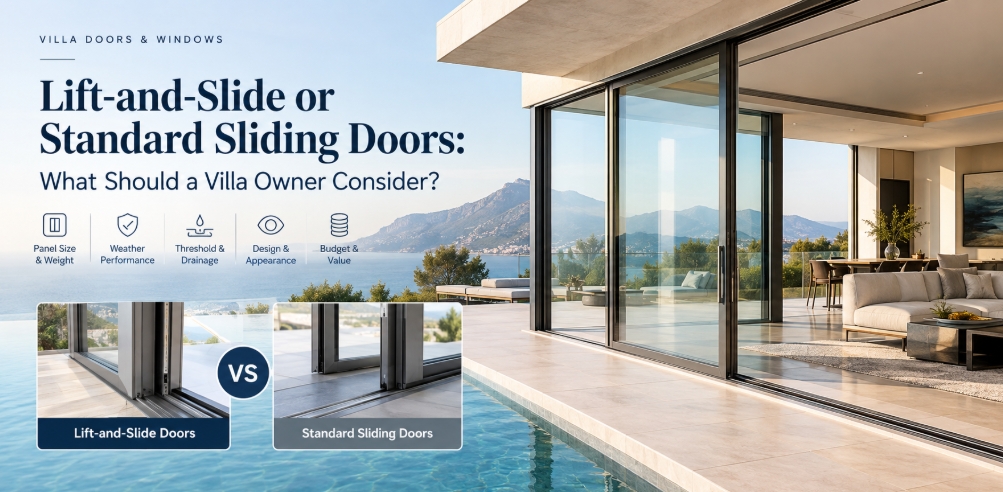
When planning large glass doors for a luxury villa, one decision is whether to use a lift-and-slide system or a standard sliding door. Both can connect indoor living spaces with a terrace, garden or pool area, but they operate differently and may suit different project requirements.
A lift-and-slide door uses a lifting mechanism that raises the moving panel slightly when the handle is operated, allowing it to slide. When closed, the panel lowers back into its sealing position. This mechanism can be useful for large, heavy glazed panels that need to move smoothly.
A standard sliding door moves along its running mechanism without the same lifting action. Depending on the system, panel dimensions and hardware, it may be entirely suitable for a villa’s living room or terrace opening.
The decision should not be based on which system sounds more premium. It should depend on the proposed panel size and weight, how frequently the door will be used, the required weather performance, the threshold design and the overall project budget.
What Is the Difference Between Lift-and-Slide and Standard Sliding Doors?
The main difference is how the moving panel operates and how the system is designed to support it.
With a lift-and-slide door, turning the handle activates a mechanism that lifts the moving panel from its lowered sealing position. The panel can then slide along its track. When the door is closed and the handle is returned to its locking position, the panel lowers again.
A standard sliding door generally remains supported by its rollers or running mechanism as it moves along the track. Its operation depends on the design of the rollers, frame, hardware and panel weight.
These differences become more important as the size and weight of the glass panels increase.
| Consideration | Lift-and-slide door | Standard sliding door |
|---|---|---|
| Operating mechanism | Raises the moving panel for sliding and lowers it when closed | Moves along its running mechanism without the same lifting action |
| Heavy panels | The lifting mechanism may make substantial panel weights easier to operate | Suitability depends on the system’s roller design and permitted panel weight |
| Everyday operation | Requires the handle to operate the lifting mechanism | Operation depends on the selected sliding system and hardware |
| Weather performance | Depends on the complete system, seals, drainage, glass and installation | Also depends on the complete system and its tested performance |
| Design flexibility | Available configurations depend on the system | Available configurations depend on the system |
| Cost | Must be assessed from the complete specification and quotation | Must be assessed from the complete specification and quotation |
One important distinction: standard sliding door is a broad category, not a single technical specification. Different products can have substantially different frame designs, rollers, locking arrangements, seals and performance capabilities.
A well-designed standard sliding door may be a better choice for one opening, while a lift-and-slide system may be more appropriate for another.
When Is a Lift-and-Slide Door Worth Considering?
Lift-and-slide doors are worth evaluating when the project calls for large glazed panels and the homeowner wants an operating mechanism designed to handle their weight.
Large openings between living rooms and terraces
In a villa with an expansive living room opening onto a terrace, the door may contain several large glass panels. Depending on the glass build-up and panel dimensions, each moving panel can become heavy.
A suitable lift-and-slide system may help make these panels easier to move. However, the proposed system must be approved for the actual panel dimensions and weight.
The overall width of the opening is not enough to determine suitability. A wide opening divided into several smaller panels presents a different operating requirement from the same opening divided into two very large moving panels.
Frequently used indoor-outdoor connections
Consider how the door will be used in daily life.
For example, a door connecting the kitchen or family living area to an outdoor dining terrace may be opened several times a day. Ease of operation matters more in this situation than it might for glazing that is rarely opened.
The lifting mechanism can be helpful when a heavy panel needs to move regularly, but the actual operating effort also depends on the hardware, installation accuracy and maintenance.
Projects with specific weather-performance requirements
Some lift-and-slide systems are designed for substantial glazed openings and particular weather-exposure requirements. Their suitability must be confirmed from the documentation for the exact system.
Do not assume that choosing lift-and-slide automatically resolves wind-driven rain, air leakage or water penetration. The frame, seals, drainage, threshold and installation details all matter.
Before specifying the system, ask the supplier for the relevant performance information and confirm that it applies to the proposed configuration.
When Can a Standard Sliding Door Be the Better Choice?
A standard sliding door may be the more practical option when the opening and moving panels fall comfortably within the selected system’s operating limits.
For example, a villa may have a moderate-sized terrace door that does not require exceptionally large moving panels. If a suitable standard sliding system can provide the required opening, operation, security and weather performance, the additional mechanism of a lift-and-slide door may not offer enough benefit to justify its cost.
A standard system is also worth considering when the design includes multiple sliding doors of different sizes. The same mechanism does not necessarily need to be used throughout the property.
A smaller opening near a bedroom, for instance, may have different operating requirements from the main living room opening. Selecting the system according to each opening can be more sensible than specifying the most elaborate option everywhere.
However, do not choose a standard sliding door solely because its initial quotation is lower. A low-priced product with unsuitable rollers, poorly specified glass or inadequate weather performance may create more problems than it solves.
The relevant comparison is between complete, appropriately specified systems—not just between product names or headline prices.
Door Size and Glass Weight: What Should You Check First?
Before deciding between the two systems, establish the dimensions and configuration of the proposed door.
The overall opening width is only one part of the decision. Panel height, individual panel width, glass construction and the number of moving panels all influence the system requirements.
A tall glass panel may weigh considerably more than a shorter panel of the same width. Likewise, thicker or specially constructed glass can affect the total weight and hardware requirements.
Ask the supplier to confirm the following:
- Overall opening dimensions: The width and height available for the complete door assembly.
- Individual panel dimensions: The actual width and height of each moving and fixed panel.
- Glass specification: The proposed glass construction, thickness and safety requirements.
- Panel weight: The estimated weight of each moving panel based on the specified glass and frame.
- Hardware capacity: The permitted panel weight and dimensions for the exact system and hardware configuration.
- Clear opening: The usable passage width after the door has been opened.
- Installation and handling: Whether the panels can be safely transported, moved into position and installed at the property.
These details should be confirmed before the system is finalized.
For a more detailed discussion of opening width, panel arrangements and usable passage space, see How Large Should a Sliding Glass Door Be in a Luxury Villa? once that article is published.
It is particularly important not to confuse a large overall opening with an equally large clear opening. Fixed panels, overlapping sliding panels and the chosen configuration affect how much space remains available for people to pass through.
Weather Sealing, Wind and Energy Performance
For a luxury villa, especially one with large glazed openings, weather performance deserves as much attention as the operating mechanism.
A coastal property exposed to strong winds and salt-laden air may have different requirements from a villa in a sheltered inland location. A home in a cold climate may place greater emphasis on heat loss, condensation control and thermal performance, while a property in a hot climate may need to consider solar heat gain.
Lift-and-slide and standard sliding systems should therefore be evaluated against the project’s actual requirements.
Air and water performance
Ask for documented air-leakage and water-penetration performance for the proposed door system, where applicable. Wind resistance should also be checked against the project’s design requirements.
Do not assume that the lifting mechanism alone determines how well a door seals. Seals, frame geometry, locking points, drainage paths, fabrication quality and installation all influence the final result.
Thermal and acoustic performance
The glass specification and frame design both affect thermal and acoustic performance. The installation interface between the frame and the building envelope matters as well.
A door with a suitable glass specification can still perform poorly if the surrounding installation is not properly designed and executed.
When comparing quotations, confirm that the performance documents relate to the actual proposed product and configuration. A test result for a different door size, glass arrangement or system should not automatically be treated as proof of equivalent performance.
For projects subject to local building regulations, the architect or relevant building-envelope professional should confirm the required performance and compliance.
Thresholds, Floor Levels and Indoor-Outdoor Design
The threshold is one of the details that should be resolved before a sliding door is ordered.
Many villa owners prefer a low or visually unobtrusive threshold between the interior and an outdoor terrace. It can create a cleaner transition between the two spaces, particularly when interior flooring and exterior paving are designed to align.
However, a low threshold introduces practical coordination requirements.
The project team needs to consider:
- Finished floor levels inside and outside.
- Surface water drainage and the direction of water flow.
- Waterproofing at the door opening.
- The door’s drainage arrangements.
- Exterior paving, decking or stone thickness.
- Accessibility and the height of any remaining step.
- The installation space required for the frame and track.
A visually flush threshold does not automatically mean that the installation will be completely level or waterproof. Those outcomes depend on the door design, site conditions, drainage and waterproofing details.
The architect, relevant building-envelope professional and local installer should coordinate these details before production drawings are approved.
This is particularly important when the door connects an interior stone floor to an exterior terrace, or when the opening is close to a pool where water exposure and floor-level coordination need careful consideration.
Visual Design: Slim Frames and the Actual Clear Opening
A large sliding door is often selected because the homeowner wants an uninterrupted view of the garden or pool.
But the appearance of the finished opening depends on more than the visible frame width.
Compare the proposed systems in terms of:
- Visible frame and meeting-stile dimensions.
- The number and arrangement of fixed and moving panels.
- The amount of glass that remains visible when the door is closed.
- The clear opening when the moving panels are stacked or overlapped.
- Handle design and position.
- Frame finish and colour.
- Alignment with adjacent fixed glazing, ceiling lines and floor finishes.
A lift-and-slide system does not automatically have slimmer frames than a standard sliding door. Equally, a standard sliding door is not necessarily visually bulky. The available profiles and configurations depend on the particular system.
If a minimal frame appearance is a major design priority, compare actual profile drawings and samples rather than relying on catalogue photographs.
You may also find Are Ultra-Slim Aluminium Windows Always Better for a Luxury Villa? useful when evaluating the relationship between slim sightlines, the selected system and practical performance.
For a corner opening, the design needs additional consideration. The structural arrangement, meeting point of the glazing and opening configuration should be resolved before ordering. The related article Corner Windows in a Luxury Villa: What Needs to Be Considered Before Ordering? can address that separate decision in greater depth.
What Should You Compare in Supplier Quotations?
Two suppliers may both quote a lift-and-slide door, yet propose different systems, glass specifications, hardware and installation details. Their prices are not directly comparable until the scope is clear.
When requesting quotations from Chinese suppliers, ask each supplier to specify:
- System and manufacturer: The exact product series and operating mechanism.
- Door configuration: Overall dimensions, individual panel sizes, number of moving panels and opening direction.
- Hardware: Rollers, lifting mechanism, locking system, handles and other included components.
- Panel limits: The permitted panel dimensions and weight for the quoted configuration.
- Glass: Glass type, build-up, thickness, safety requirements and any required thermal or solar-control properties.
- Frame finish: The specified finish and colour, including the applicable sample or approval process.
- Performance documentation: Relevant air, water, wind, thermal and acoustic performance information, as required by the project.
- Threshold and drainage: The proposed threshold detail, drainage arrangement and installation interface.
- Accessories: Screens, handles, locks and other items that may be included in one quotation but excluded from another.
- Delivery and installation scope: Packaging, transport, installation responsibilities, warranty and after-sales arrangements.
This comparison is especially important when the door is part of a larger villa procurement package that includes windows, entrance doors, stone flooring and other materials.
A supplier quotation should make clear what is included and what remains the responsibility of the homeowner’s local project team.
For example, the factory may supply the door assembly and technical drawings, while local measurement verification, structural preparation, waterproofing and installation are handled by other parties. The actual division of responsibility should be agreed in writing rather than assumed.
What Must Be Confirmed Before Approving Shop Drawings?
Even after the system has been selected, the door should not go into production until the necessary dimensions and details have been reviewed.
The shop drawings should allow the homeowner and relevant project professionals to verify the intended configuration, including:
- Final frame dimensions and the agreed basis for site measurement.
- Moving and fixed panel positions.
- Sliding direction and the location of the opening.
- Glass specifications and panel weights.
- Handle positions, locking arrangements and hardware.
- Threshold height and finished floor levels.
- Drainage and waterproofing interfaces.
- Frame finish and colour.
- Installation clearances and interfaces with surrounding construction.
Do not approve drawings based only on how the door looks in an elevation. A drawing may appear correct while leaving important questions about the clear opening, threshold or floor interface unresolved.
The manufacturing dimensions must be confirmed through the agreed project process. Preliminary drawings may be prepared earlier, but final production should depend on the required dimensions and site conditions being verified.
Do not assume that a Chinese factory will automatically take responsibility for measuring an overseas property or coordinating local installation. Those responsibilities must be explicitly agreed.
For a more detailed review process, see What Should a Villa Owner Do Before Approving Factory Shop Drawings? once published.
Sourcing Lift-and-Slide or Standard Sliding Doors from China
For homeowners sourcing aluminium doors from China, the first step is not to ask which system is cheapest. It is to establish the required door configuration and performance, then compare suppliers that can propose suitable products.
Foshan is a useful location for comparing building-material suppliers, including window and door options. Visiting suppliers can help homeowners examine finishes, inspect samples and discuss technical details in person. However, a manufacturing cluster does not automatically guarantee lower prices or better quality.
For a villa project, a sourcing process may include:
- Identifying suppliers whose systems suit the proposed opening and project requirements.
- Comparing technical specifications and quotations on a consistent basis.
- Clarifying glass, hardware, finish and accessory requirements.
- Coordinating shop drawings and outstanding specification questions.
- Following production and arranging appropriate inspections.
- Coordinating the door order with other building materials when consolidation is required.
HSY Sourcing supports overseas private villa owners with supplier comparison, specification clarification, supplier communication, order follow-up, inspection arrangements and building-material procurement coordination.
HSY is a sourcing and procurement service provider, not the door manufacturer. Architectural design, structural suitability, local code compliance, site-specific building-envelope details and installation should be handled by the relevant qualified professionals.
The aim is to make the purchasing decision clearer before the order is placed, rather than relying on a product label or a low initial quotation.
Frequently Asked Questions
Are lift-and-slide doors better than standard sliding doors?
Not in every situation. Lift-and-slide doors can be useful for heavy moving panels because of their lifting mechanism. A suitable standard sliding system may be entirely adequate for smaller or moderately sized openings. The correct choice depends on the panel dimensions and weight, operating requirements and the performance of the complete system.
Are lift-and-slide doors necessary for large villa openings?
No. A large opening does not automatically require a lift-and-slide system. The decision should be based on the individual panel dimensions, glass weight, hardware capacity, desired operation and the manufacturer’s approved system configuration.
Do lift-and-slide doors always provide better weather sealing?
No universal conclusion should be made from the operating mechanism alone. Weather performance depends on the complete door system, including seals, frame design, drainage, glass, fabrication and installation. Ask for relevant documentation for the exact proposed configuration.
Are standard sliding doors suitable for a luxury villa?
Yes, provided the selected system meets the project’s requirements for dimensions, operation, appearance, security and performance. A standard sliding door should be judged by its actual specification, not by its name.
Which system is better for a terrace or poolside opening?
Either system may be suitable. Consider panel weight, frequency of use, wind and rain exposure, threshold design, drainage and the surrounding floor finishes. Poolside locations may require additional attention to water management and material suitability.
What should I check before ordering sliding doors from China?
Confirm the exact system, panel configuration, glass specification, hardware, documented performance, threshold and drainage details, finish, shop drawings and division of installation responsibilities. Compare complete quotations and verify the final dimensions through the agreed project process before production.
Key Takeaway
Lift-and-slide and standard sliding doors can both work well in a luxury villa, but they are not interchangeable in every situation.
A lift-and-slide system may be worth considering when the design calls for large, heavy panels and its operating mechanism offers a practical benefit. A suitable standard sliding system may be the more sensible choice when it meets the project’s requirements without unnecessary complexity.
Before ordering, compare the actual panel dimensions and weight, hardware, documented performance, threshold details and installation requirements. The best decision is the one that fits the opening and works reliably in the conditions of the property—not simply the one with the more premium-sounding name.
Why HSY Sourcing
HSY Sourcing helps private villa owners compare building-material suppliers in China and coordinate procurement according to their project requirements. For aluminium windows and doors, this may include reviewing quotations, clarifying specifications, coordinating shop drawings, following up orders and arranging inspections.
For homeowners sourcing several categories for the same villa, HSY can also help coordinate procurement across doors, windows and other building materials where required.
If you are planning a villa project and considering sliding doors from China, you can share your project location, approximate opening dimensions, available drawings and expected procurement timeline to discuss the next step.