
Buying from China is standard practice now, but there is one nightmare that keeps every buyer awake: What if the goods arrive, and they aren’t what I ordered?
If you can’t fly to China right now to check the cargo before it leaves the factory, you aren’t alone. But relying on “trust” and a few filtered photos from the factory’s sales rep is how most sourcing disasters start.
Let’s look at how things actually work on the ground in Guangdong and how you can protect your money.
Why is a pre-shipment inspection actually necessary?
In China, once the container is sealed and the ship leaves the port, your leverage as a buyer drops to almost zero.
Most factories are not “evil,” but they are busy. Mistakes happen. A pre-shipment inspection in Guangdong isn’t about accusing the supplier of lying; it’s about catching human errors before they cost you thousands in freight and customs duties.
Think about it:
- If the barcodes are wrong, Amazon will reject your shipment.
- If the packaging is weak, the goods will arrive broken.
- If the quantity is short, you’ve already paid for “air.”
Once the goods reach your warehouse in the US, Europe, or Australia, returning them to China is usually impossible or more expensive than the goods themselves. The only time to fix a mistake is while the goods are still on the factory floor.
What are the real risks if you skip the inspection?
We see this all the time in factories around Foshan, Shenzhen, and Dongguan. It’s rarely about a factory trying to “scam” you. Usually, it’s just production-level confusion:
- The color of the mass production doesn’t quite match the approved sample because they used a different batch of raw material.
- The worker forgot to put the instruction manual inside the box.
- The “shipping marks” on the outer cartons are missing, which will cause a headache at the destination port.
These are “small” issues in China, but they become expensive problems at your end.
Why can’t most buyers just fly over and do it themselves?
Let’s be honest—it’s not always practical.
- The Math Doesn’t Work: If your order is USD 15,000, spending USD 3,000 on flights and hotels just to check boxes doesn’t make sense.
- Visa & Time: Getting a business visa can be a hassle, and you can’t spend 4 days traveling every time a production run finishes.
- Multiple Locations: Your chairs might be in Foshan, but your electronics are in Shenzhen. You can’t be in two places at once.
Can a big third-party inspection company solve everything?
You’ve heard of the big names. They send an inspector for a day, they give you a 20-page PDF report with an “Accept” or “Fail” grade, and they leave.
The problem? They don’t solve the issue. If they find 10% defects, they just write it down. They don’t negotiate with the boss to fix it. They don’t stay to watch the factory rework the items. You get a report, but you still have the problem.
Is a local sourcing agent a “safer” solution?
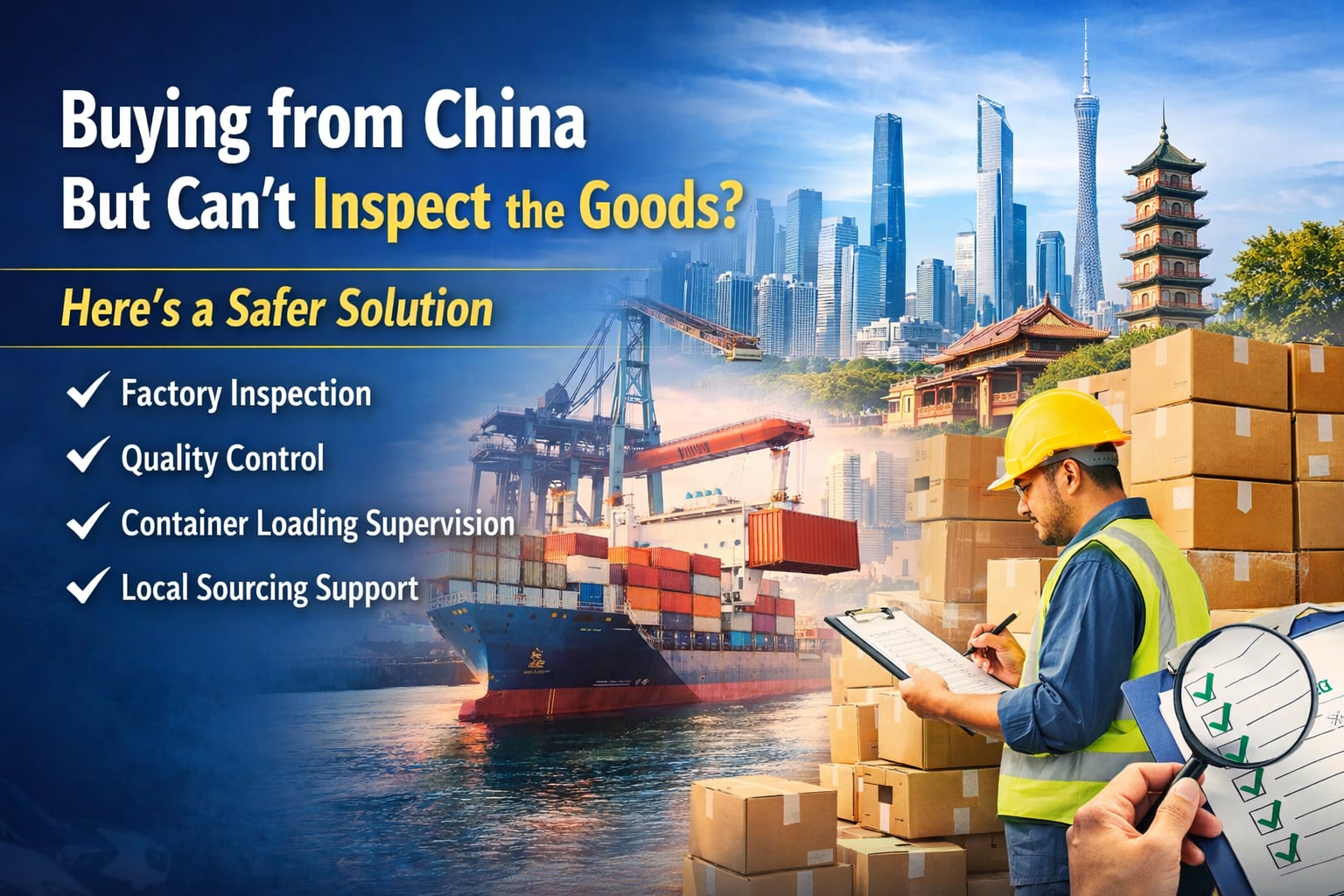
For most mid-sized buyers, having a local sourcing agent in Foshan or Dongguan is more practical. Unlike a “checker” who just takes photos, a dedicated agent acts as your office in China.
We don’t just “report” that the logo is crooked. We tell the factory: “Stop. Fix this today. I’m staying here until the labels are reprinted.” A local agent provides:
- Factory Audit: Verifying the factory is real before you pay the deposit.
- Loading Supervision: Making sure the container isn’t leaking and that workers aren’t throwing your boxes into the truck.
- Real-time Communication: Sending you a quick WeChat or WhatsApp video so you can see exactly what we see.
What should be on your “must-check” list before payment?
You don’t need a 50-page manual. You need a solid pre-shipment checklist:
- Quantity: Count the cartons yourself. Don’t trust the packing list.
- Sample Match: Put the approved sample next to the mass production. Are they the same?
- Function: Does it actually turn on? Does the zipper work?
- Packaging: Drop a carton from 1 meter height. Does it survive?
- Container Condition: Is the container floor dry? Does it smell like chemicals or mold?
Is it worth the money to pay for a local agent?
If your order is over USD 10,000, the answer is almost always yes. Think of it as insurance. You are paying a few hundred dollars to protect a five-figure investment. It prevents customer complaints, Amazon account flags, and the stress of “shipping blind.”
FAQ: Common Questions About Remote Inspection
Q: Will the factory get annoyed if I send an inspector?
A: If a factory gets angry about an inspection, that is a huge red flag. Professional factories are used to it and actually prefer it—they’d rather fix a mistake now than deal with a claim later.
Q: Can you inspect a factory that I found on Alibaba?
A: Yes. In fact, Alibaba “Gold Suppliers” should still be verified. We often find that the “factory” on Alibaba is actually just a small trading office. We go to the actual production site in cities like Zhongshan or Dongguan to see the real machines.
Q: What happens if the goods fail the inspection?
A: We hold the final payment. We show the factory exactly what is wrong and agree on a timeline for rework. We then go back to re-inspect before the container arrives.
Q: Can you help with the shipping paperwork too?
A: Yes. As a Foshan sourcing service, we handle the export documents and coordinate with the freight forwarder so the transition from factory to port is smooth.
Realistic Sourcing, Not Idealistic Promises
There is no such thing as “zero risk” when buying across the ocean. But there is a big difference between gambling and buying with your eyes open.
If you can’t be here in Guangdong, make sure you have someone on the ground who knows the difference between a good product and a “good photo.”
Would you like me to send you our “Container Loading Photo Template”? It shows exactly which angles we photograph during an inspection so you can see how we document the process for our clients. Just ask!