
If you haven’t visited a bathtub factory in Foshan lately, you might still think of Chinese-made tubs as simple, white, glossy shells designed for budget hotels. But the reality in 2026 has shifted dramatically. Today, Foshan is no longer just following European design; in many ways, it is defining the “modern” aesthetic for the global market.
At HSY Sourcing, we spend our weeks walking the production lines of the most innovative manufacturers in the region. We see which molds are being retired and which new shapes are taking over the curing rooms. We’re seeing a move away from “mass production” towards “architectural design.”
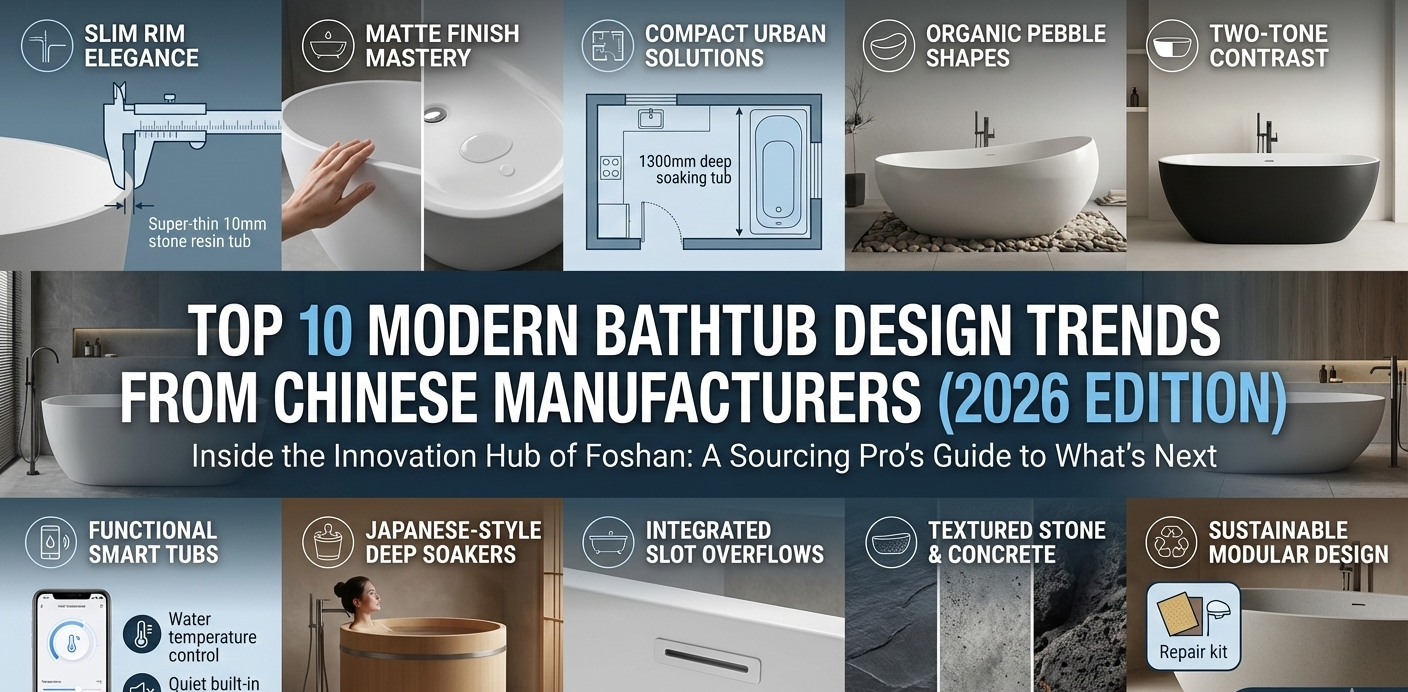
Here are the top 10 design trends currently dominating the manufacturing landscape in China, and why they matter for your next procurement project.
Why is the “Slim Rim” becoming the new standard for luxury?
A few years ago, the average edge of a freestanding bathtub was about 3cm to 5cm thick. It looked sturdy, but it felt heavy and a bit dated. Today, the biggest trend we see in Foshan is the “Slim Rim” or “Ultra-Thin Edge.” Thanks to improvements in the chemical stability of stone resin and the reinforcement techniques of acrylic, factories can now produce tubs with edges as thin as 10mm to 15mm. These thin edges give the bathtub a delicate, porcelain-like appearance. It makes a large object feel light and elegant in a bathroom. From a sourcing perspective, these tubs are highly sought after by high-end interior designers because they look “architectural” rather than “industrial.”
Are matte finishes finally replacing the classic high-gloss white?
For decades, the “shiny white” tub was the only option. But if you walk into a premium showroom in Foshan today, about 60% of the display is Matte White or Matte Grey.
The trend toward matte finishes—particularly in stone resin (solid surface)—is driven by the desire for a “soft touch.” High-gloss surfaces can feel cold and clinical. Matte surfaces feel more like natural stone or even skin. They don’t show water spots as easily and provide a much more contemporary, “spa-like” vibe. While matte acrylic is also available, stone resin is the king of this trend because the color and texture are consistent all the way through the material.
How are designers solving the “Small Space” problem with compact tubs?
As urban apartments in cities like London, New York, and Sydney get smaller, the demand for Compact Freestanding Tubs has skyrocketed.
In the past, a freestanding tub needed a massive bathroom. Now, Chinese manufacturers are developing “short but deep” models. We are seeing a huge increase in the production of 1400mm and even 1300mm tubs. To make up for the shorter length, these tubs are designed with a steeper backrest and a deeper soaking well. This allows a full-grown adult to enjoy a deep soak in a footprint that would normally only fit a standard built-in alcove tub.
Why is the “Organic Pebble” shape winning over geometric rectangles?
We are seeing a move away from sharp, 90-degree angles. The current trend is Organic, Asymmetrical Shapes—often called “Pebble” or “Egg” designs.
These shapes are inspired by nature. They feature soft, irregular curves that don’t look like they were made in a factory. While these are more difficult to manufacture because the molds are complex and the hand-polishing takes twice as long, they are the top-selling designs for luxury villa projects. They act as a piece of sculpture in the center of the bathroom.
Is the “Bicolor” look just a fad or a long-term trend?
The Two-Tone Bathtub (usually a black or charcoal exterior with a white interior) is becoming a staple in modern bathroom design.
This trend is popular because it solves a visual problem: a large white tub can sometimes “disappear” or look too clinical against white tiles. By having a dark exterior, the tub becomes a high-contrast focal point. Chinese manufacturers have perfected the “seamless join” between the two colors, ensuring that the exterior paint doesn’t peel or chip over time. We’re also seeing more “earthy” bicolors, like terracotta or forest green exteriors.
Can a bathtub really be “Smart” without being a maintenance headache?
When people hear “Smart Tub,” they often think of complicated electronics that will break in a year. But the trend in China is toward “Functional Intelligence” rather than “Gimmicky Tech.”
The most popular smart feature we see is the Integrated Constant-Temperature Heater. Instead of a complex whirlpool system, these tubs have a silent, built-in heating element that keeps the water at 40°C for hours. Another rising trend is Micro-bubble Oxygen therapy, which infuses the water with tiny bubbles that deep-clean the skin without the noisy jets of a traditional Jacuzzi. These features are designed to be low-maintenance but high-value for the end-user.
Why are “Japanese-Style Soakers” becoming a global hit?
Inspired by the traditional Ofuro, Chinese factories are producing more Deep Soaking Tubs. Unlike Western tubs where you lie down, these tubs are designed for sitting upright with the water coming up to your shoulders. They are perfect for relaxation and heat retention. Because they are taller, they create a dramatic visual presence in the room. They are particularly popular in the hospitality sector (boutique hotels) where the goal is to provide a unique “experience” for the guest.
How are “Integrated Overflows” changing the look of modern hardware?
In the old days, the overflow was a separate metal plate screwed onto the side of the tub. It often looked cheap and eventually leaked. The modern trend is the Slot Overflow (Integrated Overflow).
This is a thin, horizontal slit cut directly into the tub wall during the molding process. The plumbing is hidden inside the dual-skin of the acrylic or the solid mass of the stone resin. It results in a completely clean look with no visible metal parts on the interior of the tub. It’s a small detail, but it’s the hallmark of a high-end manufacturer.
Is “Concrete and Slate Texture” the end of pure white?
While white is still the bestseller, we are seeing a surge in Textured Stone Finishes. Through advanced resin mixing, factories can now create tubs that look and feel exactly like poured concrete, dark slate, or even volcanic rock. These aren’t just painted; the texture is part of the material. This fits perfectly with the “Industrial Luxury” or “Wabi-Sabi” design trends that are currently huge in Europe and California. They look heavy and grounded, giving the bathroom a sense of permanence.
Is sustainability actually influencing design in Foshan?
In 2026, sustainability is no longer just a buzzword; it’s affecting how tubs are designed for export. We are seeing a trend toward “Long-Life Modular Design.”
Factories are moving away from cheap composite materials that have to be thrown away if they get a crack. Instead, the focus is on high-quality, repairable Solid Surface. The “trend” here is durability. Designers are choosing materials that can be sanded and refinished back to brand-new condition after 10 years of use. For the eco-conscious importer, this is a major selling point: buy a tub once, and it lasts a lifetime.
Comparison of Design Trends
| Trend | Market Segment | Primary Benefit | Material Best Suited |
| Slim Rim | Luxury / Architectural | Elegant, modern aesthetic | Stone Resin |
| Compact Tubs | Urban Apartments | Fits in small spaces | Acrylic |
| Matte Finish | Spa / High-end | Soft touch, hides water spots | Stone Resin |
| Slot Overflow | Professional / Designer | Clean, minimal look | Both |
| Textured Stone | Industrial / Wabi-Sabi | Unique, natural feel | Stone Resin |
Conclusion: Which trend should you follow?
Trends are exciting, but as a pro buyer, you have to balance “what’s cool” with “what’s sellable.” A neon-green bathtub might be a trend in a design magazine, but it will sit in your warehouse for years.
The most successful importers we work with at HSY Sourcing tend to stick to the “Timeless Modern” category: Slim rims, matte finishes, and organic shapes in neutral colors. These designs have the longest shelf life and the highest resale value.
The real “secret” to following these trends is knowing which factories in Foshan have actually mastered the tech. A factory might show you a “Slim Rim” tub, but if their material isn’t strong enough, that rim will crack during shipping.