
For international real estate developers, hospitality procurement directors, and multi-family apartment builders, managing the supply chain for a project’s interior fit-out is highly complex. A standard Bill of Quantities (BOQ) spans hundreds of lines—ranging from structural aluminum glazing and porcelain flooring to custom wood paneling and decorative lighting.
When procurement is fragmented across geographically isolated factories, project margins are eroded by redundant domestic freight, misaligned manufacturing schedules, and compounding communication errors.
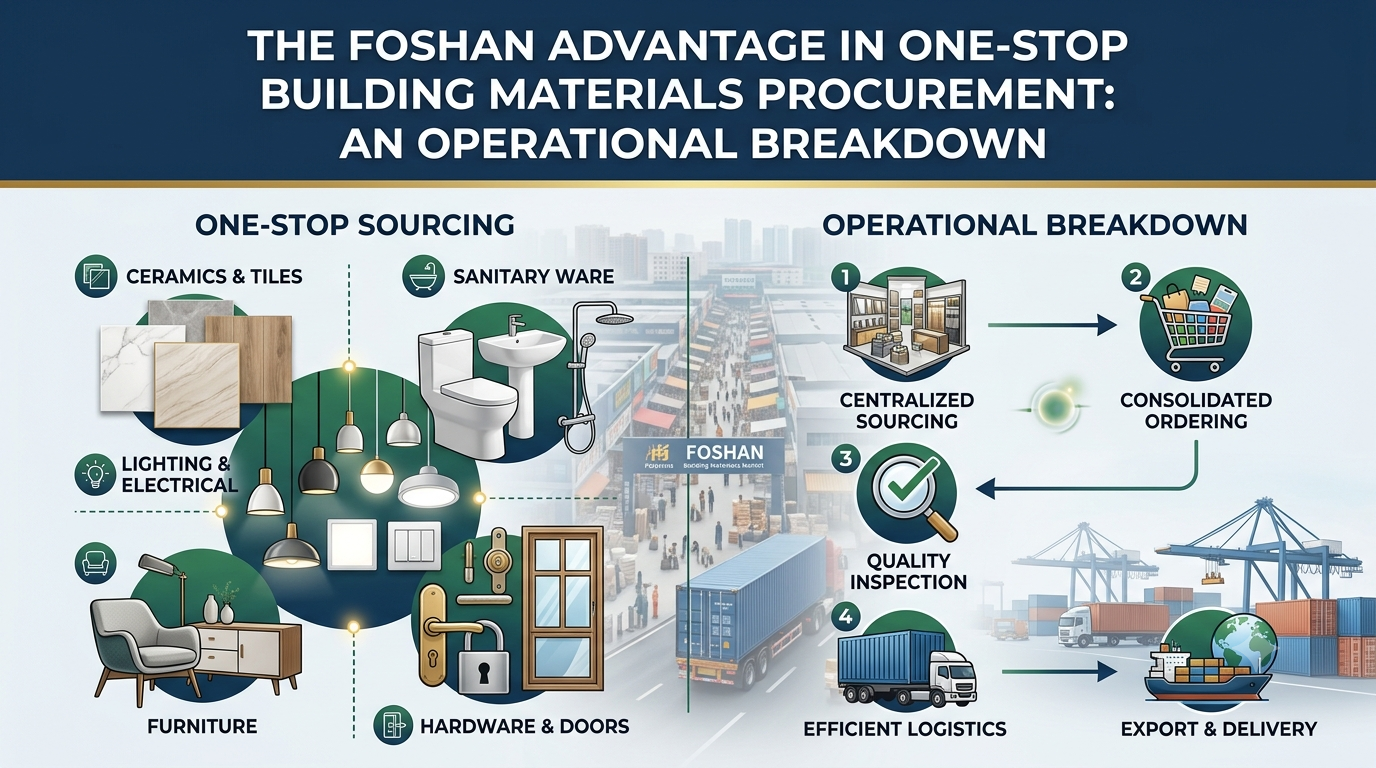
Foshan, located in China’s Pearl River Delta, has evolved past traditional manufacturing to become a hyper-integrated industrial ecosystem for one-stop building materials procurement. Sourcing a complete interior package from this singular hub allows commercial buyers to consolidate their supply chain, eliminate systemic risks, and minimize total landed costs.
Key Takeaways
- Hyper-Concentrated Supply Chain: Sourcing distinct categories like ceramics, fenestration, and millwork within a 50-kilometer radius minimizes domestic logistics friction.
- Reduction in Landed Costs: Consolidating high-density building materials with high-volume interior goods maximizes container payload efficiency and cuts ocean freight expenses per unit.
- Technical Synchronization: Localized oversight ensures that dimensions, architectural hardware finishes, and material tolerances are physically cross-checked between different factories before export.
Why is fragmented building material sourcing a high risk for commercial developments?
Fragmented sourcing introduces severe operational vulnerabilities to a project’s timeline and budget. If a developer purchases custom aluminum windows from an isolated northern province, porcelain tiles from an eastern hub, and interior doors from another region, they create a fractured supply chain with no centralized accountability.
The primary risk manifests in logistics. A delay at a single factory can stall an entire shipment, leading to split container loads, costly Less-than-Container Load (LCL) freight rates, or mounting demurrage fees at the port.
Furthermore, decentralized sourcing makes physical quality control highly impractical. Sending independent inspectors to distant provinces for mid-production and loading checks dramatically inflates pre-construction overhead.
How does Foshan’s geographic density lower procurement overhead?
The core advantage of Foshan is the intense industrial density of its specialized manufacturing districts. Rather than operating as general fabricators, separate zones within Foshan have spent decades refining complete, self-contained supply chains for specific building categories.
Within a single morning’s drive, project buyers can access tier-one contract manufacturers across the region:
- Chancheng District (Shiwan): The global epicenter for commercial porcelain tiles, sintered stone slabs, and structural ceramics.
- Nanhai District (Dali): A massive cluster for aluminum extrusion, commercial-grade window profiles, curtain walls, and architectural facades.
- Shunde District (Lecong & Leliu): The world’s largest furniture and custom woodwork manufacturing zone, specializing in hotel case goods, modular cabinetry, and commercial seating.
Because raw material refineries, custom tooling shops, and surface finishing plants sit adjacent to primary OEM factories, local manufacturers operate with minimal raw material inventory holding costs and optimized lead times. These structural savings are directly passed down to institutional volume buyers.
How does mixed-container consolidation impact total landed shipping costs?
Ocean freight is billed by the container, not the weight, meaning that maximizing the physical weight and volumetric capacity of every container directly lowers the per-unit landed cost of your building materials.
Building materials fall into two distinct logistical profiles:
- High-Density Goods: Porcelain tiles, sanitary ware, and glass are heavy but consume minimal volume. Shipping a container filled solely with tiles will hit the legal weight limit long before the container is physically full, wasting volumetric space.
- Volumetric Goods: Wardrobes, custom sofas, and light fixtures consume massive spatial volume but carry very little weight. Shipping these alone means paying for empty weight capacity.
Foshan’s one-stop geographic ecosystem allows procurement agents to implement an optimized mixed-container loading strategy. Heavy, high-density items like ceramics are loaded securely at the base of the container, while lightweight, volumetric items like furniture or lighting are stacked safely on top. This logistical balance ensures you extract maximum value from every cubic meter of ocean freight.
What technical quality checkpoints must be managed on the ground?
Executing a one-stop bulk building material order requires cross-category technical synchronization. Relying on digital compliance certificates or showroom mock-ups is insufficient for commercial-grade construction.
1. Architectural Hardware Integration
A common failure point in commercial fit-outs is the misalignment of architectural hardware. For example, the lock mortises pre-cut on custom wooden doors must perfectly match the heavy-duty handles and smart locking systems sourced from separate hardware manufacturers. A local sourcing team must physically deliver hardware samples between factories to verify mechanical tolerances before mass production is greenlit.
2. Batch-to-Batch Color Consistency
High-volume real estate projects require thousands of square meters of tiling and wall cladding. If a factory runs multiple production cycles using different raw material batches, slight color shading deviations will occur. On-site QC teams must ensure that all raw inputs are locked down simultaneously and inspect color consistency under standardized lighting conditions.
3. Structural Deflection and Moisture Control
For custom cabinetry, millwork, and doors destined for regions with high relative humidity, the moisture content of the wood core must be strictly regulated between 8% to 12%. Digital moisture meters and structural deflection tests must be deployed on the factory floor prior to packaging to eliminate post-installation warping.
Why choose HSY Sourcing as your procurement office in Foshan?
Navigating thousands of manufacturers across Foshan’s vast industrial landscape requires independent, transparent, and technically competent representation. HSY Sourcing operates strictly as your dedicated purchasing department on the ground, protecting your commercial interests at every stage of the procurement cycle.
- Direct OEM Supply Chain Access: We bypass trading companies and speculative brokers, connecting your project directly with audited, primary manufacturers capable of handling institutional commercial volume.
- Rigorous Engineering Review: Our team analyzes your project’s Bill of Quantities (BOQ) and architectural drawings, ensuring shop drawings, material substrates, and international certifications (e.g., ASTM, CE, BS) are perfectly aligned before production.
- Milestone-Based Quality Enforcement: We conduct unannounced, in-person factory inspections during raw material intake, mid-term assembly, and final pre-packaging to guarantee structural integrity and finish accuracy.
- Turnkey Warehousing and Loading Optimization: We manage the entire domestic logistics process through our centralized Foshan warehouse. We sequence production timelines, receive and check shipments from multiple categories, and engineer precise container loading plans to minimize transit damage and drive down landed costs.
Frequently Asked Questions (FAQ)
How are production timelines synchronized across completely different factories?
Timeline management is a core function of our sourcing service. Custom wood millwork may require a 45-day production window, while standard porcelain tiles may only require 15 days. We reverse-engineer the project timeline, issuing deposit payments and production releases on a staggered schedule so that all disparate categories arrive at our consolidation warehouse within the same week, avoiding storage penalties.
Can Foshan factories provide international fire-rated and environmental certifications?
Yes. Export-oriented factories in Foshan routinely manufacture goods to meet global compliance standards. We verify and source materials that match specific requirements, such as ASTM E84 Class A for wall panel fire retardancy, CARB Phase 2/E0 for low formaldehyde emissions in cabinetry, and CE/UL markings for electrical fixtures. These parameters must be explicitly stated during the initial RFQ stage.
How do you protect fragile items like ceramic tiles or glass during mixed container loading?
We enforce strict export packaging protocols. Heavy porcelain tiles and stone slabs must be packed face-to-face with protective interlayers, crated in reinforced, ISPM-15 compliant fumigated wooden pallets, and loaded exclusively at the floor of the container. Lightweight or volumetric goods are securely blocked and braced above the heavy cargo using internal load-bearing dividing structures to eliminate shifting or crushing during transit.
Is it possible to customize profiles and hardware finishes for a boutique villa or hotel project?
Yes. Foshan’s ecosystem is built for deep customization. For projects meeting the minimum production threshold, we can work with toolmakers to extrude bespoke aluminum window profiles, match custom wood veneers, or apply specific physical vapor deposition (PVD) hardware finishes to align precisely with your interior designer’s intent.