
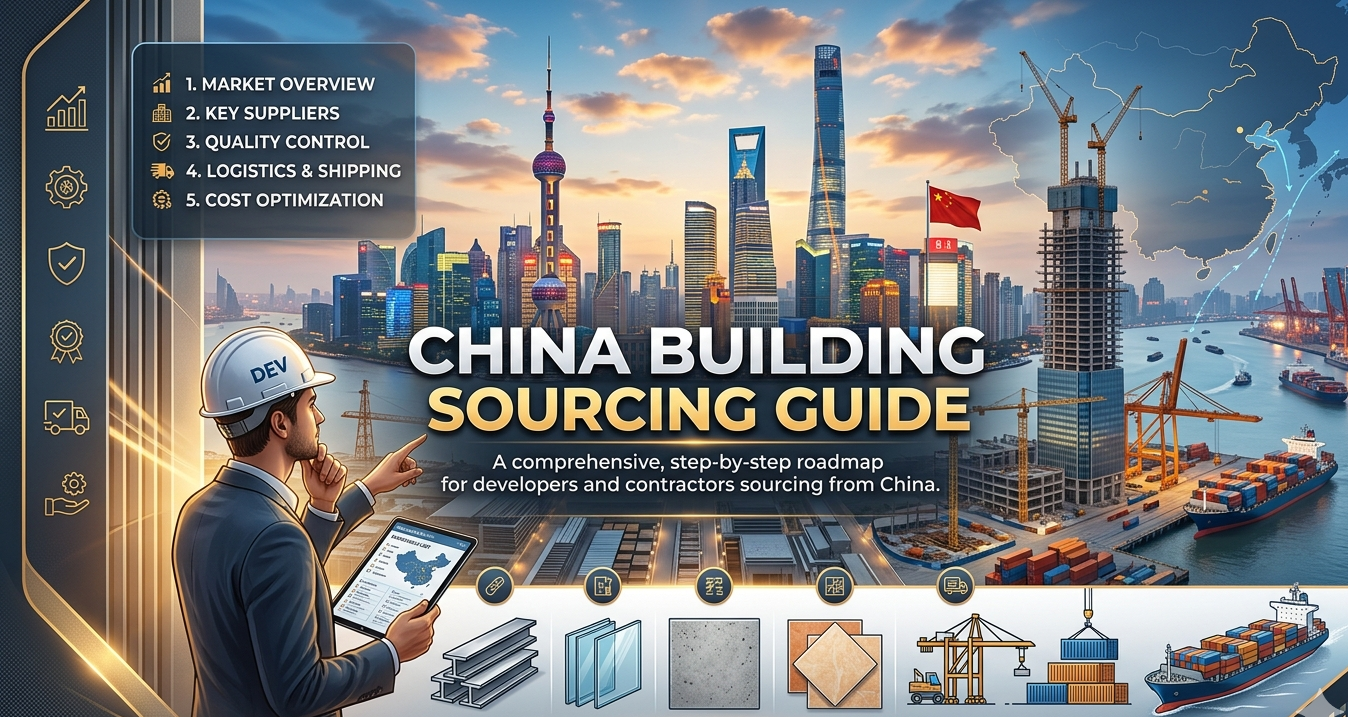
For property developers and general contractors, sourcing building materials from China is an exercise in risk management. The goal is to lower procurement costs across hundreds of units without compromising the construction schedule or facing massive on-site defect rates.
While B2B platforms make it look like you can buy structural steel and bathroom vanities by simply clicking “Add to Cart,” the reality of commercial procurement is entirely different. A delayed container of custom windows or a batch of mismatched floor tiles can stall a multi-million dollar development for weeks. To succeed, you need to approach the Chinese supply chain with strict technical specifications and an organized consolidation strategy.
Why is regional clustering critical for project sourcing?
A major mistake developers make is sourcing materials randomly across China based on the lowest online quote. If your tiles come from Shandong, your lighting from Zhejiang, and your cabinets from Fujian, your domestic logistics costs will erase your savings, and consolidating a single container will become a nightmare.
Smart developers focus on industrial clusters, primarily Foshan, Guangdong. Foshan is the epicenter for whole-house customization and building materials. Within a 50-mile radius, you have the world’s highest concentration of factories producing:
- Porcelain and ceramic tiles
- Custom kitchen cabinets and built-in wardrobes
- Aluminum window and door systems
- Sanitaryware and plumbing fixtures
- Furniture and lighting (in neighboring Lecong and Guzhen)
By localizing your supply chain in one cluster, you or your sourcing agent can audit multiple factories in a single day and consolidate different product categories into one container seamlessly.
How do you lock in technical specifications before the deposit?
“Good quality” is not a specification. Factories quote based on the exact parameters you provide. If you leave a specification blank, the factory will assume the cheapest acceptable standard to win your bid.
Before requesting a quote, your technical brief must define the invisible details:
- Aluminum Windows: Do not just specify “black frame.” Define the aluminum profile thickness (e.g., 1.4mm for standard, 2.0mm for commercial), the thermal break material (PA66), and the glass specs (e.g., 5mm+12A+5mm Low-E tempered).
- Cabinetry: Specify the core board material (Plywood vs. MDF), the formaldehyde emission standard (CARB P2 or EPA TSCA Title VI), and explicitly name the hardware brand (e.g., Blum, DTC).
- Tiles: State the required water absorption rate (<0.5% for true porcelain) and the PEI wear rating suitable for your project’s traffic level.
What is the reality of Quality Control for large projects?
In commercial developments, you cannot rely on a single golden sample. Production quality can drift over a run of 5,000 units. You need a structured Quality Control (QC) process written into your purchasing contract.
- First Article Inspection (FAI): Before mass production begins, the factory must produce one complete, finished unit (like a full bathroom vanity or a built-in wardrobe). You or your agent inspects this on the factory floor to approve the tooling, edge banding, and hardware alignment.
- In-Process QC: For long production runs, an inspector visits the factory mid-way to ensure they haven’t switched to cheaper raw materials after the first batch.
- Pre-Shipment Inspection (PSI): Before the final 70% payment is released, inspectors verify the quantities, test functionalities, and strictly check the packaging.
How does heavy cargo logistics impact your landed cost?
Building materials are heavy, bulky, and fragile. If you miscalculate the logistics, your freight costs will destroy your budget.
- Weight vs. Volume (Cubing Out vs. Weighing Out): Materials like tiles and stone are incredibly dense. You will hit the maximum weight limit of a 20ft container (usually around 26-28 tons) long before it is physically full. Paying for a 40ft container for tiles is a waste of money because you cannot load more weight into it.
- Consolidation: For mixed-use developments, you might need 10 pallets of tiles, 50 toilets, and 20 custom cabinets. Your sourcing partner must have a local warehouse to receive these goods from different factories, palletize them correctly (heavy items on the bottom, fragile on top), and load them into a single container efficiently.
- Palletizing Standards: Mandate that all heavy goods are strapped to ISPM-15 compliant fumigated pallets. Loose-loaded tiles might save a tiny bit of space, but the breakage rate and unloading labor costs on your job site will be astronomical.
Key Takeaways
- Target Clusters: Focus your procurement on specific hubs like Foshan to streamline communication, factory audits, and freight consolidation.
- Specify the Invisible: Dictate material thicknesses, core boards, hardware brands, and emission standards in your initial RFQ.
- Stage Your QC: Implement First Article Inspections and strict Pre-Shipment Inspections before releasing final payments.
- Plan for Weight: Calculate shipping based on payload weight limits, utilizing 20ft containers for dense materials like tiles.
FAQ: Sourcing Building Materials
Q1: Do Chinese factories provide local building code certifications?
A: Many export-focused factories hold international certifications (CE, UL, AS2047, watermark). However, it is your responsibility to inform the factory exactly which local building codes or fire ratings your specific municipality requires before production begins.
Q2: Should developers buy direct or use a sourcing agent?
A: If you are buying a single container of standard tiles, buying direct is fine. If you are fitting out a 100-unit apartment building with custom kitchens, windows, lighting, and flooring across 10 different factories, managing the CAD approvals, QC, and consolidation is a full-time job that requires a local team.
Q3: How long does the procurement cycle take?
A: For custom building materials, expect 15-30 days for design and sample approval, 30-45 days for mass production, and 30-40 days for ocean freight and customs clearance. Always build buffer time into your construction schedule.
Why Choose HSY Sourcing?
Managing a multi-category procurement list for a development project requires an engineering mindset, not just a middleman.
Located in Foshan, the heart of China’s building materials industry, HSY Sourcing acts as your dedicated on-the-ground procurement and project management team.
- Deep Local Network: We don’t just search B2B sites; we have established relationships with real manufacturers in the Foshan clusters for tiles, aluminum windows, and whole-house custom cabinetry.
- Technical Vetting: We review CAD shop drawings against your site measurements, verify the thickness of aluminum profiles, and ensure proper edge-banding technologies (like PUR) are used on your furniture.
- Warehouse Consolidation: We operate local warehousing to collect your goods from multiple factories. We inspect, palletize, and strategically load your containers to maximize space and ensure safe transit.
- Project-Focused QC: We perform the critical First Article and Pre-Shipment inspections, sending you detailed photographic reports so you can approve shipments with confidence.
Keep your construction project on time and under budget. Contact the team at HSY Sourcing today.