
Every hotel manager knows the feeling. A guest checks out of a suite, and housekeeping finds a massive coffee stain on the custom three-seater sofa, or a burn mark on the armrest.
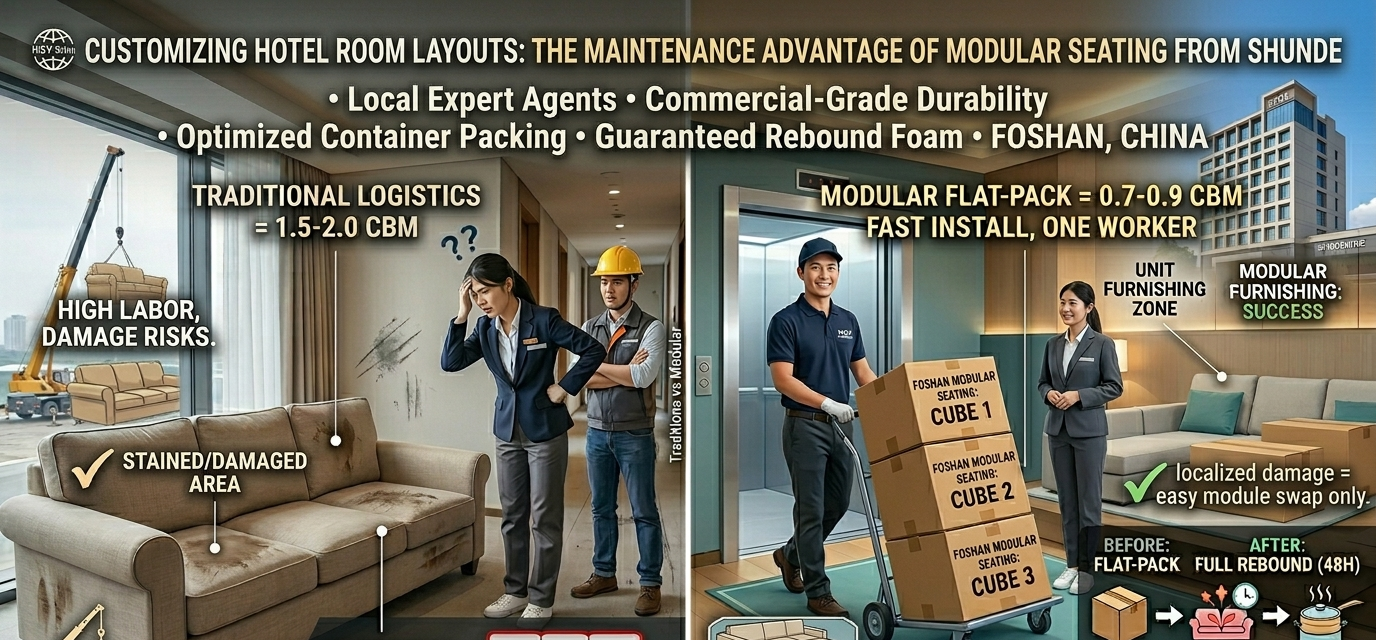
If it’s a traditional fixed sofa, you have two bad choices: pay a local upholsterer a fortune to fix it, or throw the whole piece away, leave the room out of order, and wait weeks for a replacement.
This exact scenario is why smart hotel developers and operators are switching to modular seating from Shunde. It isn’t just about looking modern; it is a calculated business decision about long-term hotel maintenance.
Here is the practical reality of why modular furniture makes sense for commercial real estate, and how it actually works on the ground.
Why do traditional hotel sofas fail the maintenance test?
Traditional sofas are built as one massive, connected unit. The fabric, the wooden frame, and the foam are permanently glued and stapled together.
In a hotel environment, damage is almost always highly localized. It’s usually just one seat cushion, one side of the armrest, or one corner that gets ruined by tenant use. But because of how traditional furniture is manufactured, 10% damage means a 100% replacement cost. You are throwing away perfectly good wood and foam just because one section of fabric is ruined.
How does a modular system fix the “ruined cushion” problem?
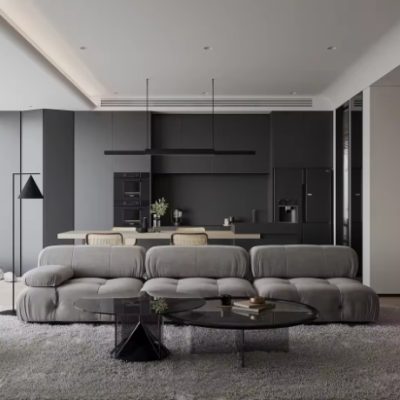
Modular sofas are built like standardized building blocks. The left armrest, the middle seat, the corner piece, and the right armrest are entirely separate units that lock together.
If a guest ruins the middle seat, you don’t throw away the sofa. Your maintenance team simply goes to the property’s storage room, grabs a spare “middle seat module,” unlocks the ruined one, and clicks the new one into place.
The room is ready to rent again in ten minutes. The “swap-and-go” method drastically reduces your FF&E (Furniture, Fixtures, and Equipment) replacement budget over a five-year period.
Can modular furniture really adapt to different hotel room layouts?
Hotels rarely have just one room size. You have standard king rooms, double queens, and odd-shaped corner suites. Buying completely different sofa designs for each room type makes procurement a nightmare and drives up your unit cost.
With a modular seating system from Shunde, you buy the exact same three or four base blocks in bulk.
- For a small standard room, you clip two pieces together to make a simple loveseat.
- For a large suite, you use five pieces to make a large L-shape sectional.
- For the lobby, you link them together into a massive double-sided seating island.
You keep your interior design consistent across the entire property, but you can adjust the footprint to fit any room perfectly.
Why source these modular blocks specifically from Shunde?
Shunde (located within Foshan) is the manufacturing heart of China’s furniture industry. Making modular furniture requires serious precision. If the metal connectors on Piece A are drilled 5 millimeters off from Piece B, the sofa simply won’t lock together on your hotel floor.
Shunde factories have the advanced CNC machinery to cut foam and wood frames with exact, repeatable precision. Furthermore, they have direct access to the massive local textile markets. This means they can apply heavy-duty, commercial-grade fabrics—like stain-resistant, waterproof, or CA117/BS5852 fire-retardant materials—directly on the production line at a fraction of the cost you would pay overseas.
FAQ: Maintaining Modular Hotel Furniture
Q: Will the modules slide apart on the hotel floor when guests sit down?
A: No. Commercial-grade modular sofas use heavy-duty steel interlocking connectors (often called crocodile clips) hidden underneath the frame. Once they are clipped together, they act as one solid, heavy piece of furniture.
Q: Can we just buy removable, washable covers instead of replacing the whole block?
A: Yes. Many Shunde factories offer designs with fully removable fabric covers featuring heavy-duty zippers. We strongly advise our hotel clients to buy an extra 10% to 15% of covers with their initial container order so housekeeping can wash and rotate them.
Q: Will the factory still make my specific module two years from now?
A: This is the most common trap. Factories often change fabric batches, dye colors, or discontinue molds. You cannot rely on buying matching pieces three years later. The practical solution is to negotiate a “spare parts package” upfront—buying extra standard modules and rolls of raw fabric to keep in your local warehouse alongside your initial order.
How HSY Sourcing Protects Your Hotel Furniture Procurement
Buying modular furniture looks simple on paper, but ensuring the pieces actually fit together and the fabric holds up requires real quality control on the ground. At HSY Sourcing, we are your dedicated Foshan sourcing agent in China. We don’t just forward you glossy factory catalogs; we manage the reality of the production line.
Here is what we do for your hotel project:
- The “Dry-Run” Test: Before anything is packed, we go to the Shunde factory and randomly assemble modules from different production batches to ensure the steel connectors click together smoothly.
- Spare Parts Negotiation: We force the factories to include the extra hardware, replacement covers, and matching fabric rolls your maintenance team will actually need.
- Mixed Container Consolidation: We gather your modular sofas, hotel beds, casegoods, and lighting into our Foshan warehouse, packing them efficiently into one container to cut your shipping costs.
Stop wasting money replacing entire sofas because of one spilled drink. Send HSY Sourcing your room layouts or FF&E list today, and let’s build a modular seating package that protects your maintenance budget.