
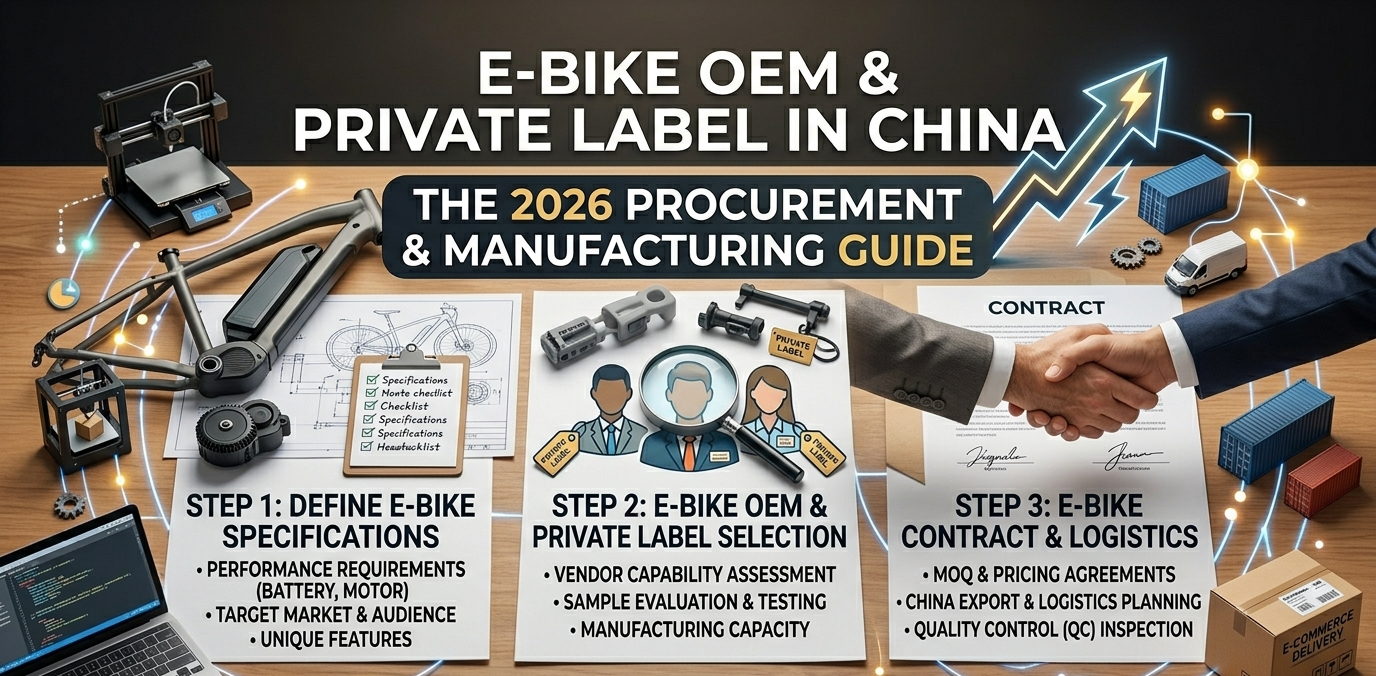
The E-bike market has transitioned from a niche “green” alternative to a global urban mobility standard. For entrepreneurs and established brands, the question isn’t whether to manufacture in China, but how to navigate the complex landscape of OEM (Original Equipment Manufacturer) and Private Label (White Label) production.
The difference between a successful brand launch and a costly recall often comes down to component-level vetting and compliance management. Here is the industrial reality of E-bike manufacturing in China for 2026.
What is the difference between E-Bike OEM and Private Label models?
Choosing the right manufacturing path depends on your budget, timeline, and the level of innovation you want to bring to the market:
- Private Label (White Label): You select a pre-existing model designed by the factory and add your branding, color schemes, and minor component tweaks. This is the fastest route to market with lower R&D costs, ideal for testing a new region.
- OEM (Original Equipment Manufacturing): You provide the unique frame geometry, battery integration specs, and custom electronics. The factory acts as your production arm. This offers complete market differentiation but requires significant investment in molds and technical engineering.
In the current market, many successful brands use a “hybrid” approach—starting with a private label frame but specifying high-end, name-brand components (like Shimano gears or Bafang motors) to ensure quality.
How do you ensure battery safety and international compliance?
In 2026, compliance is the ultimate barrier to entry. Batteries are the most scrutinized component in the supply chain. If you are importing to the EU or North America, you cannot cut corners on certifications.
- UN38.3 & UL Certifications: These are mandatory for the safe transport and sale of lithium-ion batteries.
- EN15194 (EU Standard): This is the gold standard for electric power-assisted cycles (EPAC). It covers both electrical safety and mechanical durability.
- CE & RoHS: Essential for entering the European market, ensuring the electronics are safe and free from hazardous materials.
A professional sourcing strategy involves requesting recent test reports directly from the battery cell manufacturer (e.g., Samsung, LG, or high-end Chinese brands like CATL) rather than relying solely on the bike assembly factory’s word.
What are the critical components you must inspect in the Chinese supply chain?
An E-bike is only as good as its weakest link. During factory audits and quality control, you must focus on the “Big Three”:
- The Motor (The Heart): Whether you choose a hub motor or a mid-drive system, verify the torque ratings and thermal management. Mid-drive systems are increasingly popular for high-end models but require more precise frame tolerances.
- The Controller and BMS: The Battery Management System (BMS) is what prevents fires and ensures longevity. Demand to see the software interface and safety protocols programmed into the controller.
- Frame Integrity: E-bikes are heavier and faster than traditional bikes. Inspect the weld quality on aluminum frames or the layup consistency in carbon fiber models. X-ray testing for “hidden” weld defects is a standard requirement for premium OEM projects.
Why is logistics the “final boss” of E-bike sourcing?
Shipping E-bikes is significantly more complex than standard furniture or building materials because batteries are classified as Dangerous Goods (Class 9).
- Dangerous Goods (DG) Surcharges: Expect higher freight rates and stricter documentation requirements.
- Packaging Standards: E-bikes must be packed in double-walled corrugated boxes with internal foam bracing to prevent the battery from shifting.
- Battery “State of Charge” (SoC): Most airlines and shipping lines require batteries to be shipped at a 30% charge level to minimize fire risk during transit.
Key Takeaways
- Model Selection: Use Private Label for speed-to-market; use OEM for long-term brand differentiation.
- Compliance First: Never ship without verified UN38.3 and UL/EN certifications.
- Component Vetting: Specify “Tier 1” motors and battery cells to reduce warranty claims and increase brand trust.
- Logistical Planning: Account for the extra time and cost associated with Dangerous Goods shipping and specialized packaging.
FAQ: E-Bike Sourcing Essentials
Q: What is the typical Minimum Order Quantity (MOQ) for E-bike OEM?
A: For private label (standard frames), MOQs can be as low as 50–100 units. For full OEM projects involving custom frame molds, expect an MOQ of 300–500 units per model.
Q: Can I source the battery and the bike separately?
A: It is possible, but not recommended for new brands. Most factories prefer to handle the battery-to-motor integration to ensure the BMS and Controller speak the same language. If you source separately, you take on the liability for any technical “mismatches.”
Q: How do I handle after-sales service for Chinese-made E-bikes?
A: The most effective strategy is to negotiate a 2%–3% “spare parts kit” to be included with every container. This should include extra controllers, displays, and sensors, which your local team can use for quick repairs.
Technical Procurement with HSY Sourcing
Launching an E-bike brand requires more than just a supplier; it requires a technical partner who understands the “gaps” between design and delivery. Whether you are looking for high-end mountain E-bikes or urban commuters, we provide the on-the-ground oversight in China’s manufacturing hubs to ensure your project meets international safety standards.