
When you are importing high-end bathtubs, you aren’t just buying a product; you are buying your reputation. In the world of luxury developments and premium retail, a single defect isn’t just a minor inconvenience—it’s a disaster. Imagine a stone resin tub that develops a hairline crack six months after installation in a 5-star hotel, or an acrylic tub that turns yellow under a bathroom skylight. The cost of the product is nothing compared to the cost of the replacement labor, the damage to the flooring, and the loss of your client’s trust.
Most people think quality control is just about checking the finished product before it’s loaded onto a container. But if you wait until the goods are packed to start your QC, you’ve already lost. In China’s massive sanitary ware hubs, particularly in Foshan, high-end quality is something that must be engineered into the production process from day one.
At HSY Sourcing, we’ve seen the difference between a factory that claims to be “high-end” and one that actually delivers. Here is the realistic, boots-on-the-ground logic of how to ensure your bathtubs meet the standards your premium market demands.
Why does the “Sample Trap” catch so many professional buyers?
The most dangerous moment in sourcing is the moment you approve a sample. Factories in Foshan are masters at creating a “Masterpiece Sample.” They will spend extra time hand-polishing it, using the highest-grade resin, and ensuring the overflow hardware is perfectly aligned.
The pitfall is assuming that the bulk production will automatically match that sample. In reality, mass production is where shortcuts happen. A factory might run out of the premium acrylic sheets used for the sample and swap in a slightly cheaper composite board. Or, the worker who hand-polished your sample might be on leave when your order of 50 tubs is being finished.
To avoid this, your quality control must start with a “Gold Sample” strategy. You shouldn’t just approve a sample; you should sign it, seal it, and leave it at the factory (or with your sourcing agent). This sample becomes the “contractual physical standard.” During every inspection, the production tubs are compared side-by-side with this Gold Sample. If the white doesn’t match exactly, or if the matte finish feels “sandier” than the sample, the batch is rejected before it ever leaves the curing room.
What specific material traps should you look out for during inspection?
When we talk about high-end tubs, we are usually talking about two materials: Pure Acrylic (PMMA) or Stone Resin (Solid Surface). Both have hidden traps that a standard “eyes-only” inspection will miss.
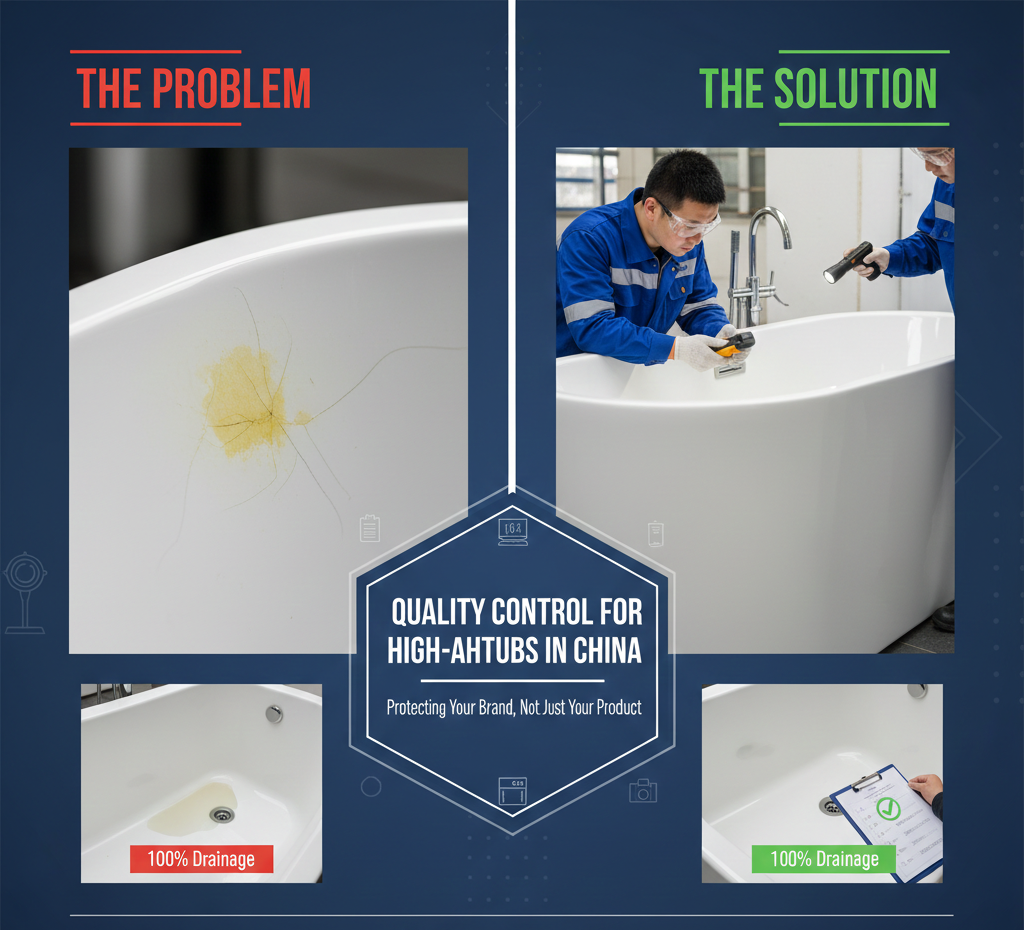
For Acrylic Tubs, the secret is in the reinforcement. The surface is just a thin skin. The strength comes from the fiberglass and resin sprayed on the back. A high-end tub should have 4 to 5 layers of reinforcement. In a low-quality factory, they will spray it thin to save money, or they will mix in too much calcium powder to make the resin thick and heavy (to trick you into thinking it’s “sturdy”). We use a high-powered “Light Test.” By shining a light through the shell, we can see the density of the fiberglass. If the light is patchy or uneven, it means the tub has weak spots that could crack under the weight of a person and water.
For Stone Resin Tubs, the trap is the “Curing Time.” High-end stone resin needs time to settle in the mold and then “bake” in a temperature-controlled room to achieve full hardness. If a factory is rushing to meet your shipping deadline, they might pull the tubs out early. These “immature” tubs look fine on day one, but after they are shipped across the ocean and sit in a warehouse, they can warp or develop micro-cracks because the chemical reaction wasn’t finished. Our QC process includes a “Hardness Test” (using a Barcol hardness tester) to ensure the stone has fully vitrified.
How can you verify structural integrity without destroying the product?
High-end quality is about what happens when the tub is actually used. The most common defect in Foshan-sourced bathtubs isn’t a scratch—it’s poor drainage.
In many factory showrooms, the tubs aren’t connected to water. You see a beautiful shape, but you don’t see the slope. If the mold is slightly off, or if the tub warped during cooling, water will pool in the corners. This leads to bacteria buildup and a very unhappy end-user.
A “Pro” QC inspection always includes a 24-hour Water Retention and Drainage Test.
- First, we fill the tub to the overflow to ensure the overflow plumbing doesn’t leak (a common failure point).
- Second, we let it sit for hours to check for slow leaks.
- Third, we pull the plug. If even a tablespoon of water remains pooled on the bottom, the tub fails. High-end means 100% drainage.
Another non-destructive test we perform is the “Flex Test.” We place the tub on a level surface and have a 90kg inspector stand in it. We check for any creaking sounds or visible flexing of the floor. A high-end tub should feel like a solid piece of rock, not a plastic toy. If it flexes, the reinforcement is insufficient, regardless of how “pretty” the surface looks.
Is the factory’s internal QC report enough to protect your investment?
Let’s be honest: a factory’s internal QC team works for the factory manager, not for you. Their job is to meet the shipping schedule. If they find a small scratch or a slightly misaligned drain, their incentive is to “fix” it with a bit of polish and move on.
For high-end goods, you need a “Third-Party Firewall.” Whether it’s your own team or an agent like HSY Sourcing, the inspector must be someone who is authorized to say “Stop.”
A common secret in the industry is the “AQL” (Acceptable Quality Level). Most factories follow a standard that allows for a certain percentage of “minor defects.” But for a luxury project, there is no such thing as a minor defect. A 2mm chip on the rim of a $1,000 tub is a 100% failure.
Our approach to high-end tubs is a 100% Visual Inspection, not a random sampling. We check every single unit. We check the polish under specific “Daylight” lamps to look for “Orange Peel” texture (a sign of poor sanding) or “Pinholes” (tiny air bubbles in the resin). If we find a single pinhole, that tub is sent back for re-finishing before it is allowed into the packing area.
What role does packaging play in the final quality of the bathtub?
You can spend months perfecting the quality of the tub, only to have it ruined in the final ten days of its journey. Quality control doesn’t end when the tub is finished; it ends when the tub is installed.
For high-end tubs, standard cardboard is a risk. We advocate for “Engineered Packaging.”
- For Acrylic: 7-layer double-corrugated boxes with high-density foam “shoes” that hold the feet of the tub in place.
- For Stone Resin: Full plywood crates. Because stone resin is heavy and brittle, a cardboard box will collapse if the container hits rough seas. A plywood crate ensures that nothing touches the tub during transit.
Furthermore, we inspect the Loading Process. Most damage happens because the loaders are trying to cram too much into one container. They might put a heavy pallet of hardware on top of a bathtub box. Our QC team stays until the container doors are closed and the seal is applied. We take photos of the bracing and the strapping to ensure that those tubs don’t move an inch during their 30-day ocean voyage.
Summary of the High-End QC Checklist
If you want to ensure your shipment is perfect, make sure your inspection team checks these specific points:
| Inspection Point | What to Look For | High-End Standard |
| Surface Finish | Glossy or Matte texture | Zero pinholes, zero “orange peel” waves |
| Color Match | Compare to Gold Sample | 100% match (no cool/warm white variance) |
| Drainage | Pour 20L of water | 100% dry after 2 minutes |
| Overflow | Fill to the brim | Zero leaks in the hidden piping |
| Reinforcement | Light Test (Flashlight) | Uniform thickness; no translucent spots |
| Dimensions | Measured at 5 points | Variance less than 2mm |
| Packaging | Crate construction | ISPM-15 Fumigated wood; no movement inside |
Conclusion
Ensuring quality for high-end bathtubs in China isn’t about being “tough” with factories; it’s about being technical and present. You have to speak the language of the production floor. You have to know that “pure acrylic” feels different from “composite,” and you have to be willing to reject a tub that looks 95% perfect but fails the 100% drainage test.
In the Foshan market, factories will give you the quality you demand and inspect, not the quality you expect and hope for.
At HSY Sourcing, we act as your technical eyes and ears on the ground. We understand that in the luxury market, there is no room for “close enough.” We ensure that every tub leaving the factory is a reflection of your brand’s commitment to excellence.