
When specifying exterior glazing for high-end villa projects, aluminum is the preferred frame material due to its structural strength, narrow profile sightlines, and resistance to weathering. However, general contractors, real estate developers, and architects frequently face a core specification decision: whether to invest in thermal break aluminum window systems or opt for standard non-thermal aluminum profiles.
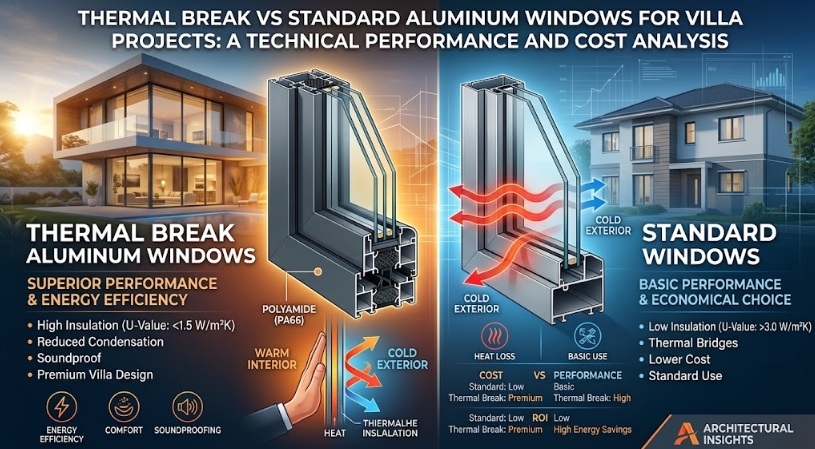
Aluminum is a natural thermal conductor. A solid aluminum frame transfers heat and cold directly across the building envelope. In a climate-controlled residential villa, standard aluminum frames lead to indoor heat loss, elevated HVAC energy loads, and interior glass condensation.
Thermal break window technology addresses this thermal conductivity by inserting a non-conductive insulating bar between the interior and exterior aluminum profiles.
This guide provides a technical breakdown comparing thermal break and standard aluminum windows across energy efficiency, structural durability, long-term costs, and manufacturing standards in Foshan, Guangdong—the world’s primary hub for architectural aluminum fabrication.
Key Takeaways
- Thermal Insulation Eliminates Energy Loss: Thermal break aluminum windows utilize PA66 GF25 polyamide insulation strips to block heat transfer through the frame, reducing window U-Factors from ~1.0–1.2 (standard aluminum) down to 0.22–0.28 (thermal break with Low-E IGUs).
- Condensation Control Protects Villa Finishes: Standard aluminum frames condense moisture on interior surfaces when indoor air meets cold outdoor frames. Thermal break profiles maintain interior frame temperatures near room temperature, preventing water damage to adjacent millwork, stone, and plaster.
- PA66 Polyamide vs. PVC Insulators: For high-end villa builds, specify PA66 GF25 (25% glass fiber reinforced polyamide) thermal bars. Never accept cheap PVC insulation strips, which degrade under high temperatures and lack structural shear strength under wind load.
- Factory Cost Delta vs. Project Value: Thermal break window packages from top-tier Foshan manufacturers typically carry a 25% to 35% higher factory unit cost than standard aluminum windows. However, because factory costs in Foshan are significantly lower than Western distributor prices, total landed savings on a complete villa package remain between 35% and 50%.
What Is the Engineering Difference Between Thermal Break and Standard Aluminum Frames?
Understanding how frame profiles are constructed clarifies why thermal break systems perform fundamentally differently under environmental stress.
+-----------------------------------------------------------------------------------+
|                   FRAME CONSTRUCTION & PERFORMANCE COMPARISON                     |
+--------------------------+------------------------------+-------------------------+
| Technical Parameter      | Standard Aluminum Windows    | Thermal Break Aluminum   |
+--------------------------+------------------------------+-------------------------+
| Frame Thermal Conduction | High (Solid aluminum body)   | Interrupted by PA66 Bar |
| Typical Frame U-Factor   | 1.0 – 1.3 BTU/hr·ft²·°F      | 0.22 – 0.32 BTU/hr·ft²·°F|
| Structural Wall Thickness| 1.4 mm – 1.8 mm              | 2.0 mm – 3.0 mm         |
| Acoustic Insulation (STC)| 28 dB – 32 dB                | 38 dB – 45 dB           |
| Interior Condensation    | High risk in cold/humid weather| Prevented by thermal bar|
+--------------------------+------------------------------+-------------------------+
Standard Aluminum Frames (Non-Thermal)
A standard aluminum window frame consists of a single continuous extruded aluminum profile. Because aluminum has a high thermal conductivity rate (k ≈ 160–200 W/m·K), ambient outdoor temperatures transfer directly to the interior frame surface.
- Warm Climates: Outdoor heat radiates through the window frames directly into air-conditioned living spaces, forcing cooling systems to run continuously.
- Cold/Humid Climates: Cold outdoor air cools the interior aluminum frame below the room’s dew point, causing water droplets to collect along the inside edge of the window.
Thermal Break Aluminum Frames
Thermal break systems separate the exterior and interior extruded aluminum sections using a rigid, low-conductivity insulating strut.
- Thermal Isolation: The insulating bar (typically PA66 GF25 polyamide, with k ≈ 0.3 W/m·K) stops thermal bridging across the frame.
- Structural Stability: Polyamide 66 reinforced with 25% glass fiber matches the thermal expansion coefficient of aluminum, ensuring the joint remains structurally tight through extreme temperature fluctuations without warping or separating.
How Does Thermal Break Technology Impact Villa HVAC Energy Efficiency and Indoor Comfort?
For sprawling luxury residential builds with expansive glass facades, the choice of window frame directly governs building energy performance and occupant comfort.
+-------------------------------------------------------------------------+
|                  THERMAL BRIDGING IN ALUMINUM PROFILES                   |
|                                                                         |
|  STANDARD PROFILE:                                                      |
|  [Exterior Heat/Cold] ───> [Solid Aluminum Frame] ───> [Interior Space] |
|                                                                         |
|  THERMAL BREAK PROFILE:                                                 |
|  [Exterior Frame] ──> [PA66 Polyamide Bar] ──X──> [Interior Frame]      |
|                        (Thermal Bridge Cut)                             |
+-------------------------------------------------------------------------+
1. U-Factor and SHGC Reduction
Window thermal performance is measured by U-Factor (rate of heat loss) and Solar Heat Gain Coefficient (SHGC). While high-performance Low-E double or triple glazing addresses glass insulation, standard aluminum frames undermine glass efficiency by acting as thermal leaks around every panel.
Pairing insulated Low-E glass units (IGUs) with thermal break aluminum frames reduces the overall window assembly U-Factor to meet stringent building codes, such as Title 24 in California or international green building standards.
2. Acoustic Sound Reduction
The composite construction of a thermal break frame—combining dual aluminum extrusions with a semi-rigid polyamide core—dampens structural vibration and sound waves better than a single solid aluminum piece. When combined with asymmetric double-laminated glass (e.g., 6mm + 12A + 5mm+0.76PVB+5mm), thermal break windows reduce ambient outdoor traffic or wind noise by up to 45 decibels (STC rating 38–45).
What Are the Real-World Cost Differences When Sourcing from Foshan?
Evaluating the financial decision between standard and thermal break aluminum windows requires looking at direct factory production costs alongside total landed project budgets.
+-------------------------------------------------------------------------+
|                   TOTAL LANDED COST BREAKDOWN STRUCTURE                 |
|                                                                         |
|  [Factory Unit Production] ──> Extrusions + Thermal Strips + Glass + HW |
|             +                                                           |
|  [Export Packaging]        ──> Fumigated Plywood Crates & A-Frame Skids |
|             +                                                           |
|  [Ocean Shipping & Port]   ──> 40ft FCL Freight + Terminal Handling     |
|             +                                                           |
|  [Customs & Tariffs]       ──> HTS Duty + Local Import Taxes & Drayage  |
+-------------------------------------------------------------------------+
Factory Unit Cost Comparison
In Foshan’s manufacturing hub, window pricing is primarily calculated per square meter ($/m²):
- Standard Aluminum Windows (Basic Glazing): Direct factory cost ranges from $90 to $150 per m².
- High-Spec Thermal Break Windows (6063-T6 Aluminum, PA66 Bar, Low-E IGU): Direct factory cost ranges from $180 to $320 per m², depending on system complexity (e.g., tilt-and-turn, narrow-sightline sliding, or concealed sash mechanisms).
Project-Level Savings Analysis
For a 600 m² luxury villa requiring 180 m² of exterior windows and doors, direct factory production for a complete thermal break system in Foshan averages $32,000 to $55,000.
When compared to purchasing equivalent high-spec thermal break systems through regional distributors in North America, Europe, or Australia (where similar packages range from $90,000 to $160,000), direct procurement from Foshan delivers net project savings of 35% to 50%, even after adding ocean shipping, custom A-frame packaging, tariffs, and customs clearance.
What Technical Standards Must You Audit When Purchasing Thermal Break Windows in Foshan?
Not all thermal break windows manufactured for export offer the same structural or thermal integrity. Auditing technical specifications before placing a production order prevents jobsite failures.
+-----------------------------------------------------------------------------------+
|                        PRE-FABRICATION TECHNICAL AUDIT                            |
|                                                                                   |
|  [Insulation Bar Type]     ◄── Verify PA66 GF25 Polyamide (Reject PVC)             |
|  [Profile Wall Thickness]  ◄── Minimum 2.0mm for windows / 2.5mm–3.0mm for doors  |
|  [Glass Safety Etching]    ◄── Permanent SGCC / ANSI Z97.1 corner marks           |
|  [Corner Assembly Method]  ◄── Cast aluminum corner keys with injected epoxy resin|
+-----------------------------------------------------------------------------------+
1. Polyamide (PA66) vs. PVC Insulation Bars
Some budget-focused factories substitute cheap PVC insulation strips in place of genuine PA66 GF25 polyamide.
- The Risk: PVC has a much lower melting point, degrades under sustained UV exposure, and exhibits a different thermal expansion coefficient than aluminum. Over time, PVC bars shrink, leading to frame seal separation, water leaks, and structural failure.
- The Check: Require mill test certificates specifying PA66 GF25 insulation material and verify bar branding during factory floor inspections.
2. Profile Alloy and Wall Thickness
For structural stability in high-end villa builds:
- Primary window frame extrusions should utilize 6063-T5 or T6 grade aluminum.
- Profile wall thickness should meet a minimum of 2.0 mm for casement/tilt-and-turn windows and 2.5 mm to 3.0 mm for large-format sliding doors to resist wind-load flexing and support heavy double- or triple-pane glass panels.
3. Corner Crimping and Resin Injection
High-quality thermal break frames do not rely solely on simple mechanical screws at frame corners. Quality Foshan fabricators utilize heavy cast aluminum corner keys combined with pneumatic corner crimping and two-component epoxy resin injection. This creates a completely rigid, watertight corner joint that will not sag over time.
Why Choose HSY Sourcing as Your Window Procurement Partner in Foshan?
Sourcing custom architectural windows across long distances requires strict technical oversight on the factory floor. HSY Sourcing operates as your dedicated local procurement team, engineering auditor, and quality management partner in Foshan.
- Foshan Industry Access: Based directly in Foshan, we maintain daily working relationships with top export-certified window and door manufacturers across Nanhai and Shunde.
- Technical Blueprint & Code Audit: We convert architectural elevations into detailed metric CAD shop drawings. We verify rough opening deductions, structural wall anchorage points, drainage channels, and hardware load capacity against your local building code requirements before cutting begins.
- On-Site Physical Quality Control: Our inspectors conduct multi-stage physical audits during production:
- Profile & Bar Checks: Caliper verification of aluminum wall thickness and PA66 polyamide bar authenticity.
- Corner & Seal Inspection: Checking corner crimping tightness, epoxy resin injection, and EPDM rubber gasket continuity.
- Glass Verification: Confirming permanent SGCC / ANSI Z97.1 safety logos, Low-E coating positioning, and Argon gas fill spacer seals.
- Supervised Packaging and Container Loading: We manage staging at our Foshan warehouse, inspecting all solid plywood A-frame skids and supervising container loading with ratchet lashing and dunnage air bags to prevent ocean transit damage.
- Flat Agency Pricing: We work strictly on a transparent, flat service fee. We do not accept hidden factory markups or kickbacks, ensuring you receive true direct-factory pricing.
Frequently Asked Questions (FAQ)
Are standard non-thermal aluminum windows ever suitable for luxury villa builds?
Standard aluminum windows are generally limited to non-conditioned interior partition walls, covered pool houses in warm regions, or mild tropical climates where indoor-outdoor temperature differentials are minimal and building codes do not mandate strict U-Factors. For air-conditioned luxury villas or cold-climate builds, thermal break windows are necessary to meet energy performance standards and avoid condensation issues.
What is the lead time for custom thermal break window packages from Foshan?
The standard timeline from drawing approval to jobsite delivery ranges between 10 to 14 weeks:
- CAD Shop Drawing & Material Sample Approval: 2 weeks.
- Factory Extrusion, Cutting, & Assembly: 4 to 5 weeks.
- Ocean Freight & Customs Clearance: 4 to 5 weeks.
- Inland Jobsite Delivery: 3 to 5 days.
How do we verify that imported thermal break windows comply with local energy codes?
HSY Sourcing works with tier-1 export manufacturers that hold valid third-party test reports from recognized testing bodies (such as Intertek or NFRC). We ensure that the specific glass-and-frame configuration specified for your project meets the required U-Factor and SHGC performance values before production is authorized.
Can custom thermal break windows imported from Foshan include integrated flyscreens and motorized blinds?
Yes. Modern Foshan export systems frequently integrate heavy-duty stainless steel mesh flyscreens (304 security mesh) directly into the thermal break frame profile. Additionally, double-glazed units can be custom-manufactured with motorized or manual magnetic louvers sealed inside the insulated glass cavity.