
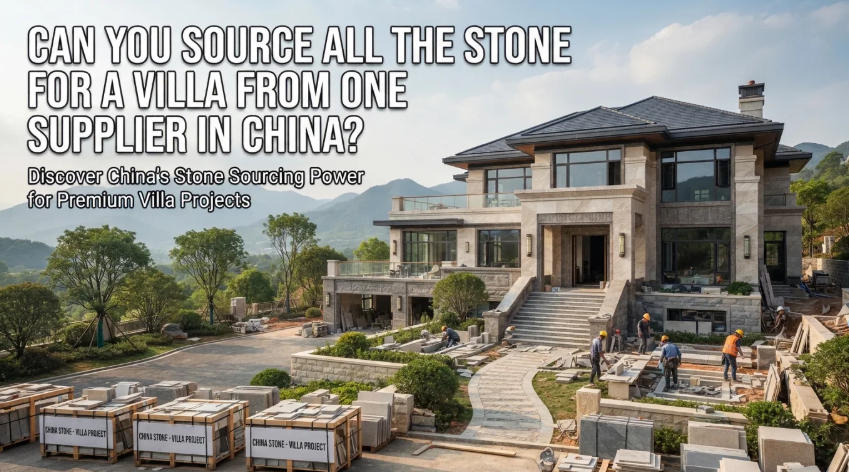
A typical private residential build requires marble for feature walls, quartzite for the kitchen island, travertine for living areas, granite or limestone for outdoor paving, onyx for a powder room, and sintered stone for wet zones—alongside custom vanity tops, stair treads, fireplace surrounds, and pool coping.
When faced with a 40-line stone schedule and an upcoming installation deadline, the natural procurement question is: “Can I give the entire stone package to one supplier in China and deal with only one company?”
Yes, a capable China-based project stone supplier can coordinate most or even all of a villa’s stone package, but that does not mean every material should come from one factory.
Selecting a single vendor simply because they have a thick catalogue or quote every line item on your bill of quantities (BOQ) is one of the fastest ways to end up with mismatched batches, delayed fabrication, and broken pieces on site. Whether consolidating your order under one roof works depends entirely on what that supplier actually controls: raw block access, physical slab selection, shop drawing translation, vein matching, fabrication, pre-shipment inspection, and export packing.
One Supplier vs. One Factory: Why the Distinction Matters
In residential stone procurement, buyers often treat “one supplier” and “one factory” as the same thing. In China’s stone hubs—such as Shuitou (Fujian) and Yunfu (Guangdong)—they operate very differently.
One Factory
A physical stone factory owns gang saws, bridge cutters, CNC machines, and polishing lines. However, individual factories specialize. A workshop set up to cut high-volume granite paving or standard marble floor tiles rarely has the specialized machinery, dust-free environment, or skilled technicians needed for ultra-thin sintered stone mitering or intricate waterjet medallions. Furthermore, no single factory stocks every quarry block from Italy, Turkey, Brazil, Greece, and domestic Chinese quarries simultaneously.
One Project Supplier
A project-oriented stone supplier acts as the central commercial and technical coordinator. They may own their own fabrication workshop for cut-to-size work while sourcing raw slabs from specialized block importers in the local stone market, or subcontracting sintered stone processing to a dedicated sintered fabrication plant. You get one contract, one point of communication, and consolidated container loading, while the work is distributed behind the scenes.
Multiple Specialist Suppliers
Here, you split the package—buying bulk flooring from a large tile factory, sourcing a rare bookmatched marble directly from a major slab importer, and awarding custom vanity tops to a specialized fabricator.
Do not fall into the trap of assuming “direct factory = better” or “trading company = bad.” A direct factory that subcontracts half your BOQ without telling you carries more risk than a transparent project supplier who openly manages four specialized workshops. The real question is: Who actually controls the slabs, the cutting layout, and the quality check before the crate is nailed shut?
What “All the Stone for a Villa” Actually Includes
When you ask a vendor to quote your entire stone schedule, you are rarely asking for one type of material or one type of manufacturing. A complete residential specification usually spans three distinct categories:
- Natural Stone: Marble, quartzite, travertine, limestone, granite, onyx, slate, and semi-precious slabs. Each has different hardness, porosity, resin requirements, and breakage risks during cutting.
- Engineered and Large-Format Surfaces: Sintered stone (such as Lapitec, Laminam, or domestic Chinese brands), porcelain slabs, and engineered quartz. These require entirely different diamond blades, slower cutting speeds, and specific reinforcement backing compared to natural marble.
- Finished Architectural Applications: Standard calibrated floor tiles, exterior wall cladding, dry-hung facade panels, mitered kitchen islands, integrated bathroom vanities, stair treads and risers, carved fireplace surrounds, window sills, thresholds, bullnose pool coping, and bookmatched feature walls.
A company equipped to supply 600 m² of flamed granite driveway pavers is rarely the same company you want fabricating a 3.2-meter bookmatched Calacatta Viola waterfall island.
When Using One Project Supplier Makes Sense
Consolidating your stone package through a single project-oriented supplier works well under specific conditions:
- High variety, moderate volume: Private villas are the opposite of hotel projects. A hotel buys 10,000 m² of two materials; a villa buys 30 m² to 150 m² each of twelve different materials, plus dozens of one-off custom pieces. Managing twelve separate factories for small quantities is logistically exhausting.
- Heavy custom fabrication: If your drawings include bespoke vanities, curved stair treads, and intricate threshold details, having one technical team translate your architectural drawings into unified shop drawings prevents dimensional clashes where different stones meet.
- Need for container consolidation: Shipping half-empty containers from three different ports increases freight costs and handling damage. One project supplier can receive finished crates from partner workshops, verify counts, and load containers according to your site installation sequence (e.g., loading exterior paving and structural stairs last so they come out first).
- Clear drawings and BOQ: One supplier performs best when you already have room-by-room specifications, elevations, and target finishes, allowing them to price accurately rather than guessing.
The primary value here is not mere convenience—it is reducing the communication friction across the chain of architect → supplier → slab yard → fabricator → QC → warehouse → site.
When One Supplier Is Not the Best Choice
Splitting your stone package across two or three specialist suppliers is often the smarter move in the following scenarios:
1. A Specific Rare or High-Value Marble
If your living room relies on a specific lot of Statuario, Arabescato, or exotic Brazilian quartzite, a general project supplier may not hold the best blocks. Buying directly from a major slab importer who physically holds the bundle in Shuitou gives you first pick of the best veins before middlemen mark up the slabs.
2. Large Quantities of a Single Material
If your project requires 800 m² of a single limestone for facades and flooring, going directly to a factory that specializes in that exact quarry material eliminates trading margins and ensures block consistency across the entire run.
3. Specialized Architectural Fabrication
Complex 3D CNC carving, ultra-thin honeycomb-backed stone panels for ceilings, or microscopic waterjet inlays require specialized machinery. If your primary supplier does not own that equipment, they will simply outsource it anyway—adding margin while reducing your visibility into the workshop.
4. Divergent Technical Requirements
Sintered stone and natural marble behave completely differently during fabrication. If half your villa uses sintered stone, splitting the sintered package to a dedicated sintered fabricator often yields cleaner mitered edges and lower breakage rates than forcing a traditional marble shop to handle it.
5. Unverified Material Availability
The single biggest trap in China stone procurement is a supplier saying, “Yes, we can supply this marble,” when they actually mean, “We saw a sample of it once and think we can find it in the market after you pay the deposit.”
The Biggest Risk: Matching Slabs and Batch Consistency
In luxury residential work, stone is part of the architectural composition, not a commodity infill. A quotation line item that simply reads “White Marble — 120 m² — $65/m²” is completely inadequate for a private villa.
Natural stone varies dramatically from block to block and even from the top to the bottom of the same block. Without strict allocation controls, you risk receiving floor tiles cut from a warm, creamy block alongside wall panels cut from a cool, grey block of the exact same marble name.
Before committing an order, your procurement specification for every major area should define:
- Exact commercial and quarry name alongside an approved physical control sample
- High-resolution photos and videos of the actual reserved slabs (not catalogue stock images)
- Net slab dimensions and usable yield (accounting for natural fissures, resin fills, and irregular edges)
- Exact slab thickness and surface finish (honed, polished, leathered, brushed)
- Dry-lay and vein-matching requirements, including vein direction (vein-cut vs. cross-cut) and bookmatching layouts
- Acceptable variation limits and a 5% to 10% overage/reserve allocation from the same block to cover site breakage or future repairs
If you are planning dramatic feature walls or large islands, reviewing how to source bookmatched marble from China for a luxury villa properly will save you from costly re-orders.
Why You Should Never Approve Stone From Catalogue Photos
Catalogue photos and small 10×10 cm sample boxes represent an idealized snapshot of a quarry—often taken years earlier from a block that no longer exists.
For secondary spaces like utility rooms or hidden thresholds, a standard sample approval is fine. For primary visual zones—the main entrance foyer, living room feature wall, fireplace surround, kitchen island, and master bathroom—you must inspect and approve the actual physical slabs allocated to your order.
Before any diamond blade touches the stone, a competent supplier should lay out the slabs in their yard or fabrication shop, mark the cutting lines directly onto the slab photos (digital vein mapping), and get your written sign-off on which part of each slab becomes your island top or shower wall.
Comparing Three Villa Stone Procurement Models
| Procurement Model | Main Advantage | Main Risk | Best Suited For |
| One Project Supplier | Single point of coordination, unified shop drawings, and consolidated container loading | Capability and pricing vary across different stone types; relies on partner workshops for specialty items | Multi-category villa stone packages with high custom fabrication needs and moderate volumes |
| Multiple Specialist Suppliers | Direct access to top-tier quarry blocks, specialized machinery, and tighter material control | Higher workload managing multiple contracts, schedules, quality inspections, and separate shipments | Projects with rare bookmatched marbles, large single-material runs, or heavy sintered stone usage |
| One Factory for Everything | Simple commercial structure with direct manufacturing pricing | Limited stone inventory; high likelihood of hidden subcontracting or compromises on material matching | Villas with straightforward designs using 2–3 common stones and standard tile sizes |
18 Questions to Ask a China Stone Supplier Before Ordering
Before awarding your stone package to a single supplier, use these questions to separate capable project coordinators from pure order-takers:
- Which stones on my BOQ do you physically hold in your own slab yard right now?
- Which materials will you source from external slab importers or partner factories?
- Can you send timestamped photos and videos of the actual blocks or slab bundles available for my quantities?
- Once I pay a deposit, how are those specific slabs physically tagged and reserved so they are not sold to another buyer?
- What are the exact net dimensions of the available slabs, and what wastage factor are you calculating for my cut sizes?
- Will your technical team produce detailed shop drawings and cutting layouts from my architectural files before cutting starts?
- How do you handle dry-lay testing and vein-matching for bookmatched walls and large floor areas?
- Which specific factory will fabricate my custom mitered islands, vanities, and CNC pieces?
- Are sintered stone and porcelain slabs cut in a dedicated workshop or on the same lines as natural marble?
- Who conducts in-process quality checks during cutting, edge profiling, and surface finishing?
- Will you provide pre-shipment dry-lay photos with piece-by-piece measurement verification before crating?
- How are finished pieces labeled (by room, elevation, and drawing number) so my site installers don’t have to guess?
- If a slab cracks during fabrication or fails inspection, do you hold reserve slabs from the same block for replacement?
- What fumigated wood crating, foam protection, and A-frame bracing standards do you use for export shipping?
- If materials come from different partner workshops, where are they consolidated into containers?
- Can you load containers in reverse installation order (e.g., exterior stone and stairs accessible first)?
- What happens commercially if a finished batch fails to match the approved physical control sample?
- Will you provide a transparent production schedule broken down by slab selection, shop drawings, fabrication, dry-lay, and packing?
Red Flags to Watch For During Quoting
Subcontracting specialized work is normal in China’s stone industry and is not inherently a problem—provided the supplier is transparent about it. However, walk away or pause immediately if you notice these warning signs:
- Instant pricing without drawing review: A supplier quotes custom stairs, vanities, and bookmatched walls within 24 hours without asking for elevations, edge profiles, or thickness details.
- No distinction between natural and sintered stone: Treating sintered stone pricing and fabrication timelines identically to natural marble indicates a lack of technical experience.
- Refusal to share actual slab photos: If a vendor insists that “all our Grade-A marble looks just like the catalogue,” they likely do not have the material in stock.
- Vague line-item descriptions: Quotations that omit slab thickness, finish type, overage allowances, or edge detailing leave room for major price increases after you pay a deposit.
- Unrealistic “everything is in stock” promises: No single company holds full stock of 15 rare international marbles, quartzites, and travertines simultaneously.
- No dry-lay or pre-shipment inspection protocol: If their standard process goes straight from cutting to crating without a floor dry-lay review, mismatched veins and dimensional errors will only be discovered at your construction site.
How a Sourcing Partner Fits Into Villa Stone Procurement
For most overseas villa owners, the hardest part of buying stone from China is not finding a vendor—it is verifying what happens after the deposit is paid. Managing slab yard visits in Shuitou, cross-checking shop drawings against architectural plans, auditing third-party workshops, and supervising container loading from thousands of miles away is difficult to do over email.
This is where an on-the-ground procurement partner like HSY Sourcing bridges the gap. Rather than acting as a stone factory or pushing you toward a single vendor’s limited inventory, we work on the buyer’s side to structure the procurement strategy around your actual drawings and BOQ.
Depending on your project’s complexity, that may mean consolidating 80% of your stone package under one capable project fabricator while carving out a rare bookmatched marble or specialized sintered stone package to a dedicated specialist—then inspecting every batch at the factory floor and consolidating the cargo at our warehouse before export. You maintain full visibility into which factory is producing each item while still dealing with one coordinated logistics and quality-control workflow.
If you are evaluating how stone fits into a broader procurement plan, reviewing our guides on whole-villa building materials sourcing and how to inspect marble and sintered slabs before shipping can help you structure your timeline.
A Practical Procurement Example
Consider a 900 m² coastal villa with the following schedule:
- 180 m² of honed travertine for main interior flooring
- 45 m² of bookmatched Calacatta marble for the double-height living room feature wall and master bath
- 28 m² of leathered Taj Mahal quartzite for the kitchen island, backsplashes, and outdoor BBQ counter
- 220 m² of bush-hammered limestone and granite for terraces, driveways, and pool coping
- 65 m² of large-format sintered stone for secondary bathrooms and laundry areas
- 14 custom stone vanities, a floating marble staircase, and two carved limestone fireplaces
The owner initially wants to hand the entire list to one marble factory to keep things simple. However, looking closely at the schedule reveals why a single-factory approach would struggle:
- The marble factory can easily handle the travertine flooring, custom vanities, and floating stairs, and they have strong local access to the Calacatta and Taj Mahal slabs.
- The sintered stone, however, requires specialized waterjet and miter-folding equipment that the marble factory does not own.
- The 220 m² of exterior granite and limestone is heavy, straightforward, and significantly cheaper when sourced directly from a dedicated exterior paving quarry-factory rather than paying a boutique interior marble shop to broker it.
The practical solution: Assign the interior marble, travertine, quartzite, stairs, and vanities to one strong project fabricator where dry-lay vein matching is critical. Source the exterior paving directly from an exterior stone factory, and assign the sintered stone to a dedicated sintered fabricator. All three suppliers deliver their finished, inspected crates to one consolidation warehouse to be loaded together into containers according to the site’s construction schedule.
Should You Use One Stone Supplier for Your Villa?
Use this quick framework to decide how to structure your order:
One project supplier is usually suitable when:
- Your villa uses many stone varieties in moderate quantities (under 150 m² per type).
- You have a high proportion of custom-fabricated elements (vanities, stairs, thresholds, wall panels) that require unified shop drawings.
- You want single-point coordination for packing, labeling, and container consolidation.
- The supplier proves they have direct access to the required slab lots and shows transparent control over fabrication and dry-lay QC.
Splitting across multiple specialist suppliers is better when:
- One or two feature areas rely on rare, expensive slabs where you need direct selection from the primary block importer.
- You have massive square meterage of a single stone (e.g., 500+ m² of facade cladding or exterior paving) where direct factory pricing makes a major financial difference.
- Your design mixes fundamentally different materials, such as heavy natural marble alongside large-format sintered stone or intricate waterjet inlays.
- Your chosen project supplier cannot show physical slab inventory or verifiable fabrication capability for a critical item on your BOQ.
For a complex residential build, the goal should never be “one supplier at all costs.” The goal is getting the right slab lot from the right source, fabricated by a workshop equipped for that specific material, verified through dry-lay inspection before crating, and delivered as one coordinated shipment.
Ready to Review Your Villa’s Stone Package?
If your project already has architectural drawings, room-by-room elevations, a stone schedule, or a BOQ with target quantities and material references, send your package to HSY Sourcing for a procurement assessment.
We will review your specifications and give you a practical breakdown of which items can safely be consolidated through one China project supplier, which materials should be sourced from specialist slab yards or factories, and what slab allocation checks are needed before you place a deposit.
To get started, share your:
- Floor plans and relevant interior/exterior elevations
- Stone schedule or BOQ with estimated quantities
- Approved material references or inspiration photos
- Target delivery window to your destination port
Frequently Asked Questions
Can one supplier provide all the stone for a villa in China?
Yes, a project-oriented stone supplier in China can coordinate and supply an entire villa’s stone package, including natural stone, sintered stone, and custom fabricated items. However, they typically achieve this by combining their own workshop capabilities with partner slab yards and specialized fabricators rather than producing everything inside a single factory.
Is it better to buy villa stone from one supplier or several factories?
It depends on your project’s complexity. One project supplier is better when you have many different stones in moderate quantities and heavy custom fabrication needs. Splitting the order across two or three specialist factories is better when you need huge volumes of one material, rare bookmatched slabs, or specialized sintered stone processing.
Can a Chinese stone supplier source imported marble?
Yes. China is the world’s largest importer and processor of raw stone blocks. Major stone hubs like Shuitou hold massive inventories of raw blocks and slabs imported directly from Italy, Turkey, Greece, Brazil, Spain, and Iran, often offering more variety and lower fabrication costs than buying finished stone in Europe or North America.
How do I make sure the marble slabs match across my villa?
Never approve stone based on small samples or catalogue images. Require your supplier to reserve specific slab bundles from the same quarry block, provide high-resolution photos of every actual slab, map out the cutting lines digitally, and perform a physical floor dry-lay inspection of the finished pieces before packing.
Can different stone products be shipped in one container?
Yes. Different stone types—such as floor tiles, custom vanity tops, stairs, and exterior pavers—can be consolidated into the same 20-foot container. Proper weight distribution, heavy-duty fumigated wooden A-frames or crates, and loading in reverse installation sequence are essential to prevent breakage and simplify unloading at your site.
Should I buy natural stone and sintered stone from the same supplier?
You can buy them through one project coordinator, but they should rarely be fabricated on the same workshop floor. Sintered stone requires specialized cutting blades, lower feed speeds, and specific mitering techniques. Ensure your supplier uses a dedicated sintered stone fabrication line rather than a traditional marble workshop.
What drawings does a China stone supplier need to quote accurately?
To provide an accurate quote and prevent hidden charges later, provide floor plans, wall elevations, a room-by-room stone schedule (listing material, finish, and thickness), edge profile details for countertops and stairs, and joint/grout specifications.
How should I inspect stone before shipment from China?
Every custom villa order should undergo a pre-shipment dry-lay inspection. Have the supplier lay out the cut pieces on the factory floor according to your room layouts to verify vein matching, color consistency, overall dimensions, edge finishes, and labeling before the stone is crated.