
In a 700 to 1,500 m² private villa project, the interior finish schedule often lists a line item that looks simple on paper: “Warm white matte paint.”
When that line item reaches a paint factory or a procurement coordinator, it cannot be quoted accurately. A single residential build of that scale includes double-height living walls exposed to harsh daylight, acoustic plaster ceilings, gypsum board partitions, lime-plastered masonry, humid powder rooms, high-traffic staircases, and service corridors. Specifying one coating across all of these surfaces creates predictable site problems—ranging from chalking in hallways to flat, lifeless feature walls or blotchy finishes over incompatible primers.
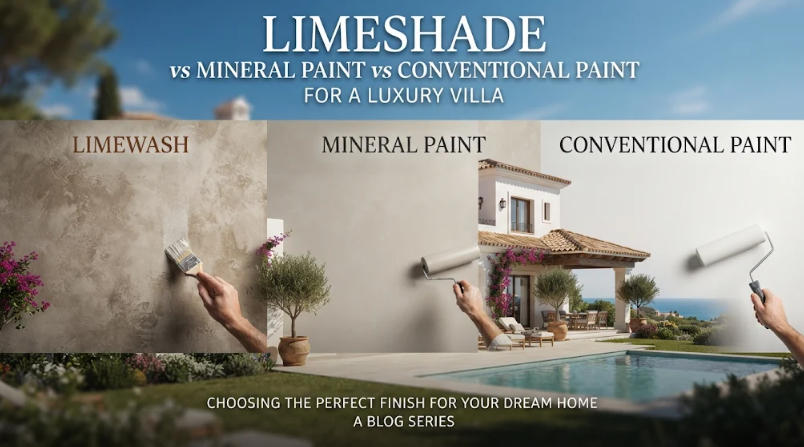
There is no single best paint system for an entire luxury villa. The right choice depends on the room, substrate, desired visual character, cleaning requirements, moisture exposure, vapor permeability, application method, maintenance expectations, and total project budget.
A common procurement mistake is treating wall coatings as a simple hierarchy where limewash equals luxury, mineral paint equals premium, and conventional paint equals budget. In practice, a well-specified conventional architectural coating is often the right engineering choice for heavy-use circulation zones, while limewash or silicate mineral paint belongs on specific focal walls and mineral substrates.
Defining the Three Paint Categories
These three coating categories are not chemically equivalent, nor do they bond to walls in the same way. Treating them as interchangeable colors on a swatch card leads to adhesion failures and unrealistic maintenance expectations.
Limewash
Traditional limewash is a mineral-based coating made primarily from slaked lime (calcium hydroxide) and water, often combined with natural mineral pigments and, in many modern commercial formulations, minor additives to improve workability or adhesion.
Unlike modern polymer paints that dry into a continuous plastic-like film on top of the wall, traditional limewash penetrates a porous mineral substrate and cures through carbonation—absorbing carbon dioxide from the air to revert into calcium carbonate (limestone). Because it absorbs unevenly depending on substrate suction and brush pressure, it produces a soft, chalky, matte finish with distinct tonal movement.
However, not every commercial product sold as “limewash” has the same formulation. Some contain acrylic binders to allow application over standard drywall, which alters both vapor permeability and surface sheen.
Mineral Paint
“Mineral paint” is a broad commercial category rather than a single chemical formula. True potassium silicate mineral paints (often referred to as Keim-type silicate systems) use liquid potassium silicate as a binder. When applied to an unpainted mineral surface such as cement render, lime plaster, or masonry, the silicate undergoes silicification—forming an insoluble chemical bond with the substrate itself rather than sitting on top of it.
Other products marketed under the “mineral paint” umbrella use sol-silicate formulations (a blend of silica sol and potassium silicate designed to adhere to both mineral and certain previously painted surfaces) or hybrid mineral-acrylic dispersions. Because performance varies widely across binders, you must verify the actual Technical Data Sheet (TDS) rather than relying on the category name.
Conventional Paint
In architectural specification, conventional paint refers to modern water-based emulsion coatings, typically built on pure acrylic, styrene-acrylic, or vinyl-acrylic polymer binders. When applied, the water evaporates and the polymer particles coalesce into a continuous, uniform film over the primer.
“Conventional” does not mean low-grade. High-end architectural acrylic coatings are engineered for strict color consistency, controlled sheen levels (from dead-flat to eggshell and satin), high scrub resistance, stain blocking, and reliable adhesion across gypsum drywall, wood trim, primed metal, and previously painted surfaces.
Core Comparison Framework
Because each manufacturer formulates products differently, the comparison below reflects general material tendencies rather than universal standards. Specific performance metrics must always be verified against the manufacturer’s TDS.
| Specification Factor | Limewash | Mineral Paint | Conventional Premium Paint |
| Visual character | High tonal variation and brush movement | Usually more controlled, velvety mineral look | Highly uniform and consistent |
| Matte appearance | Excellent (deeply chalky, zero glare) | Excellent (dead-flat to low mineral sheen) | Depends on product (available from flat to satin) |
| Vapor permeability | Generally very high (in traditional formulations) | Often high, depending on binder system | Depends on formulation (typically lower than pure mineral) |
| Washability & scrub resistance | Usually limited unless sealed (sealing alters look) | Product-specific (silicates resist weathering well, variable wet scrub) | Often the strongest option for frequent wet cleaning |
| Substrate sensitivity | High (typically requires porous, sound mineral base or specific mineral primer) | Medium to high (depends on pure silicate vs. sol-silicate) | Usually more flexible across drywall, plaster, and existing paint |
| Application sensitivity | High (requires skilled wet-edge brushing and technique) | Medium (requires consistent wet-on-wet application) | Lower (standard roller or airless spray application) |
| Color consistency | Lower (intentional batch and application variation) | Generally good (high UV and mineral pigment stability) | Generally strongest (tight batch-to-batch tinting control) |
| Maintenance & touch-up | More specialized (spot touch-ups often flash) | Product-specific (re-coating full wall plane often preferred) | Generally easier to touch up and repaint |
| Primary villa role | Decorative focal walls and low-contact living spaces | Exterior facades, mineral plasters, refined matte interiors | Corridors, staircases, kitchens, service areas, uniform ceilings |
Where Limewash Actually Makes Sense in a Luxury Villa
Limewash is an aesthetic and material choice, not a universal upgrade. Its value lies in how the surface interacts with architecture and natural light.
In large private residences, standard flat paint on a 6-meter-high living room wall can look overly synthetic or sterile, especially when raked by afternoon sunlight through floor-to-ceiling glazing. Limewash diffuses that light softly. Because absorption varies slightly across the plaster and each overlapping brush stroke deposits a slightly different thickness of lime and mineral pigment, the wall develops subtle depth that shifts throughout the day.
Suitable villa locations for limewash include:
- Double-height living room walls: Softens massive vertical wall planes without requiring heavy architectural paneling.
- Master bedrooms and private studies: Creates a calm, non-reflective atmosphere where wall contact is minimal.
- Dining rooms and formal lounges: Works well in Mediterranean, organic modern, wabi-sabi, or limestone-heavy interior palettes.
- Architectural fireplace surrounds and niches: Highlights recessed volumes and shadow lines.
Where Limewash May Be the Wrong Choice
Specifying limewash in the wrong zone creates immediate post-handover frustration. Unsealed traditional limewash has low resistance to friction and wet wiping. If someone brushes past a narrow hallway with a suitcase or wipes a fingerprint off a wall with a damp microfiber cloth, the surface can burnish, chalk onto clothing, or leave a permanent dark water mark.
Avoid or carefully reconsider limewash in:
- High-traffic corridors and stairwells: Frequent hand contact and brushing will wear down the mineral surface quickly.
- Kitchens and dining splash zones: Cooking oils, wine splashes, and food stains penetrate porous lime coatings and cannot be scrubbed out easily.
- Children’s bedrooms and playrooms: High impact and frequent cleaning demands make unsealed limewash impractical.
- Bathrooms and shower splash zones: Direct water contact causes temporary darkening and eventual erosion unless protected with specialized sealers—which often darken the color and introduce a plastic sheen that defeats the purpose of limewash.
- Projects requiring invisible spot touch-ups: Because limewash relies on organic brush movement and batch absorption, touching up a single scuff mark mid-wall almost always leaves a visible patch; usually, the entire wall corner-to-corner must be recoated.
- Poorly prepared drywall: Applying traditional limewash directly over standard paper-faced gypsum board with uneven joint compound suction results in unsightly blotching unless a dedicated mineral quartz primer is applied first.
Where Mineral Paint Fits Better
When a villa owner or architect wants the authentic, glare-free matte aesthetic and mineral composition of limewash—without the heavy cloudiness, chalking, or unpredictable brush streaks—mineral paint is often the stronger specification.
Silicate and sol-silicate mineral paints deliver a crisp, uniform, ultra-matte surface that retains a subtle crystalline depth under natural daylight. Because mineral pigments (such as iron oxides and earth pigments) are inorganic, they resist UV fading far better than many organic colorants, making mineral paint particularly reliable in sunlit rooms with large glass facades.
Mineral paint fits well when:
- You want a refined, uniform matte look: It bridges the gap between artisanal texture and contemporary minimalism.
- Substrates are mineral-based: On lime-cement plaster, skim-coated masonry, or exterior render, potassium silicate chemically bonds to the substrate, preventing peeling and blistering.
- High vapor permeability is needed on solid walls: In humid climates or thick masonry builds, mineral coatings allow trapped moisture vapor to escape without lifting the paint film.
- Better surface hardness is required: Depending on the specific product, commercial silicate interior paints offer noticeably better resistance to light dry rubbing than traditional limewash, though you must check the manufacturer’s wet-scrub rating before using them in high-wear areas.
As always, verify the TDS: a pure potassium silicate paint requires an unpainted mineral substrate, whereas a sol-silicate mineral paint can often be applied over sound existing dispersion paints without stripping the wall.
Where Conventional Premium Paint Is Actually Better
In high-end residential construction, luxury is better served by specifying the right technical performance for each room rather than forcing a single fashionable finish into every space.
A top-tier architectural acrylic coating is engineered to solve practical building problems that mineral coatings cannot address efficiently. When properly tinted and applied over a compatible primer, a high-grade matte or velvet-matte acrylic coating delivers clean architectural lines, consistent color across rooms, and reliable long-term serviceability.
Conventional premium paint is typically the better choice for:
- Corridors and transitional hallways: High-build, washable acrylic formulations resist scuffing and allow staff or homeowners to wipe away marks with mild detergent without altering the sheen.
- Staircases: Walls along stair treads take constant hand contact and furniture movement during move-in; durable scrub-resistant coatings hold up significantly better.
- Children’s bedrooms: Easy cleaning and straightforward future repainting matter more than artisanal tonal variation.
- Kitchen-adjacent walls and pantries: Grease-resistant, washable formulations handle routine wiping near prep zones.
- Service areas, staff quarters, and utility rooms: Standardized, cost-effective coatings simplify maintenance and keep project budgets focused on primary living areas.
- Large areas requiring strict color uniformity: When a minimalist interior relies on sharp shadow gaps, flush baseboards, and uninterrupted color planes, conventional coatings provide the highest predictability.
- Long-term facility maintenance: Five years after handover, repainting a damaged wall section is far simpler when the project manual lists a standard, documented architectural paint code.
Do Not Choose Paint by VOC Alone
Many villa owners default to filtering paint options strictly by “Zero VOC” or “Low VOC” labels. While low Volatile Organic Compound emissions are important for indoor air quality during and after installation, VOC content alone does not define coating quality or durability.
A low-VOC paint with weak binder resin may scuff easily, require three or four coats to achieve opacity, or fail under routine cleaning—forcing premature repainting that increases overall material use and disruption. Furthermore, depending on regional testing standards, a “zero-VOC” base paint may still gain measurable VOCs once dark or saturated colorants are added at the tinting machine.
When evaluating a coating for a residential project, weigh VOC data alongside:
- Wet-scrub resistance class (such as ISO 11998 Class 1 or Class 2 ratings, where applicable)
- Hiding power / opacity per coat
- Adhesion to the specific primer and substrate
- Color stability and resistance to burnishing
- Certification standards relevant to the project’s jurisdiction (e.g., French A+, Indoor Air Comfort Gold, GREENGUARD, or local equivalents)
Do Not Choose by “Breathability” Alone
“Breathability”—technically measured as water vapor permeability (often expressed as an $S_d$ value, where lower values indicate higher vapor diffusion)—is frequently oversold in residential paint marketing.
High vapor permeability is genuinely useful in solid masonry, stone, or lime-plastered walls that need to release absorbed humidity outward without blistering the paint film. However, a breathable paint does not solve an underlying building moisture problem.
If a villa wall suffers from:
- Rising damp due to a missing or failed damp-proof course
- Exterior facade cracks or failing window perimeter sealants
- Plumbing leaks behind wet walls
- Chronic condensation caused by thermal bridging or inadequate HVAC dehumidification
applying limewash or silicate mineral paint will not fix the defect. Moisture will continue to move through the wall, carrying soluble salts to the surface that cause efflorescence, powdery deposits, and coating failure. Always resolve waterproofing, drainage, and vapor barriers at the structural level before selecting the interior wall finish.
How to Choose by Room
The table below serves as a practical starting point for structuring a villa finish schedule. Final selections depend on the actual wall substrate, natural light exposure, and manufacturer TDS verification.
| Villa Area | Primary Functional Priority | Practical Coating Direction | Key Specification Check |
| Double-height living room | Visual depth under strong daylight; low glare | Limewash or mineral paint | Confirm scaffold access and wet-edge application plan |
| Master bedroom | Calm matte aesthetic; low physical wear | Limewash, mineral paint, or dead-flat premium acrylic | Verify primer compatibility with gypsum or plaster |
| Corridors & hallways | Frequent cleaning; scuff and impact resistance | Washable premium conventional paint (matte/eggshell) | Check wet-scrub rating and burnish resistance |
| Main staircase | High hand traffic; long-term durability | Durable washable conventional paint | Ensure batch consistency across multi-floor planes |
| Kitchen & prep areas | Grease and stain removal; frequent wiping | Scrubbable premium acrylic (low sheen / eggshell) | Avoid unsealed porous lime or chalky mineral finishes |
| Powder room | Decorative impact; moderate humidity | Product-specific (mineral paint or sealed decorative finish) | Verify splash resistance near vanity basin |
| Children’s bedrooms | Easy spot cleaning and future repainting | Washable premium conventional paint | Document exact color codes for future maintenance |
| Ceilings (general) | Eliminating roller marks and light glare | Dead-flat conventional ceiling paint or mineral matte | Prioritize long open time for large ceiling spans |
| Architectural feature walls | Tactile texture and intentional tonal movement | Limewash or textured decorative mineral plaster | Approve physical sample on site before bulk order |
A Villa May Need 3 Paint Systems, Not 1
Trying to force a single paint type into every room of a 1,000 m² residence either compromises durability in utility spaces or flattens the architectural character of main living zones. A well-structured villa finish schedule typically divides the interior into two or three complementary systems:
- System A — Decorative Limewash: Reserved for selected focal walls, double-height living areas, or master suites where natural light highlights tonal movement and physical contact is low.
- System B — Interior Mineral / Silicate Paint: Specified for large mineral-plastered walls, ceilings, or humid-climate masonry assemblies where a refined, uniform dead-flat finish and high vapor permeability are desired.
- System C — Premium Washable Architectural Acrylic: Applied throughout corridors, staircases, secondary bedrooms, kitchens, closets, and service areas where cleanability, scuff resistance, and straightforward touch-ups are essential.
Coordinating colors across these three systems requires physical sample matching rather than relying on digital Pantone or RAL codes alone, as identical pigment formulas reflect light differently in lime, silicate, and acrylic binders.
How to Specify the Paint in a Villa Finish Schedule
Vague finish schedules lead to inaccurate supplier quotations and disputes during installation. Compare how a typical interior design note translates into an actionable procurement specification:
Weak specification:
Living Room Walls — Warm White Matte Paint
Actionable specification:
Living Room Feature Walls (Grid A–D) — Traditional slaked-lime wash, warm off-white tone (custom match to approved control sample), dead-matte finish, 2–3 coats applied by cross-brush technique over manufacturer-specified mineral quartz primer on sound gypsum board. Physical sample board (min. 600 × 600 mm) on actual project substrate required prior to bulk production.
Weak specification:
Corridors & Staircase — White Washable Paint
Actionable specification:
Corridors & Staircase Walls — Premium water-based pure acrylic interior coating, velvet-matte sheen (≤5 GU at 60°), warm white, 2 finish coats over 1 coat alkali-resistant primer. Minimum ISO 11998 Class 1 wet-scrub resistance according to manufacturer TDS.
Note that coat counts, sheen angles, and scrub classes should always be confirmed against the chosen manufacturer’s technical documentation rather than assumed.
How to Compare Supplier Samples
Never approve a bulk paint order for a luxury villa based on a digital screen render, a tiny printed fan-deck chip, or a photograph sent over messaging apps.
For serious residential projects, require physical drawdowns or sample boards prepared using:
- The actual substrate (e.g., the specific gypsum board, cement skim coat, or lime plaster used on site)
- The actual primer specified in the system
- The exact number of finish coats planned for installation
- The intended application tool (block brush, roller nap, or spray tip)
- Fully cured, dry panels (wet limewash and mineral paints appear significantly darker than their cured dry state)
For limewash especially, manufacturer application guides emphasize testing on the actual wall surface because final color depth and mottling depend heavily on substrate absorbency and painter technique. Evaluate all approved sample boards on site under both natural morning/afternoon daylight and the villa’s installed artificial lighting (e.g., 2700K or 3000K architectural LEDs) before releasing the bulk purchase order.
How to Compare Supplier Quotations
Comparing two paint quotations solely by container price—such as comparing one supplier’s 18-liter pail price against another’s—is misleading. Spreading rates, solid content, dilution ratios, and primer requirements vary significantly between lime, silicate, and acrylic systems.
To evaluate quotations fairly on a villa Bill of Quantities (BOQ), calculate the estimated material cost per finished square meter:
$$\text{Material Cost per m}^2 = \left( \frac{\text{Primer Cost}}{\text{Primer Coverage per m}^2} \right) + \left( \frac{\text{Finish Paint Cost} \times \text{Required Coats}}{\text{Finish Coverage per m}^2} \right) + \text{Wastage Allowance}$$
When comparing bids from multiple suppliers, line up these variables side by side:
- Base product unit price (per liter or per kilogram—note whether the product is sold by weight or volume)
- Mandatory primer cost and coverage rate (specialty mineral primers often cost as much as the topcoat)
- Number of coats required to achieve full hiding power or desired decorative depth
- Practical coverage rate (m²/L or m²/kg) adjusted for substrate porosity (rough plaster consumes noticeably more paint than smooth skim coat)
- Custom tinting / color-matching fees and minimum batch quantities
- Packaging durability for export transit (reinforced pails, palletization, and leak protection)
- International freight, volumetric/weight charges, and import duties
- Wastage allowance (typically 10%–15% depending on application method and surface texture)
What Technical Documents Should the Supplier Provide?
Before finalizing a supplier for a villa project, request a complete technical documentation package. While exact testing standards vary by country and product category, a credible manufacturer or supplier should be able to provide:
- Technical Data Sheet (TDS): Details binder chemistry, theoretical spreading rate, recommended wet/dry film thickness, dilution limits, drying/recoat intervals, and substrate preparation rules.
- Safety Data Sheet (SDS / MSDS): Lists chemical hazards, handling precautions, and transport classification (critical for sea or air freight clearance).
- System Primer & Compatibility Guide: Confirms which primer must be used over gypsum board, cement render, or existing coatings.
- Performance Test Reports (where applicable): Independent or factory test data for wet-scrub resistance, water vapor permeability ($S_d$ value), adhesion, or fire reaction rating.
- VOC & Environmental Compliance Data: Test reports verifying VOC content or indoor air quality certifications required in the destination country.
- Application Instructions: Specific guidance on ambient temperature/humidity limits, tools, and wet-edge maintenance.
- Batch & Shelf-Life Information: Storage temperature requirements (water-based and silicate coatings can be ruined if frozen in transit) and shelf life from manufacturing date.
Sourcing Villa Paint Systems From China
Sourcing architectural coatings and decorative mineral finishes from China can be practical when a villa project involves substantial wall area, multiple finish systems (such as combining custom limewash feature walls with large volumes of interior acrylics), custom color matching, or consolidated container shipping alongside other building materials.
However, sourcing from China is not automatically advantageous on every order. If a project only requires 10 pails of a standard color, standalone international freight and customs clearance can outweigh factory pricing. The real procurement test is whether the Chinese manufacturer can meet your technical specification, provide verifiable TDS/SDS documentation, reproduce custom sample boards accurately, package liquids safely for export sea freight, and deliver within your construction schedule.
How HSY Sourcing Supports Villa Paint Procurement
HSY Sourcing is not a paint factory; we operate as a Foshan-based procurement and consolidation partner for overseas residential and villa projects. When a homeowner, architect, or builder is sourcing materials from China, our role is to bridge the gap between design intent and factory execution:
- Supplier research and pre-screening: Identifying specialized decorative limewash producers and established architectural coating factories rather than relying on general trading listings.
- Technical specification translation: Communicating substrate details, primer requirements, sheen levels, and TDS expectations clearly to factory technical teams.
- Apples-to-apples quotation comparison: Normalizing bids by coverage rate, coat count, primer inclusion, and packaging rather than raw pail price.
- Sample board coordination: Arranging physical sample panels on actual substrates, inspecting them before dispatch, and shipping them to your project team for lighting approval.
- Pre-shipment inspection: Checking batch numbers, tint consistency, manufacturing dates, shelf life, and export palletizing before goods leave the factory.
- Warehouse receiving and container consolidation: Receiving paint orders at our Foshan warehouse and consolidating them safely into the same shipment as your custom kitchen cabinets, wardrobes, aluminum windows and doors, natural stone slabs, furniture, sanitary ware, and lighting.
Already Have Your Villa Drawings or Interior Finish Schedule?
If you are currently preparing procurement for a private villa build and have your floor plans, room schedules, interior finish schedules, 3D renders, or preliminary BOQ, you can share your wall finish requirements with the HSY Sourcing team.
We can review your room-by-room substrate and finish needs, identify which areas warrant decorative mineral systems versus durable architectural coatings, and coordinate sample boards and structured quotations from vetted Chinese suppliers alongside your wider villa material package.
Frequently Asked Questions
Is limewash better than conventional paint for a luxury villa?
Neither is universally better. Limewash provides soft tonal movement and a deeply chalky matte surface that works well on large, low-contact living room or bedroom walls. Conventional premium architectural paint provides superior scrub resistance, uniform color, and easy maintenance, making it better suited for corridors, staircases, kitchens, and utility zones.
Is mineral paint more durable than limewash?
In most architectural applications, yes. Silicate and sol-silicate mineral paints cure into a harder surface than traditional unsealed limewash, resist UV fading exceptionally well, and show less chalking when brushed against. However, wet-scrub resistance varies significantly between mineral paint brands, so you should check the manufacturer’s TDS before specifying it in high-wear areas.
Can limewash be used throughout an entire villa?
It is rarely practical to use unsealed limewash throughout an entire residence. High-traffic hallways, stairwells, children’s rooms, and kitchen walls experience frequent physical contact and wet wiping, which can burnish, stain, or wear down traditional limewash. Most villa projects restrict limewash to selected focal walls and low-traffic rooms.
Is mineral paint suitable for bedrooms?
Yes. Interior mineral paints are well suited for bedrooms because they offer a glare-free, dead-flat finish, strong color stability, and low odor once cured. Just verify whether the specific product requires a mineral primer if your bedroom walls are finished in standard gypsum drywall.
Is conventional acrylic paint considered suitable for luxury interiors?
Yes. High-end architectural acrylic coatings are widely used in luxury residential projects—particularly in contemporary interiors that require crisp, uniform color planes, subtle shadow gaps, and high durability in circulation areas. Specifying a top-tier washable matte acrylic in hallways while using limewash or plaster on feature walls is standard architectural practice.
What is the difference between limewash and silicate mineral paint?
Traditional limewash uses slaked lime (calcium hydroxide) as its binder, cures by carbonation, and creates an intentionally mottled, cloudy appearance with visible brush movement. Silicate mineral paint uses potassium silicate (or sol-silicate) as its binder, forms a chemical bond with mineral substrates through silicification, and produces a much more uniform, controlled matte finish.
Can limewash be applied over drywall or existing paint?
Traditional limewash cannot be applied directly over smooth gypsum drywall or standard acrylic paint because it needs a porous, absorbent mineral surface to bond properly. To apply limewash over drywall or existing paint, you must first apply a specialized mineral quartz primer recommended by the limewash manufacturer to create mechanical tooth and uniform absorption.
How should I compare paint quotations from Chinese suppliers?
Do not compare suppliers by bucket or pail price alone. Request the TDS for each product and calculate the total material cost per finished square meter by factoring in the mandatory primer cost, practical spreading rate (m²/L or m²/kg), required number of finish coats, custom tinting fees, and export packaging.
Should I approve a physical paint sample before ordering?
Yes. Digital color swatches and printed cards do not show how a coating absorbs into your specific wall substrate or reacts to your villa’s lighting. Always request a cured, dry physical sample board prepared with the exact primer, coat count, and application method intended for your project, and inspect it on site under both daylight and evening lighting before confirming bulk production.