
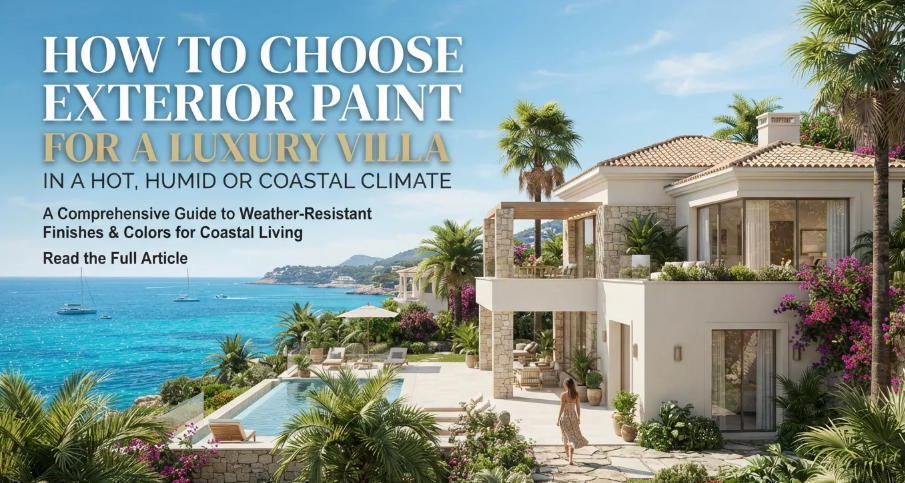
Selecting exterior paint at the procurement stage of a villa build is rarely a matter of picking a color swatch or defaulting to a well-known brand. When you already have architectural elevations, facade material schedules, and a Bill of Quantities (BOQ), the decision is technical: matching a complete coating system to the specific microclimates, substrates, and wall assemblies of the structure.
Exterior paint should be selected as part of a coating system for the specific building and climate, not simply by choosing a premium paint brand or a color that looks good in a rendering.
A single specification rarely works across different sites—or even across all elevations of the same villa. A dry inland property, a shaded tropical site, an exposed beachfront residence, and a multi-story coastal facade each subject the building envelope to different physical stresses. Reliable specification follows a clear sequence:
Climate → Exposure → Substrate → Surface preparation → Primer / intermediate coat → Topcoat → Finish → Application → Maintenance
Start With the Specific Climate, Not the Paint Brand
Project briefs often group “hot, humid, and coastal” into a single category, yet each environmental factor degrades a coating film in a distinct way. A villa may face one or several of these stressors simultaneously:
- Hot climates: High surface temperatures accelerate chemical weathering and drive thermal expansion and contraction across facade materials. Intense ultraviolet (UV) radiation breaks down binder polymers and degrades pigments over time.
- Humid climates: Persistent atmospheric moisture slows film curing and evaporation, creates condensation risks on cooler wall surfaces, traps moisture inside porous substrates, and encourages algae and mildew growth.
- Heavy-rain climates: Repeated cycles of saturation and drying test film adhesion, erode softer binders, exploit poor flashing details, and leave water-runoff staining beneath sills and parapets.
- Coastal environments: Airborne salt deposits settle on surfaces, wind-driven rain forces moisture into micro-cracks, high UV and humidity compound degradation, and salt spray accelerates corrosion on adjacent metal components.
Paint Does Not Fix a Building Moisture Problem
Before comparing coating formulations, verify the integrity of the underlying construction. The coating is the final layer of a building envelope system, not a substitute for correct waterproofing and drainage.
If a villa suffers from rising damp, leaking roof parapets, unsealed window perimeters, defective flashing, structural cracking, or inadequate drainage slopes, upgrading to a higher-grade exterior paint will not resolve the issue. Moisture trapped behind a paint film builds vapor pressure, leading to blistering, peeling, efflorescence, and delamination regardless of the topcoat’s price per liter.
Specify a Complete Coating System, Not a Standalone Topcoat
Evaluating exterior paint by comparing the USD-per-liter price of two topcoats leads to inaccurate budgeting and premature failure. A specification must account for the entire multi-layer build:
- Substrate: The structural wall or render material receiving the finish.
- Surface preparation: Cleaning, efflorescence removal, crack routing/filling, and moisture verification.
- Primer / sealer (where required): Stabilizes chalky or porous surfaces, blocks alkalinity in fresh cementitious substrates, and promotes inter-coat adhesion.
- Intermediate / build coat (where specified): Adds dry film thickness (DFT), levels minor surface irregularities, or provides elasticity.
- Exterior topcoat: Delivers UV resistance, weather protection, color, and sheen.
Two coatings with identical per-liter prices can have vastly different installed costs and lifespans if one requires a dedicated alkali-resistant primer and three coats at lower spread rates, while another requires two coats over a standard sealer. Evaluate suppliers on complete system coverage, dry film thickness, and total applied cost per square meter.
Match the System to the Villa’s Exterior Substrates
A villa’s elevations frequently combine multiple materials—such as sand-cement render over concrete block, cast-in-place concrete, stucco, mineral plaster, fiber cement boards, or previously painted masonry. A paint product that performs well on one substrate may not be the correct system for another.
Before issuing a purchase order, confirm the following parameters with the technical supplier for each substrate on your schedule:
- Substrate compatibility and alkalinity: Fresh cement render and concrete remain highly alkaline during curing, which can saponify incompatible binders.
- Moisture tolerance and curing window: Maximum allowable substrate moisture content prior to application, and required curing time for new plaster or concrete.
- Surface preparation and crack treatment: Required surface profile, cleaning protocols, and compatible elastomeric or cementitious fillers for hairline shrinkage cracks.
- Primer and coat count: Exact primer chemistry, recommended number of intermediate and topcoats, and wet/dry film thickness per coat.
- Application method: Suitability for airless spray, roller, or brush application under local site temperatures and humidity levels.
UV Exposure: What to Verify Beyond Marketing Claims
Intense sunlight degrades exterior coatings through photo-oxidation, causing color fading, binder chalking, loss of gloss, and eventual film embrittlement. Rather than relying on claims that a resin or pigment is “UV proof,” request verifiable technical data from the manufacturer—such as accelerated weathering test results (e.g., QUV exposure data) and pigment lightfastness ratings for your selected shades.
Color choice directly affects thermal performance. Dark architectural tones absorb significantly more solar radiation than light tones, raising facade surface temperatures. Higher surface temperatures accelerate polymer aging and increase thermal movement in the underlying render, making dark facades more prone to micro-cracking and visible fading over time.
Managing Humidity, Algae, and Mildew
In humid or tropical environments, biological growth—primarily green or black algae and mildew—is one of the most common causes of premature aesthetic failure. Growth is governed by moisture availability, surface temperature, ambient shade, surrounding landscaping, and surface texture (rougher textures trap airborne spores and hold water longer).
While modern exterior coatings incorporate in-film biocides and algicides, if the wall remains persistently wet, changing the paint alone is unlikely to solve the problem. Long-term resistance depends on architectural detailing—adequate roof overhangs, properly sloped window sills with drip grooves, and clean rainwater drainage—paired with a smooth, low-dirt-pickup coating formulation.
Coastal Villas: Salt Air and Adjacent Metalwork
Coastal exposure requires separating wall coating performance from metallic corrosion protection:
- Wall coating protection: Coastal masonry and render require coatings resistant to wind-driven rain, salt crystallization, and intense UV, along with scheduled freshwater washing to remove accumulated salt deposits under sheltered eaves where rain does not rinse the wall.
- Corrosion protection of metal components: Standard architectural wall paints are not corrosion-inhibiting metal primers. Aluminum window frames, steel railings, louvers, fasteners, and exterior light fixtures require dedicated marine- or coastal-grade metal coatings (such as PVDF fluoropolymer finishes or multi-coat epoxy/polyurethane systems) isolated from dissimilar metals to prevent galvanic corrosion.
Water Repellency vs. Vapor Permeability
Exterior wall assemblies must shed liquid rainwater while managing water vapor moving through the wall structure. A good exterior coating system must be compatible with the building envelope and moisture behavior of the wall.
- Water shedding: The topcoat must prevent liquid wind-driven rain from penetrating the facade.
- Vapor permeability: Many masonry, lime-based, and porous cementitious walls need to release internal moisture vapor outward. Applying a dense, low-permeability film over a wall assembly that retains moisture can trap vapor at the substrate interface, causing blistering and peeling.
Select a balance of liquid water resistance and water vapor transmission (measured via standard permeability ratings) appropriate for your wall construction and interior climate control.
Major Exterior Coating Categories
Rather than treating one chemistry as universally superior, match the binder system to the substrate and exposure:
- Acrylic-based exterior coatings: Pure 100% acrylic or styrene-modified acrylic emulsions offer broad color availability, predictable application, and reliable UV stability when properly formulated. They suit a wide range of primed cementitious and fiber-cement substrates.
- Elastomeric coatings: Formulated to create a thicker, flexible film capable of bridging hairline static shrinkage cracks in stucco or render. They are useful on wind-driven rain exposures when specified by the manufacturer, though they cannot bridge active structural cracks and typically have lower vapor permeability than standard acrylics.
- Mineral / silicate coatings: Potassium silicate and mineral-based coatings bond chemically with mineral substrates (such as bare cement render, concrete, and mineral plaster) and offer high vapor permeability and natural alkalinity. Note that not all “mineral-look” textured paints are true silicate coatings; verify the binder chemistry if breathability is a specification requirement.
- Specialty coatings (e.g., silicone-modified or fluoropolymer): Considered where extreme dirt-pickup resistance, high water repellency combined with vapor permeability, or extended color retention on high-exposure elevations justifies higher material cost.
Practical Color Selection for Hot Climates
Facade color influences solar heat gain, maintenance intervals, and visual longevity:
- Whites and warm off-whites: Reflect a high percentage of solar radiation, reducing surface thermal stress. Pure bright whites, however, can create harsh glare in tropical sunlight and show dust, soil splash, and algae streaks quickly.
- Light neutrals, warm greys, and beiges: Soften visual glare and mask airborne dust better than stark white while keeping solar absorption moderate.
- Dark architectural tones: Require high-stability inorganic pigments, careful verification of substrate thermal movement, and acceptance of higher maintenance visibility.
Do not approve final exterior colors from a digital screen or 3D rendering. Always apply physical brush-out or spray-out sample panels on site and inspect them in direct morning sunlight, midday glare, and shaded afternoon light.
Why Facade Orientation Matters
Different elevations of the same villa experience distinct microclimates depending on latitude, local solar path, and prevailing winds:
- High-sun elevations (such as west-facing facades in most regions, or south/north elevations depending on the hemisphere) endure peak afternoon heat and intense UV radiation, accelerating fading and thermal stress.
- Shaded elevations and enclosed courtyards dry slowly after rain or morning dew, creating higher risk for algae and mildew growth.
- Ocean-facing elevations absorb direct salt spray and wind-driven rain, whereas sheltered leeward walls accumulate unwashed salt deposits under overhangs.
Where exposure varies sharply across the building, your architect or consultant may specify different sheen levels, biocide packages, or topcoat systems for specific elevations.
Translating Architectural Drawings into a Coating Schedule
During procurement preparation, consolidate data from your architectural elevations, wall finish schedules, facade material schedules, and BOQ area takeoffs into a structured coating schedule. This gives suppliers an unambiguous technical brief for quoting.
| Code | Location | Substrate | Finish | Coating System | Special Requirement |
| EX-01 | Main sun-exposed facade | Cement render | Low sheen | Exterior acrylic or silicone-modified system | High UV and color retention |
| EX-02 | Shaded courtyard walls | Mineral plaster | Matte | High-permeability mineral / silicate system | Breathability and algae resistance |
| EX-03 | Ocean-facing elevation | Reinforced render | Low sheen | Coastal exposure system | Wind-driven rain and salt resistance |
| EX-04 | Perimeter & service walls | Cement render | Satin / low sheen | Standard exterior acrylic system | Washability and easy recoating |
(Note: This table is an illustrative framework; final system codes must be confirmed against your project’s wall details and manufacturer data.)
Supplier RFQ Checklist for Sourcing Exterior Paint from China
When issuing a Request for Quotation (RFQ) to architectural coating manufacturers or sourcing partners in China, require complete technical documentation alongside pricing so bids can be compared accurately on a system-by-system basis:
- Product Technical Data Sheet (TDS): Confirming binder type, volume solids, density, and recommended application parameters.
- Safety Data Sheet (SDS / MSDS): Required for international sea/air freight classification, customs clearance, and site safety compliance.
- Recommended Substrates: Explicit confirmation of compatibility with your project’s specific wall materials (e.g., cement render, concrete, fiber cement).
- Surface Preparation Requirements: Substrate moisture limits, pH/alkalinity limits, cleaning methods, and crack-filling specifications.
- Primer / Sealer Recommendation: Exact product name, dilution ratio, and compatibility with the specified topcoat.
- Number of Coats & Film Thickness: Recommended coat sequence along with wet film thickness (WFT) and dry film thickness (DFT) per coat.
- Theoretical and Practical Coverage: Spread rate in square meters per liter ($\text{m}^2/\text{L}$) at the specified film thickness so total liter quantities can be verified against your BOQ wall areas.
- Drying and Recoating Times: Touch-dry, recoat window, and full-cure times across relevant temperature and relative humidity ranges.
- Exterior Weathering & Test Data: Third-party or laboratory test reports covering water resistance, vapor permeability, alkali resistance, and scrub/wash resistance.
- UV & Color Retention Documentation: Accelerated weathering test data or pigment lightfastness specifications for your selected color codes, plus availability of physical draw-down samples prior to bulk production.
Coordinating Exterior Paint Procurement for Your Villa Project
If you are preparing a BOQ or material schedule for an overseas villa build, HSY Sourcing coordinates directly with vetted architectural coating manufacturers in China to match complete primer-to-topcoat systems to your drawings, verify technical data sheets, arrange physical color samples, and consolidate export shipments alongside your other facade and finishing materials. Share your architectural elevations, wall finish schedule, and project location to request a structured system review and quotation.