
Selling air fryers, blenders, or kettles on Amazon is high-reward, but it’s also high-stakes. Amazon doesn’t just “hide” your listing if things go wrong; they freeze your funds and ban your brand if they suspect your product is a fire hazard or your paperwork is fake.
Most sellers think a “Gold Supplier” badge on Alibaba is a safety net. It isn’t. To be truly “Amazon-Ready,” you have to look past the shiny photos and avoid these common Shunde factory traps.
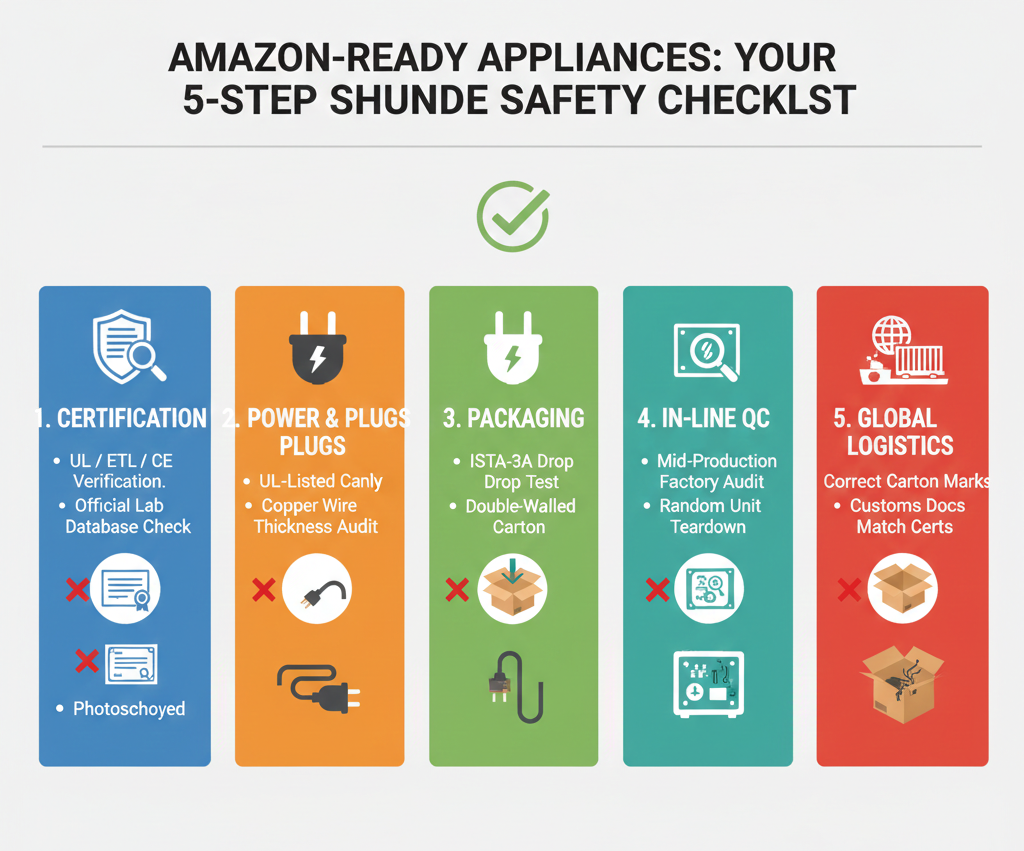
Are those certificates real or just Photoshopped?
This is the biggest hurdle. When you ask a Shunde factory, “Do you have UL or ETL for the US market?” they will always say “Yes” and send you a PDF.
The reality check:
- The Name Gap: Often, the certificate belongs to the factory’s other big customer, or it’s for an older model that looks similar but has different internals. If the name on the certificate doesn’t match your brand or the specific model number, Amazon’s AI will reject it instantly.
- The Expiry Trap: Factories sometimes stop paying the annual maintenance fees to labs like Intertek or SGS, meaning the cert is technically invalid.
- Our Process: We don’t just look at the PDF. We go to the testing lab’s online database and type in the number. If it doesn’t show up as “Active,” we don’t let you place the deposit.
Will your plug melt and trigger a 1-star review?
Amazon’s “Product Safety” bots are programmed to look for keywords like “smoke,” “burnt,” or “spark.” If a customer uploads a photo of a melted plug, your listing is dead within minutes.
The hidden shortcut: To save $0.30 per unit, some factories use power cords that aren’t truly UL-listed or have thinner copper cores than promised. These cords get soft and hot when the appliance runs for 30 minutes. When we audit a batch in Shunde, we don’t just look at the machine. We check the “UL” or “VDE” markings on the cable and physically cut a few open to make sure the copper thickness matches the safety spec.
Is your box tough enough for the FBA gauntlet?
Amazon FBA warehouses are not gentle. If you use “Supermarket Packaging”—the thin, pretty boxes meant for a retail shelf—your product will arrive at the customer’s house with a cracked plastic shell or a dented side.
- The Return Rate Death Spiral: If your return rate hits 5-10% because of shipping damage, Amazon will flag your account for “high defect rates.”
- The Solution: We insist on the ISTA-3A Drop Test. We take a finished unit, put it in its box, and drop it 10 times from about 3 feet at different angles. If the machine rattles or the box splits, we make the factory upgrade the cardboard and the internal foam before the container is loaded.
Does the mass production actually match the perfect sample?
Shunde engineers are brilliant at making a “Golden Sample.” It looks perfect, runs quietly, and feels premium. But during mass production, when the factory is trying to hit a deadline, quality can slip. A screw is missed, a solder joint is “cold,” or the plastic grade is slightly downgraded.
The real-world fix: We don’t wait until the container is full to check quality. We do an “In-Line” inspection. We show up when the factory is about 30% through the order. We pull machines right off the assembly line and take them apart. If we see the internals look messier than the sample, we stop the line right there. It’s much easier to fix 300 units in the factory than to deal with 1,000 bad units in an FBA warehouse.
FAQ: The Honest Truth About Amazon Electronics
Q: Can I start with an MOQ of 100 units to “test the market”?
A: Realistically, no. Most reputable Shunde appliance factories won’t turn on their assembly lines for less than 500 or 1,000 units. If someone offers you an MOQ of 50, they are likely a middleman buying from a wholesale market, which means you have zero control over the quality or certifications.
Q: What if Amazon asks for a Children’s Product Certificate (CPC) for a small kitchen gadget?
A: If the factory doesn’t have it, you’ll have to pay a lab to test it. Never try to forge these documents. Amazon verifies them with the labs. If you get caught, your account is permanently gone.
Q: Is it worth paying more for a “High-Spec” version?
A: On Amazon, yes. A 5% higher price at the factory is much cheaper than a 10% return rate and a banned account. We always advise our clients to spend the extra dollar on better motors and thicker plastic.