
For overseas real estate developers, hospitality groups, and general contractors managing multi-unit apartment or luxury villa projects, importing from China involves navigating a deeply fragmented supply chain. An average interior or structural specification sheet requires sourcing from multiple factories: porcelain tiles, custom kitchen cabinetry, bathroom vanities, sanitary fittings, aluminum doors, and loose furniture.
When an importer manages these vendors independently, ocean logistics quickly become inefficient. Shipping multiple small orders via public Less than Container Load (LCL) freight forces the importer into a cycle of high local transport fees, multiple customs declarations, and unpredictable destination Container Freight Station (CFS) handling surcharges. Furthermore, public LCL shipping exposes high-end project finishes to physical damage, as custom furniture or fragile glazed units are stacked alongside unrelated industrial freight.
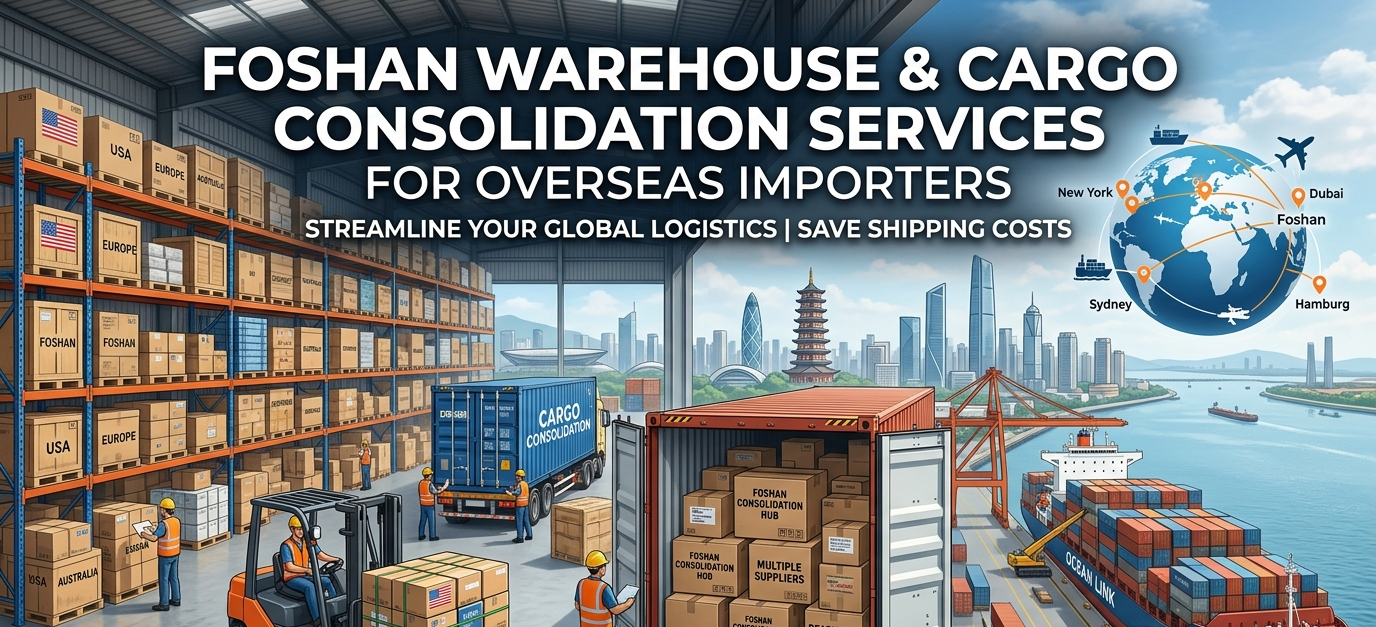
The operational solution is a centralized warehouse and cargo consolidation framework based directly in the Foshan manufacturing cluster. By establishing a localized staging hub, overseas buyers can securely collect cross-category building materials, inspect them under uniform standards, and merge them into optimized, single-destination Full Container Loads (FCL).
Key Takeaways
- Elimination of Destination CFS Fees: Consolidating separate vendor packages into a single FCL container bypasses the high-premium unpacking, sorting, and storage fees charged by public destination port stations.
- Volumetric Load Balancing: Mixing heavy architectural materials (ceramics and quartz) on the container floor with lightweight volumetric cargo (cabinetry and mattresses) on top maximizes both weight and space capacities.
- Unified Compliance Footprint: Combining multiple factory deliveries at a single warehouse allows for a single, comprehensive export customs declaration under consolidated Bill of Lading (B/L) terms.
Why do public LCL shipments increase the landed cost of project materials?
Public LCL shipping is structurally unsuited for high-volume, multi-vendor building material packages. When a factory delivers a partial order to a public consolidation port warehouse, the cargo is handled by general logistics laborers who lack specific knowledge of fragile interior finishes.
[Fragmented Vendor Shipments] ──> Public LCL Port Warehouse ──> Multiplied Customs Fees + Destination CFS Premium
[Centralized Warehouse Route] ──> Dedicated Foshan Staging ──> Single Customs File + Engineered FCL Container
The financial and physical risks of this model break down into three specific areas:
- Compounding Clearance Documentation Overheads: Each independent factory shipment requires a standalone export clearance filing in China and a corresponding import entry file at the destination port. Ten small vendor shipments mean paying ten sets of documentation fees, customs broker charges, and terminal handling invoices.
- High-Premium Destination CFS Surcharges: At the destination port, public LCL containers are routed to a physical warehouse to be un-stuffed and split. The labor rates for sorting mixed freight at Western or Middle Eastern ports are calculated on a premium per-CBM or per-kilogram basis, frequently exceeding the cost of the actual ocean freight leg.
- Uncontrolled Cargo Crushing: Public LCL containers are loaded purely based on the arrival sequence of the freight. Custom lacquered kitchen cabinets or upholstered hotel headboards may end up positioned directly beneath heavy industrial steel parts or un-palletized raw chemicals from unrelated shippers.
Utilizing a dedicated, project-specific warehouse in Foshan removes these variables. Importers pay for a clean, direct FCL ocean transit, maintaining absolute control over how their goods are handled from the factory line to the job site.
How does Foshan’s regional density lower internal warehousing and trucking costs?
A cargo consolidation strategy fails if the internal domestic trucking costs to bring goods to the warehouse surpass the ocean freight savings. Foshan is uniquely engineered to avoid this issue due to its hyper-concentrated industrial geography. Within a 30-to-50-kilometer radius of a central Foshan warehouse sits a dense network of global-scale manufacturing centers:
- Chancheng & Nanzhuang: Primary production zones for large-format porcelain tiles and sanitary ware.
- Shunde (Lecong): The world’s primary hub for contract furniture manufacturing, upholstery, and commercial millwork.
- Nanhai (Dali): The central hub for architectural aluminum extrusion, window assemblies, and glass doors.
Because these distinct product ecosystems share physical borders, local shuttle trucks can collect orders from multiple factories in a single morning. This proximity ensures that domestic logistics remain a nominal cost factor, making the consolidation warehouse an efficient collection center for the entire project BOQ.
What is the exact process of balancing weight and volume in a mixed container?
Professional cargo consolidation is a balancing act between a container’s physical volume limit and its legal maritime weight payload. A standard 40-foot High Cube (40HQ) container provides roughly 68 usable cubic meters (CBM) of space and a maximum safe weight limit of 26 to 28 metric tons.
Loading a single material category across an entire project creates severe spatial or weight inefficiencies:
| Material Characteristic | Single-Category Result | The Consolidation Solution |
| High Weight / Low Volume (e.g., Porcelain Tiles, Quartz Counters) | Container hits the 26-ton weight limit while 50% of the vertical air space remains empty air. | Palletized tiles are secured flat across the container floor to establish a low, stable center of gravity. |
| High Volume / Low Weight (e.g., Kitchen Cabinets, Sofas, Mattresses) | Container fills its 68 CBM volume while using less than 35% of its allowed weight payload. | Volumetric, flat-pack cabinetry and upholstered furniture are stacked into the upper air space above the tiles. |
By managing the intake of these materials at a single warehouse, loading teams can calculate precise weight-to-volume ratios before the ocean container arrives. This ensures you utilize nearly 100% of both limits, driving down the landed freight cost per unit for every material on your project list.
What operational staging sequence prevents delays and material damage?
Managing the convergence of goods from multiple suppliers requires a clear, milestone-driven operational flow inside the warehouse facility.
1.Receiving, Inventory Verification, and Moisture Auditing:Phase 1: Dockside Check-In.
As trucks arrive from various factories, our warehouse team unloads the cargo, verifies box counts against the project BOQ, and checks for external box damage. Wood components undergo a digital pin-meter check to ensure their moisture content matches the target equilibrium range of the destination country.
2.Secure, Category-Segregated Temporary Storage:Phase 2: Technical Buffer Staging.
Materials are assigned to specific, numbered racking bays dedicated to your project. Fast-producing items like porcelain tiles are stored in dry ground zones, safely buffered while waiting for long-lead items like custom millwork or aluminum windows to finish production.
3.3D Volumetric Load Calculation and Crate Reinforcement:Phase 3: Pre-Load Simulation.
Our logistics team inputs the final, physical dimensions and weights of all project crates into load-optimization software. Fragile items like custom glass panels or sintered stone vanities are audited to ensure they are packed in heavy-duty, fumigated wooden A-frames before loading begins.
4.Density-Stratified Loading and Customs File Assembly:Phase 4: Container Sealing.
The container is positioned at our dock. Heavy masonry forms the base, followed by rigid plywood dividers and protective dunnage airbags, with lightweight furniture placed on top. Simultaneously, individual factory packing lists are compiled into a single export declaration under uniform HS codes.
Why Choose HSY Sourcing for Your Warehouse & Consolidation in Foshan?
Overseas developers cannot reliably manage the physical realities of a warehouse dock via email. HSY Sourcing operates as your independent, on-the-ground engineering and logistics office in Foshan, representing your explicit commercial interests with zero factory markups.
- Dedicated Local Staging Facilities: We operate secure warehouse space directly within the Foshan industrial zone, designed to handle the sorting, tracking, and long-term storage of complex real estate BOQs.
- Cross-Category Technical Competence: Our team does more than count boxes. We inspect incoming materials at our receiving dock—cross-checking custom vanity finishes against tile shade runs and testing click-lock flooring profiles before items are cleared for storage.
- Comprehensive Custom Brokerage: Combining products from multiple factories means navigating complex local export profiles. We resolve this by compiling individual vendor invoices, managing local tax structures, and generating a single export customs declaration pack.
- Engineered Container Load Plans: We design custom loading patterns for every container, ensuring that heavy architectural finishes are structurally isolated from delicate interior furnishings to eliminate shifting and breakage during rough ocean transit.
Frequently Asked Questions (FAQ)
How long can our project materials be stored in your Foshan warehouse while waiting for other factories?
We provide flexible storage windows tailored to your project’s assembly schedule. Because we synchronize production timelines during the procurement phase, we aim to minimize holding times. However, if a specific factory faces an unavoidable delay, your early-completed building materials can be securely stored in our dry racking bays until the complete shipping volume converges.
How do you handle export customs clearance when a container contains goods from ten different factories?
Different manufacturers in China operate under different export tax profiles. Some have direct export licenses, while others require domestic invoicing. HSY Sourcing manages this complexity behind the scenes: we legally merge the diverse packing lists, classify each item under its correct Harmonized System (HS) code, and generate a single consolidated export declaration that complies with maritime laws.
What happens if we discover damaged packaging or wrong specifications upon warehouse receipt?
If an item arrives at our warehouse dock with damaged packaging or incorrect dimensions, we immediately halt the check-in process. We document the issue with high-resolution photos and video, file an immediate claim with the manufacturing factory, and coordinate local transport to return the defective batch for remanufacturing before the primary container loading date arrives.
Can your warehouse team handle fragile materials like large-format sintered stone panels?
Yes. Large-format sintered stone and natural marble slabs are highly vulnerable to cracking from structural flexing during ocean transport. We mandate that factories secure these products in heavy-duty, enclosed wooden A-frame crates. Inside the shipping container, these frames are loaded vertically along the steel sidewalls and lashed down with high-tensile structural strapping to prevent any shifting during rough sea transit.