
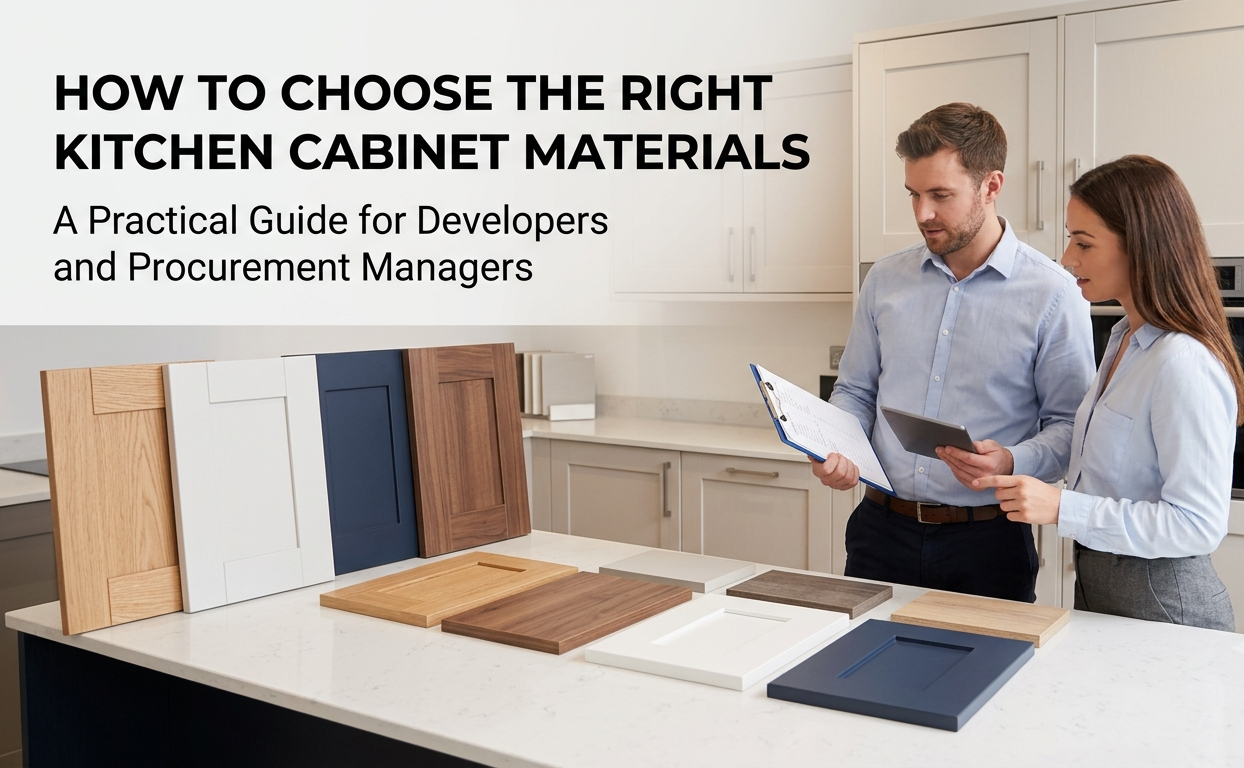
Selecting kitchen cabinet materials for commercial real estate, hotels, or residential developments isn’t just about aesthetics. It directly impacts your project budget, installation timeline, maintenance costs, and long-term tenant or guest satisfaction.
With hundreds of material combinations available—from particle board and marine plywood to PET finishes and natural wood veneers—making the wrong specification choice can lead to swollen boards, peeling edges, or unexpected budget overruns.
This guide breaks down cabinet core materials, surface treatments, and practical selection criteria based on real-world engineering standards and commercial procurement requirements.
Key Takeaways
- Carcass vs. Door Finishes: Always evaluate the cabinet box (carcass) and the door panel separately. A strong moisture-resistant carcass paired with a durable door finish yields the best return on investment.
- Plywood for Moist Environments: Plywood outperforms other engineered woods in water resistance and screw-holding strength, making it ideal for sink units, coastal developments, and high-end hotels.
- Particle Board (MFC) for Multi-Family Budget Efficiency: High-density moisture-resistant particle board remains the standard choice for large-scale apartment projects where cost per unit is the primary constraint.
- PUR Edge Banding is Non-Negotiable: For commercial projects, specify PUR (Polyurethane) or laser edge banding rather than traditional EVA glue to prevent seam lines and moisture penetration.
What Are the Core Materials Used for Kitchen Cabinet Carcasses?
The cabinet carcass (the interior box) provides structural integrity and load-bearing capacity. The four main base materials used in commercial cabinetry manufacturing each serve specific performance tiers and budget levels.
+-------------------+----------------------+--------------------+---------------------+
| Material          | Moisture Resistance  | Screw Retention    | Best Application    |
+-------------------+----------------------+--------------------+---------------------+
| Plywood           | High                 | Excellent          | Hotels, Villas, Sinks|
| Particle Board    | Low to Medium (MR)   | Moderate           | Apartments, Bulk RFQ|
| MDF               | Low                  | High (Smooth surface) Unframed Lacquer Doors|
| Solid Wood        | Medium (Climate dep.)| High               | Luxury Villas       |
+-------------------+----------------------+--------------------+---------------------+
1. Plywood (Multi-layer Board)
Plywood is constructed by bonding thin layers of wood veneers together at right angles.
- Pros: High structural strength, excellent resistance to moisture expansion, and superior screw-holding ability. It does not sag easily under heavy stone countertops.
- Cons: Higher material cost than particle board.
- Best For: Hotel guest suites, luxury villas, coastal projects, and the specific cabinet unit underneath the kitchen sink.
2. Particle Board / Chipboard (MFC)
Made from wood chips bonded with resin under heat and pressure. Melamine-faced particle board (MFC) is widely used in commercial developments.
- Pros: Cost-effective, lightweight, flat surface, and highly efficient to process in mass production.
- Cons: Poor performance if submerged in water unless specified with Moisture-Resistant (MR/Green core) additives.
- Best For: Large-scale apartment complexes, student housing, and budget-conscious residential developments.
3. Medium-Density Fiberboard (MDF)
MDF is produced by breaking down hardwood or softwood residuals into fine wood fibers, combined with wax and resin binders.
- Pros: Perfectly smooth surface with no wood grain texture, ideal for routed panel designs and painted/lacquered finishes.
- Cons: Heavy, and absorbs water rapidly if the edges are exposed or improperly sealed.
- Best For: Decorative cabinet doors, routed shaker doors, and curved architectural joinery.
4. Solid Wood
Natural timber such as oak, walnut, maple, or teak.
- Pros: Unmatched natural texture, premium feel, and long service life if properly maintained.
- Cons: High cost, vulnerable to swelling or cracking in high-humidity or dry climates due to natural thermal expansion.
- Best For: Ultra-luxury private villas, boutique heritage hotels, and high-end executive suites.
Which Surface Finish Delivers the Best Performance and Aesthetics?
Once the structural core is selected, the outer finish determines scratch resistance, cleanability, UV stability, and overall design appeal.
Melamine & High-Pressure Laminate (HPL)
Paper saturated with melamine resin pressed onto a substrate. HPL is a thicker, high-durability variant.
- Characteristics: Highly scratch-resistant, uniform color, wide range of wood-grain and stone textures.
- Ideal Project Use: High-traffic rental apartments, student housing, and mid-tier hotel kitchenettes.
PET & Acrylic Panels
Thermoplastic sheets laminated over MDF or plywood cores.
- Characteristics: Available in super-matte or ultra-glossy surfaces. Highly fingerprint-resistant (especially anti-fingerprint PET), eco-friendly, and smooth to the touch.
- Ideal Project Use: Modern luxury apartments and urban high-rise developments seeking a minimal, handleless design.
Lacquer / 2-Pack Spray Paint
Multiple coats of polyurethane paint applied to MDF panels and baked dry.
- Characteristics: Seamless edges (no edge-banding lines visible), rich color depth, available in matte, satin, or high-gloss.
- Ideal Project Use: High-end residential villas, luxury hotel residential units, and custom shaker-style kitchens.
Natural Wood Veneer
A thin slice of real timber laminated onto an MDF or plywood core, finished with a clear protective coat.
- Characteristics: Offers the authentic look and feel of solid wood at a fraction of the cost and with greater dimensional stability.
- Ideal Project Use: Upscale villa developments, executive suites, and premium interior fit-outs.
How Do You Select Cabinet Materials Based on Project Type?
Procurement decisions should align with project lifecycle demands, climate conditions, and intended asset use.
For Hotel Projects
Hotels require low-maintenance surfaces that withstand frequent housekeeping cleaning cycles.
- Recommended Combination: Plywood carcass + PET or HPL doors + PUR edge banding.
- Key Consideration: Specify soft-closing heavy-duty hardware (such as Blum or DTC) rated for high-frequency daily usage.
For Apartment Complexes & Real Estate Developments
Multi-unit projects demand strict cost control per unit without compromising move-in quality or tenant durability ratings.
- Recommended Combination: Moisture-resistant Particle Board (E0 grade) carcass + Melamine or PET door panels.
- Key Consideration: Standardize module sizes across units to lower production costs and speed up on-site installation.
For Private Villas & High-End Luxury Homes
Luxury projects prioritize custom detailing, unique finishes, and premium materials.
- Recommended Combination: Marine Plywood or Solid Wood carcass + Natural Wood Veneer or Lacquer doors.
- Key Consideration: Integrate internal hardware systems like pull-out larders, motorized lift doors, and concealed LED channel lighting.
What Technical Specifications Should You Check Before Ordering in Bulk?
When issuing an RFQ or placing a bulk manufacturing order, ensure your technical spec sheet includes the following parameters:
- Environmental & Formaldehyde Emission Standards: Specify E0 Grade or CARB P2 compliance to meet international indoor air quality regulations for commercial hospitality and residential occupancy.
- Edge Banding Technology: Always request PUR (Polyurethane) adhesive or Laser edge banding. Standard EVA hot-melt glue breaks down faster when exposed to heat near ovens or humidity around dishwashers.
- Hardware Durability Ratings: Confirm hinges and drawer runners pass salt-spray tests (minimum 48 to 72 hours) to prevent rusting, especially for coastal developments.
Why Source Your Custom Kitchen Cabinets with HSY Sourcing?
Navigating raw material selection, factory verification, quality control, and shipping logistics from overseas can be challenging for developers and overseas procurement teams.
Based in Foshan, China—the global manufacturing hub for furniture, cabinetry, and interior building materials—HSY Sourcing serves as your dedicated local sourcing partner and quality assurance office on the ground.
- Direct Access to Foshan Manufacturing Clusters: We connect you directly with specialized cabinetry factories capable of handling large-scale OEM/ODM project specifications, skipping unnecessary middleman markups.
- Strict Material Verification & Quality Control: Our team inspects raw panel density, formaldehyde test reports, edge-banding seam tightness, and pre-assembly hardware alignments before goods leave the factory floor.
- One-Stop Freight & Cargo Consolidation: Beyond kitchen cabinets, we consolidate your entire building material order—including doors, windows, sanitaryware, tiles, and loose furniture—into unified container shipments to lower ocean freight costs and streamline customs clearance.
- Project-tailored B2B Service: We work directly from your architectural floor plans and BOQs (Bill of Quantities) to supply shop drawings, 3D renderings, and physical material samples for client approval prior to mass production.
Frequently Asked Questions
What is the most durable material for a kitchen cabinet carcass?
Plywood is widely considered the most durable carcass material due to its cross-laminated construction, high moisture resistance, and superior screw-holding strength compared to MDF or particle board.
What is the difference between EVA and PUR edge banding?
EVA (Ethylene-Vinyl Acetate) uses a hot-melt glue that can re-soften under heat and moisture, leaving a visible seam line over time. PUR (Polyurethane) forms a chemical bond that is heat-resistant, waterproof, and creates an almost invisible joint line, making it much more suitable for commercial projects.
Is particle board acceptable for commercial apartment projects?
Yes, provided it is high-density, moisture-resistant (MR) particle board that meets E0 or CARB P2 environmental standards. It is the industry standard for cost-effective multi-family housing developments worldwide.
How does HSY Sourcing ensure the quality of custom cabinet orders in Foshan?
We conduct on-site factory audits, verify raw material specifications against your contracted BOQ, perform sample approvals prior to mass production, and execute full pre-shipment inspections covering dimensions, finish quality, hardware smooth operation, and packaging stability.