
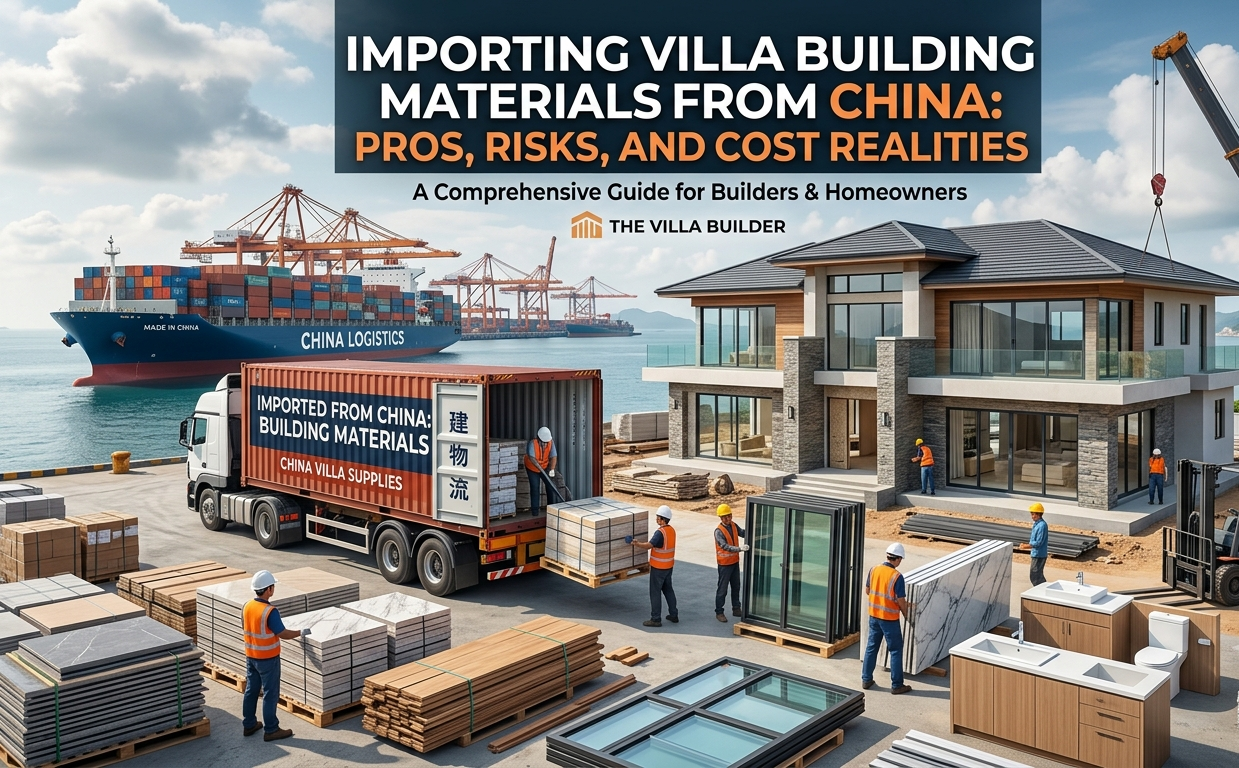
Directly importing building materials from China for a luxury villa project is a strategy increasingly adopted by real estate developers, general contractors, and private homeowners looking to manage high-end finish budgets. The potential savings are significant: purchasing architectural glass, sintered stone, custom joinery, and plumbing fixtures directly from manufacturing hubs can lower finishing material expenses by 30% to 45% compared to domestic retail prices.
However, importing is not a simple transaction. It transforms a standard retail purchasing process into an international supply chain operation involving lead-time management, factory vetting, technical drawing approvals, quality control, and customs clearance.
Evaluating whether importing fits your project requires weighing raw material savings against the operational complexity of managing remote production.
Key Takeaways
- Project Scale Threshold: Direct importing delivers the highest ROI on projects with a finishing material budget exceeding $80,000 to $100,000, where Full Container Load (FCL) freight efficiency offsets handling overhead.
- Customization vs. Off-the-Shelf: Importing from specialized hubs like Foshan allows complete customization of dimensions, profile thickness, surface textures, and hardware brands rather than relying on limited local distributor inventory.
- Core Risk Factors: Unverified factory dimensions, lack of pre-shipment inspection, and inadequate ocean freight crating represent the main causes of project delay and material loss.
- Role of Local Oversight: Partnering with an on-the-ground agent in Foshan converts fragmented multi-factory orders into a consolidated, quality-checked container shipment.
What Are the Real Financial and Customization Benefits of Importing Villa Materials?
The primary driver for sourcing from China is the gap between direct factory pricing and local distribution costs. Domestic building material showrooms carry heavy overhead, including local warehousing, importer margins, showroom leases, and sales commissions—all of which are passed on to the buyer.
Supply Chain Cost Comparison:
Traditional Retail: Factory Price -> Exporter -> Importer -> Distributor -> Showroom -> Buyer (+100% to +200% Markup)
Direct Sourcing:    Factory Price -> HSY Sourcing (QC & Consolidation) -> Direct Export -> Buyer (30% to 45% Savings)
Beyond cost reduction, direct factory access offers distinct advantages for high-end residential builds:
- Direct Access to Bespoke Sizing: High-end architectural designs often require non-standard dimensions—such as $3.2\text{-meter}$ floor-to-ceiling doors, oversized $1600\times3200\text{mm}$ sintered stone wall slabs, or custom motorized slim-line sliding glass systems. China’s custom manufacturing sector is set up specifically for short-run, made-to-measure orders.
- Material Grade Control: Sourcing directly allows architects to specify exact raw material grades, such as E0/ENF ultra-low formaldehyde plywood cores, 6063-T5 aluminum profiles ($1.8\text{mm}–2.0\text{mm}$ wall thickness), and premium brand hardware (e.g., Blum, DTC, Geberit).
- Freight Efficiency via Container Consolidation: A luxury villa requires products across 10 to 15 distinct manufacturing categories. Loading these items into consolidated 40ft High Cube containers maximizes space utilization and reduces freight cost per cubic meter ($m^3$).
What Are the Main Risks and Challenges When Sourcing Villa Materials Remotely?
While the economic advantages are clear, remote procurement introduces specific operational risks if the process lacks local management.
Primary Import Risks & Prevention Controls
 ├── Dimensional Mismatches  --> Prevented by: Factory CAD Shop Drawing Sign-Off
 ├── Quality & Color Drift  --> Prevented by: Physical Control Sample Approval & Batch Checks
 ├── Code Non-Compliance     --> Prevented by: Pre-Order Technical & Certification Review
 └── Transit Damage         --> Prevented by: Reinforced A-Frame Crating & Container Loading Supervision
1. Technical and Dimensional Discrepancies
Custom items like kitchen cabinets, vanities, and aluminum window frames are built to millimeter tolerances. If production relies on unverified preliminary architectural sketches rather than final on-site measurements, installed items will require expensive site modifications.
2. Quality and Batch Variations
In large-scale tile or stone production, slight variations in temperature or glaze chemistry between kiln runs cause color shade differences. Ordering from multiple unverified factories risks inconsistent finishes across open floor plans.
3. Regional Building Code and Standard Mismatches
Building components must comply with destination-country standards. Common pitfalls include ordering plumbing fixtures with incorrect thread pitches (NPT for North America vs. BSP for Europe/Australia) or lighting fixtures with non-compliant voltage drivers and safety certifications (e.g., UL, CE, SAA).
How Does the Foshan Custom Manufacturing Ecosystem Support Luxury Villa Projects?
Foshan, located in Guangdong Province, is recognized globally as the center for ceramic tile, sanitary ware, custom furniture, aluminum window systems, and interior millwork manufacturing.
Unlike general trading cities, Foshan operates as an interconnected industrial ecosystem where specialized manufacturing clusters are located within a 30-kilometer radius:
| Industrial District in Foshan | Primary Product Specialization | Key Manufacturing Advantage |
| Shiwan & Nanhai | Porcelain Tiles, Sintered Stone, Mosaics | World-leading large-format slab pressing and surface inkjet technology |
| Shunde (Lecong & Longjiang) | Custom Furniture, Cabinetry, Millwork, Doors | High-capacity OEM/ODM joinery plants using German woodworking machinery |
| Dali & Nanhai | Architectural Aluminum, Windows & Doors | Advanced thermal-break extrusion, anodizing, and PVDF coating facilities |
| Chancheng | Sanitary Ware, Faucets, Hardware | Solid brass casting, PVD physical vapor deposition coating, smart toilet assembly |
This geographic concentration makes Foshan ideal for villa procurement. An agent can visit multiple factories in a single day, inspect raw materials, verify mock-ups, and consolidate shipments from separate plants into one central warehouse.
Which Villa Material Categories Offer the Highest Return on Investment When Imported?
Not every material is suitable for ocean transport. Heavy, low-cost raw commodities (like standard red bricks or sand) are inefficient to ship. The highest cost savings occur in specialized, high-labor, or high-margin finishing categories.
ROI Hierarchy for Imported Villa Materials:
High ROI: Custom Windows, Sintered Stone, Custom Millwork/Cabinets, Sanitary Ware
Moderate ROI: Architectural Lighting, Exterior Cladding, Internal Doors
Low ROI: Standard Civil Raw Materials (Concrete, Rebar, Rough Timber)
1. Thermal Break Aluminum Windows and Slim Glazing Systems
- Typical Savings: 40% to 50%
- Why it works: Domestic European or North American aluminum window systems are extremely expensive. Foshan manufacturers produce high-performance thermal break profiles with Low-E double or triple glazing at a fraction of the cost.
2. Sintered Stone Slabs and Porcelain Tiles
- Typical Savings: 35% to 50%
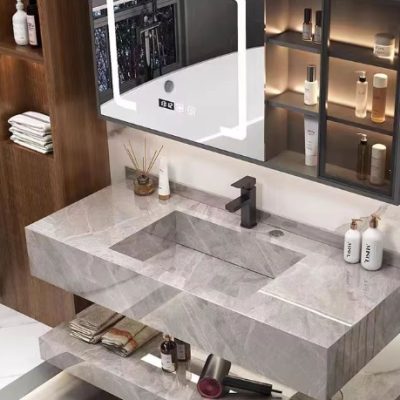
- Why it works: Large-format sintered stone ($1200\times2700\text{mm}$, $1600\times3200\text{mm}$) offers marble aesthetics with superior durability. Sourcing directly from Foshan tile manufacturers provides access to premium surface textures at factory-gate rates.
3. Custom Kitchen Cabinetry and Integrated Wardrobes
- Typical Savings: 30% to 42%
- Why it works: Millwork requires intensive assembly labor. Foshan joinery plants utilize automated CNC cutting to produce custom marine-grade plywood cabinetry, complete with soft-close hardware and integrated LED lighting, at competitive costs.
What Does a Safe and Reliable Sourcing Workflow Look Like Step-by-Step?
To prevent budget overruns and quality failures, procurement should follow a structured six-stage execution plan.
The 6-Stage Sourcing Workflow:
Phase 1: BOQ Audit & Specification Mapping
 └── Phase 2: Supplier Vetting & Quotation
      └── Phase 3: CAD Shop Drawing Approval
           └── Phase 4: Sample Sign-Off & Deposit
                └── Phase 5: Multi-Stage On-Site Quality Control
                     └── Phase 6: Warehouse Consolidation & FCL Loading
- Bill of Quantities (BOQ) Audit: Review architectural floor plans and finish schedules to define material quantities, structural loads, and performance criteria.
- Supplier Vetting: Match each product category with established tier-1 manufacturing facilities, bypassing non-manufacturing trading companies.
- CAD Shop Drawing Sign-Off: Require factories to convert architectural designs into millimeter-accurate production drawings for client sign-off before manufacturing starts.
- Physical Sample Verification: Approve physical control samples for wood veneers, metal finishes, glass tints, and stone textures.
- Multi-Stage On-Site Inspection: Conduct raw material checks, mid-production assembly verification, and 100% pre-shipment inspections before releasing final balance payments.
- Consolidated Container Loading: Collect completed orders at a central Foshan warehouse, inspect export packaging, and supervise container packing to maximize crate stability.
Why Partner with HSY Sourcing for Your Villa Project in Foshan?
Managing multiple specialized factories across different districts in Foshan requires technical knowledge, time, and a physical presence on the ground. HSY Sourcing acts as your direct technical procurement team in China.
1. Direct Local Presence in the Foshan Market
Based directly in Foshan, our team maintains daily working relationships with tier-1 manufacturers across ceramic, aluminum, furniture, and hardware sectors. We negotiate directly at factory-gate prices without intermediate agent add-ons.
2. Engineering and Technical Drawing Oversight
We do not simply place purchase orders; we review factory shop drawings against your architectural plans. Our team verifies structural tolerances, opening sizes, hardware compatibilities, and material specs to ensure error-free site assembly.
3. Strict Three-Stage On-Site Quality Control
We enforce rigid inspection gateways prior to balance payments:
- Raw Material Verification: Checking board formaldehyde grades (E0/ENF), aluminum extrusion wall thickness, and stone batch dye lots.
- In-Line Fitting Checks: Assembling trial cabinet modules and testing window seal tightness during production.
- Pre-Shipment & Packaging Audit: Inspecting finished goods and supervising the installation of protective A-frame crates for fragile items.
4. Complete Warehouse Consolidation and Export Management
HSY Sourcing operates a central warehouse in Foshan where goods from 10 to 20 different factories are collected, inspected, labeled, and loaded into 20ft or 40ft HQ containers. We manage export documentation, customs filings, and ocean freight logistics to deliver directly to your project site.
Frequently Asked Questions About Importing Villa Materials from China
What is the minimum project budget to make importing from China cost-effective?
Importing is most cost-effective when finishing material costs exceed $80,000 to $100,000. At this volume, total savings easily exceed international ocean freight, customs tariffs, insurance, and local port handling costs.
How do you ensure dimensional accuracy for custom joinery and window systems?
Every custom order relies on approved factory CAD shop drawings. We cross-reference these production drawings against your final site measurements (accounting for finished wall, floor, and ceiling tolerances) before factory production begins.
How long does the entire sourcing, manufacturing, and shipping process take?
Plan for a 3 to 4-month total window. Custom production (cabinets, doors, aluminum windows) takes 30 to 45 days after shop drawing approval. Ocean freight takes 15 to 20 days to the Middle East/Southeast Asia, and 25 to 40 days to North America, Europe, or Africa.
How are fragile items like large porcelain slabs or glass protected during ocean transit?
Large-format sintered stone slabs ($1600\times3200\text{mm}$) and glass panels are packed in heavy-duty fumigated wooden A-frame crates reinforced with corner padding and steel strapping. Our team directly supervises container loading to ensure proper weight distribution and tie-downs inside the container.