
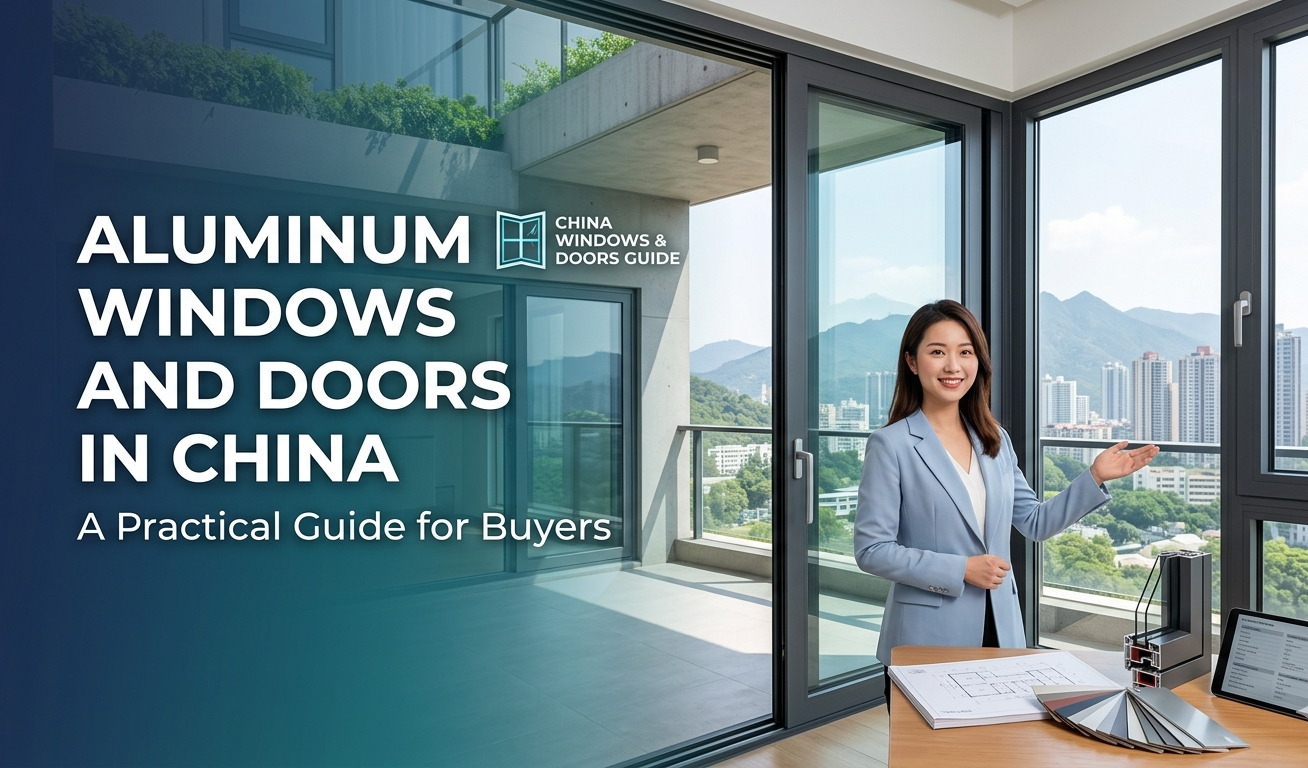
For developers and importers, the decision to source aluminum windows and doors from China is usually driven by the ability to access high-performance systems at a fraction of the cost of European or North American brands.
However, the Chinese market is not a monolith. You can find everything from “retail-grade” thin aluminum frames to “Passive House” certified systems. The success of your project depends on your ability to distinguish between these two tiers and manage the technical details that happen between the factory floor and the job site.
Why is the price difference so significant when sourcing from China?
The primary reason for the cost advantage isn’t just labor; it is the industrial cluster effect. In Foshan, Guangdong—the aluminum capital of the world—the entire supply chain is within a 20-mile radius. This includes aluminum extrusion plants, powder coating facilities, hardware manufacturers, and glass processing centers.
By sourcing directly from this hub, you eliminate the overhead of international brand markups. However, price should never be the only metric. If a quote is significantly lower than the market average, the factory is likely compromising on the “hidden” components: the wall thickness of the aluminum, the grade of the thermal break, or the quality of the internal gaskets.
What defines a “high-performance” aluminum system in the Chinese market?
In the context of 2026 construction standards, a “good” window is defined by its thermal efficiency and structural integrity. When reviewing factory profiles, look for these specific technical indicators:
- Aluminum Alloy Grade: Ensure the factory uses 6063-T5 aluminum. This is the industry standard for architectural strength and finish quality.
- The Thermal Break: If your project is in a climate with temperature extremes, a “thermal break” is mandatory. Verify that the strip is made of PA66GF25 (Polyamide). Cheaper PVC strips will become brittle over time, leading to frame failure and air leakage.
- Glazing Specifications: Don’t just ask for “double glazing.” Specify the thickness of the glass (e.g., 6mm + 12Argon + 6mm) and the type of Low-E coating. In 2026, warm-edge spacers are also becoming standard for preventing condensation.
- Hardware Vetting: Hardware is the first thing to break. If you aren’t using European brands like Roto or G-U, ensure you are using top-tier Chinese brands like KinLong or Hopo, which are tested for high cycle counts.
How can you verify quality when you aren’t at the factory?
Buying windows from 5,000 miles away involves risk. To mitigate this, you must move beyond emails and request objective evidence of quality:
- Cross-Section Samples: Ask the factory to send a physical cross-section of the frame. You can measure the wall thickness yourself with a caliper to ensure it matches the 1.4mm or 2.0mm specification.
- Third-Party Test Reports: Request the factory’s recent test reports for Air Infiltration (AAMA/ASTM) or U-Value (NFRC/CE). A factory that cannot provide original, verifiable lab reports is likely a trader, not a high-end manufacturer.
- Mock-up Inspection: For large projects, have one window produced to your exact size. Have a representative perform a “rain test” at the factory to check for drainage and seal integrity before mass production begins.
What are the logistical risks of shipping heavy aluminum and glass?
The manufacturing of the window is only half the battle. Aluminum frames are heavy, and glass is fragile. Standard bubble wrap is insufficient for international ocean freight.
- Crating Requirements: Windows must be packed in fumigated plywood crates or steel A-frames.
- Loading Supervision: In the container, windows must be secured vertically. If they are stacked horizontally, the weight of the frames will shatter the glass at the bottom of the stack.
- HS Code Accuracy: Different types of windows (with or without glass, aluminum vs. steel) have different import tariffs. Incorrect documentation can lead to customs delays or heavy fines in your home country.
Key Takeaways
- Cluster Advantage: Focus your search on Foshan, Guangdong for the best balance of quality and price.
- Technical Specifics: Specify PA66GF25 thermal breaks and 6063-T5 aluminum to ensure the windows last 20+ years.
- Hardware Priority: Never cut costs on hinges or rollers; these are the most common points of failure in aluminum systems.
- Logistics Matter: Plywood crating is a mandatory expense to prevent breakage during transit.
FAQ: Aluminum Windows & Doors
Q: Can I buy just a few windows for a home renovation?
A: Yes, but be aware that shipping and crating costs for 2 or 3 windows can be very high. Sourcing from China is most cost-effective for full villas, apartment blocks, or commercial developments.
Q: How do I know if the “CE” or “AS2047” certification is real?
A: Ask for the certificate number and the name of the issuing laboratory. You can usually verify these directly on the laboratory’s website.
Q: What is the average lead time?
A: Typically 30 to 45 days for production, plus 3 to 5 weeks for ocean shipping. For custom colors (RAL colors), add another 10 days for powder coating.
Why Choose HSY Sourcing for Your Window Project?
Buying windows in China is a technical challenge. One measurement error or a misunderstanding of the “Rough Opening” can result in a container full of unusable products.
HSY Sourcing acts as your engineering and quality control team on the ground in Foshan.
- Technical Drawing Review: We don’t just pass messages. We review your architectural drawings and cross-check them with the factory’s shop drawings to ensure the drainage, opening directions, and hardware specs are correct.
- On-Site Inspections: We visit the factory during production. We measure the actual aluminum wall thickness and witness the assembly of the thermal breaks to ensure no substitutions were made.
- Expert Logistics: We supervise the container loading. We ensure that your fragile glass and heavy frames are crated and secured vertically for the long journey overseas.
- Radical Transparency: You get unedited video reports and factual data. If a factory is cutting corners, Ando and our team will tell you immediately.