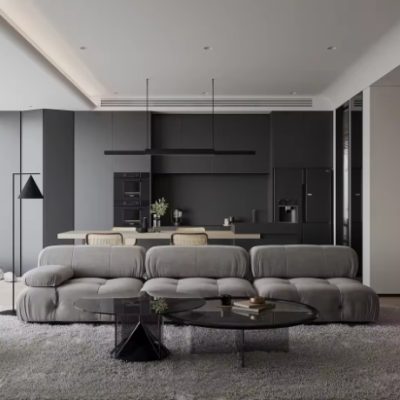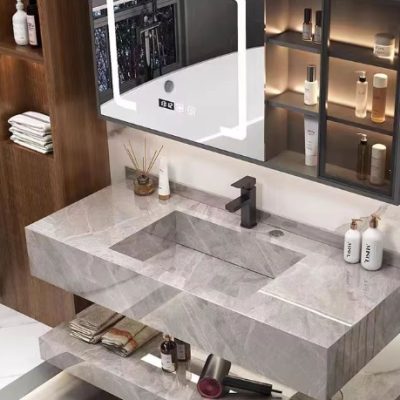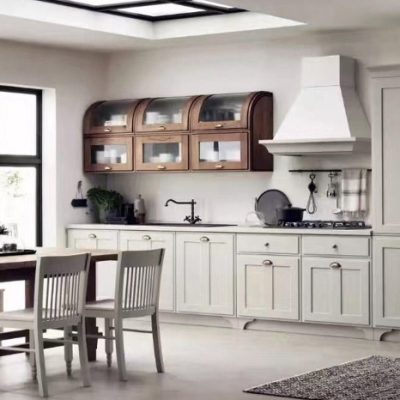

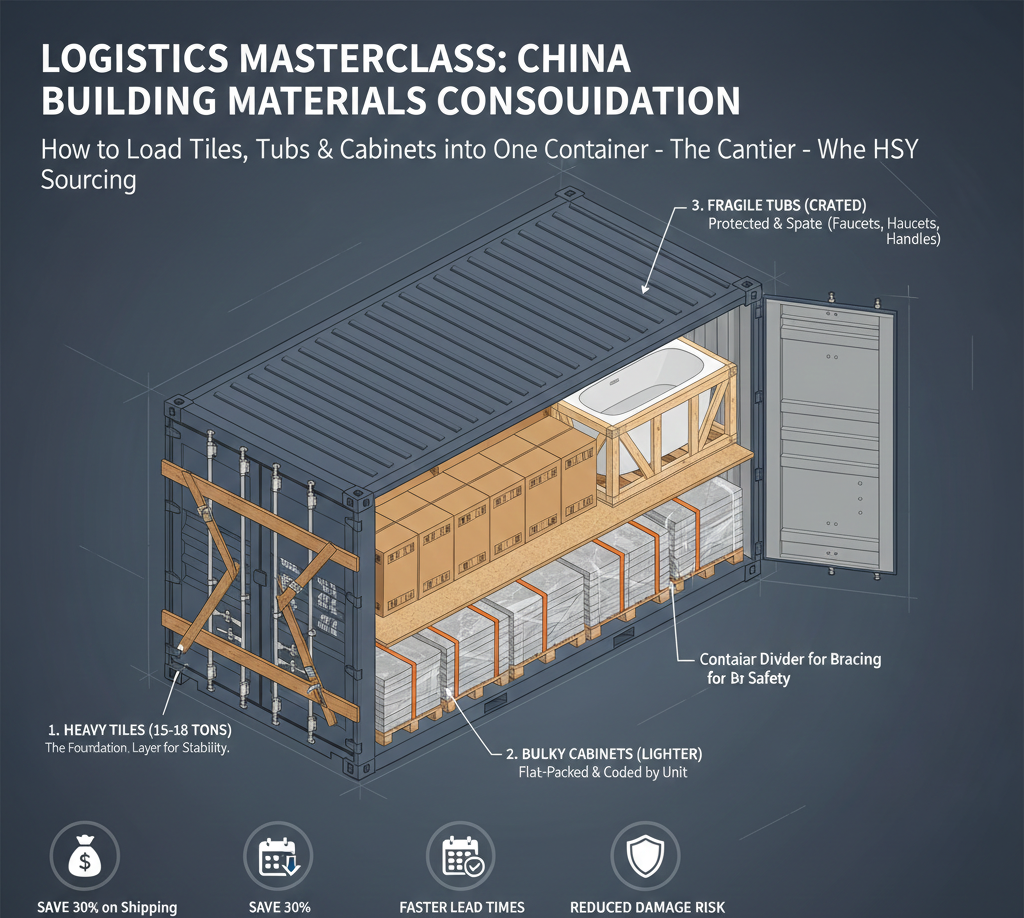
If you are managing an apartment development or running a building material wholesale business, you have likely heard the tempting pitch: “Go to Foshan, China. You can buy all your tiles, tubs, and cabinets in one place for a third of the price back home.”
It sounds like a dream. But as a sourcing agent who actually lives and works in Foshan, let me throw a bucket of cold water on that dream for a second.
Importing building materials from China is not like buying something on Amazon. When you deal with multiple factories—a tile factory, a bathtub factory, and a cabinet factory—you aren’t just facing a “buying” problem. You are facing a massive “Consolidation” puzzle. If you get it wrong, you end up with shattered tiles, crushed vanities, and a massive bill for project delays.
Today, I’m not going to talk about “global supply chains” or “synergy.” I’m going to tell you the raw, honest truth about how to actually get tiles, tubs, and cabinets into the same container safely and profitably.
Why is “Consolidation” the only way to make a project profitable?
If you are a billionaire building 1,000 homes and ordering 50 containers of just tiles, you don’t need this guide. But for the rest of us—developers doing 20-unit apartments or medium-sized wholesalers—you usually need a mix.
If you ask the tile factory to ship your tiles and the cabinet factory to ship your cabinets separately, your local trucking fees and customs clearance fees will double. Even worse, tiles are heavy. If you only ship a container of tiles, you will hit the weight limit (around 27 tons) while the container is still half empty at the top.
This is the logic of consolidation: We use the “heavy” tiles and the “light” cabinets or tubs to complement each other. The tiles go on the bottom, and the cabinets go on top. You use 100% of the weight limit and 100% of the space. That saved shipping cost goes directly into your net profit.
How do you solve the “Weight vs. Volume” calculation trap?
In the logistics world, this is called “balancing the load.” If you don’t have experience, it’s easy to make a expensive mistake.
A 40ft High Cube (40HQ) container has a weight limit of roughly 26 to 28 tons. Tiles are incredibly dense. If you buy 25 tons of tiles, that container is “full” in terms of weight, even though it looks empty.
Here is how we do it in the real world: We advise clients to limit tiles to about 15-18 tons. This covers the floor of the container to a height of about 30-40 cm. We then use the remaining “airspace” for cabinets and tubs. Cabinets take up a lot of room but don’t weigh much. Bathtubs (especially acrylic ones) are basically big boxes of air.
If you don’t have an agent coordinating this, the tile factory will tell you they can fill a whole container, and the cabinet factory will say the same. You’ll end up paying for two expensive shipments when you only needed one. Our job is to calculate this exact ratio before you even pay your deposits.
Why are different “Lead Times” the biggest logistics nightmare?
This is what drives overseas contractors crazy.
- Tiles: If they are in stock, they can be ready in 7-10 days.
- Bathtubs: Usually take 20-25 days to produce.
- Cabinets: Since they involve measurements, shop drawings, and custom cutting, they take 45 days or more.
If you don’t have a central warehouse, here is what happens: The tile factory screams at you to pick up your goods because they need the warehouse space. Meanwhile, the cabinet factory hasn’t even started cutting the wood.
Our Solution: We provide a middle-man warehouse. When the tiles are ready, we pull them to our warehouse. When the tubs are ready, they go there too. Once the slowest item—the cabinets—passes our quality check, we call the trucking company to bring the container to our warehouse. We load everything at once. Without this “buffer zone,” your logistics chain will snap.
How do you ensure tons of tiles don’t crush your bathtubs?
Imagine a container tossing on the ocean for 30 days. If the loading is messy, the tile pallets will shift, and your cabinets will come crashing down like a house of cards.
The “Unwritten Rules” of Loading:
- Tiles as the Foundation: Tiles must be on heavy-duty, fumigated wooden pallets and strapped tightly. They are the “ground” of your container.
- Physical Barriers: We often put a layer of thick plywood between the tile layer and the cabinet layer. This prevents the wooden cabinets from touching the rough edges of the tile pallets.
- The Bathtub Trick: Bathtubs must be in wooden crates, never loose. But bathtubs are mostly empty space inside. We often use that space to “stuff” small, light items like faucets, handles, or toe kicks.
- Securing the Door: We require the loading crew to use professional tension belts and wooden bracing at the container door. This prevents goods from falling out and injuring someone when you open the container at the destination.
Why does the “50km Radius” determine your local costs?
Foshan is huge, but the core industries are concentrated. Tiles are in Nanzhuang, cabinets are in Longjiang, and sanitary ware is in Chancheng or Gaoming.
If you buy tiles in Foshan, bathtubs in Zhejiang, and cabinets in Fujian, your internal trucking costs in China will be insane. More importantly, if something goes wrong, an agent cannot be in three provinces on the same day to fix it.
Let’s be realistic: We suggest Foshan for consolidation because the factories are literally 30 minutes apart. This means we can collect, inspect, and load your goods at a very low cost. This is the power of an “Industrial Cluster.” The money you save on trucking is real money in your pocket.
What are the hidden risks that Alibaba won’t tell you?
As an agent, I have to be honest: importing building materials is not always perfect.
- Color Batches: Tiles are fired in batches. If you miscalculate and need 5 more square meters later, getting an exact color match is nearly impossible.
- Customs Documentation: A consolidated container means you have three different sets of invoices and packing lists. If the weight of the tiles is wrong by 1 ton on the paperwork, or the cabinet material is mislabeled, your container gets flagged. The “Demurrage” (storage fees) at the port can be $500 a day.
- The Blame Game: When the container arrives and a tub is cracked, the tile factory blames the loader, and the loader blames the cabinet factory. Without an agent taking videos and photos of the loading process, you have zero chance of getting a refund.
Our value is simple: We settle the responsibility before the container is sealed. We document every step so that if there is a problem, we know exactly who is responsible.
FAQ: Real Questions About Consolidation
Q: Can’t I just hire a freight forwarder to do the consolidation?
A: You can, but it’s risky. A freight forwarder’s job is to move boxes, not to check what’s inside. If the cabinet factory forgot three side panels, or the tiles are the wrong color, the forwarder won’t tell you. You need someone who goes into the factory and counts the SKUs.
Q: Is customs clearance harder for a mixed container?
A: Yes, because you have multiple HS Codes (Customs codes). We consolidate these into one clean master list. We make sure the paperwork is “boring” for the customs officer—boring is good.
Q: Which product is most likely to cause problems?
A: Always the cabinets. Tiles and tubs are standard products. Cabinets are custom. 90% of after-sales issues are about cabinet measurements. That’s why we spend the most time on pre-shipment assembly checks for cabinets.
Conclusion
Importing building materials from China is a marathon of managing details. If you only chase the lowest price and ignore the logistics and quality control, the money you “save” will disappear into damage, delays, and stress.
HSY Sourcing exists to turn this complex puzzle into a simple schedule. We find the factories, we negotiate the price, we check the quality, and finally—most importantly—we scientifically pack everything into that container so it arrives at your site ready to install.