
When international buyers look at a Bill of Quantities (BOQ) for a hotel or residential development, the initial instinct is often to search online platforms and pick the cheapest supplier for each item. This usually results in buying tiles from Shandong, custom cabinets from Jiangsu, plumbing from Zhejiang, and furniture from Guangdong.
In commercial procurement, this scattered approach is a fatal error. Chinese manufacturing is deeply regionalized. Buying across multiple provinces destroys your ability to control design consistency and exponentially increases your domestic logistics costs.
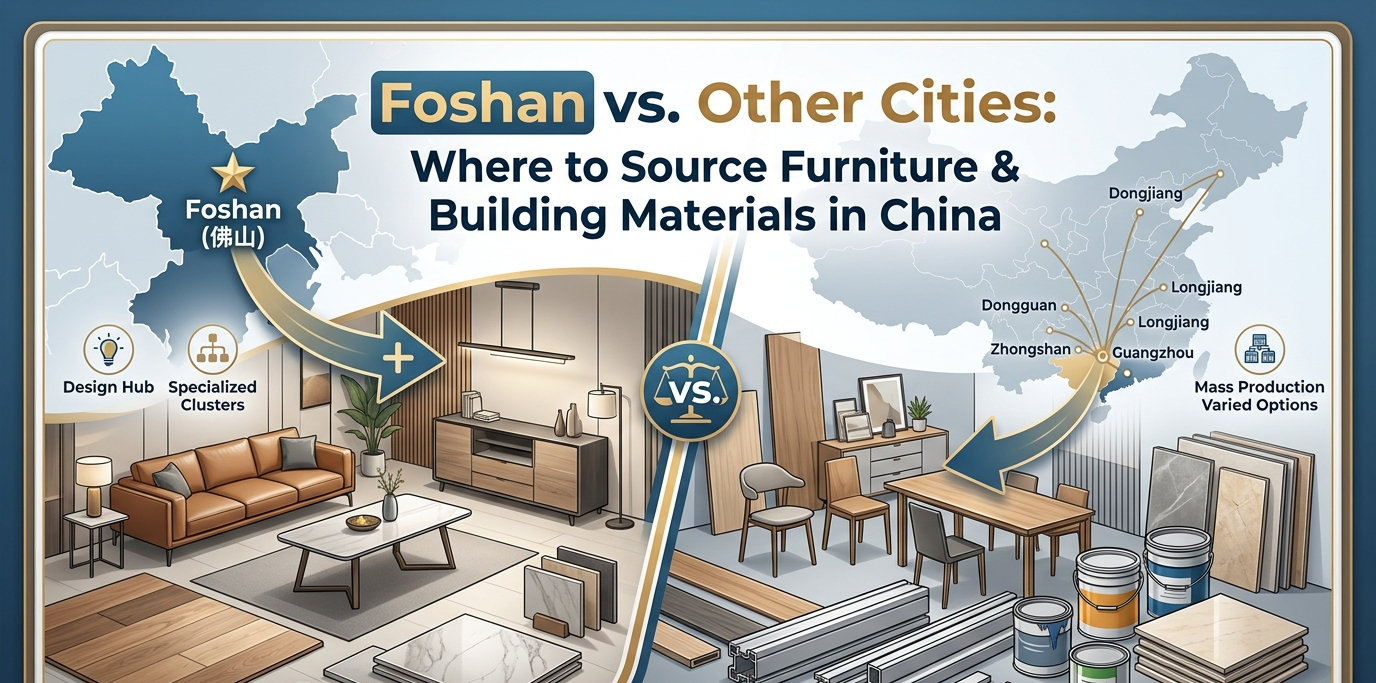
If your project requires a mix of Furniture (FF&E) and Building Materials, the sourcing location is just as important as the factory itself. Here is a realistic, side-by-side comparison of China’s major manufacturing hubs and why Foshan usually wins the contract for integrated projects.
Why does the specific city in China matter for your procurement strategy?
China operates on a “Cluster Economy” model. Entire cities are dedicated to perfecting a single supply chain. If you buy a sofa in a city that specializes in electronics, that factory is likely importing the fabric, foam, and wood frames from hundreds of miles away, adding a massive markup to your price.
By sourcing directly within the correct industrial cluster, you eliminate the middlemen, gain access to raw material markets, and drastically reduce production lead times. The challenge for property developers is finding a cluster that supports both heavy construction materials and delicate interior finishes.
Foshan vs. Dongguan: Which is better for high-end project interiors?
Both are located in Guangdong province, and both are globally recognized for furniture, but they serve different procurement models.
- Dongguan: Historically, Dongguan is the hub for extremely high-end, export-only loose furniture. If you are a luxury retail brand looking to manufacture a standalone designer chair or a specific line of bedroom furniture, Dongguan factories offer incredible craftsmanship.
- Foshan: Foshan is the king of the Integrated Project. It is home to Lecong (the world’s largest furniture market) and Shunde (the custom millwork hub). Crucially, it is also home to Shiwan—China’s undisputed capital for ceramics, porcelain tiles, and sintered stone.
The Verdict: If you are buying standalone furniture to sell in a retail store, Dongguan is excellent. If you are outfitting a 200-room hotel and need the custom wardrobe veneer to match the bathroom vanity, and you need it shipped in the same container as the floor tiles, Foshan is the only logical choice.
Foshan vs. Zhejiang Province: Where should you buy building materials?
Zhejiang province (specifically cities like Ningbo, Wenzhou, and Hangzhou) is a massive player in the building material sector, but its strengths are different from Foshan’s.
- Zhejiang: Excellent for metal processing. If you need massive quantities of raw brass valves, hinges, door handles, or plastic injection components, Zhejiang is highly competitive. It is also a premier hub for outdoor and patio furniture.
- Foshan: Foshan dominates the “heavy” and “aesthetic” building materials. It is the source for large-format porcelain slabs, custom aluminum windows, and structural glass.
The Verdict: While Zhejiang is great for standalone hardware or outdoor items, it lacks the deep upholstery and custom cabinetry ecosystem of Foshan. For a whole-house interior package, Foshan allows you to source the heavy tiles and the custom cabinets in the same 50km radius.
How does regional consolidation in Foshan save money on freight?
The ultimate advantage of choosing Foshan over a fragmented multi-city approach comes down to container physics.
If you buy tiles from Shandong and beds from Jiangsu, you have to ship them separately. Tiles are heavy but take up very little space. Beds are light but take up a massive amount of volume. You end up paying to ship a container of heavy tiles (maxing out weight limits with mostly empty space) and another container of beds (shipping mostly air).
In Foshan, a professional sourcing partner utilizes Volumetric Packing. We bring the heavy porcelain tiles from Shiwan and the high-volume flat-packed cabinets from Shunde into one local warehouse. We load the heavy tiles on the bottom of the container and stack the lighter cabinetry and furniture on top. This FCL (Full Container Load) strategy can reduce your total ocean freight bill by 20% to 35%.
How do you control quality when mixing materials from different local factories?
Even within Foshan, you are dealing with different factories for stone, wood, and upholstery. The critical difference is that in Foshan, Active Cross-Checking is physically possible.
If you need the metal legs of a dining chair to perfectly match the metal finish of your kitchen cabinet handles, your sourcing agent doesn’t need to mail samples across the country. They can drive the physical metal swatch from the cabinet factory to the furniture factory in 30 minutes to ensure the PVD coating matches before mass production begins.
Key Takeaways
- Don’t Fragment Your Supply Chain: Sourcing across different Chinese provinces leads to unmatched finishes, logistical nightmares, and high LCL freight costs.
- Foshan for Projects: Foshan is uniquely equipped for developers because it houses both the heavy building material supply chain (tiles/stone) and the FF&E supply chain (furniture/millwork) in one cluster.
- Dongguan for Retail: Use Dongguan if you are a luxury retail furniture brand, but pivot to Foshan for large-scale, multi-category commercial fit-outs.
- Leverage Container Physics: Centralizing in one city allows you to mix heavy and light goods in the same container, drastically lowering shipping costs.
FAQ: Navigating Chinese Manufacturing Hubs
Q: Can I source outdoor furniture from Zhejiang and consolidate it in Foshan?
A: Yes, but domestic trucking costs apply. If the volume of outdoor furniture is small, we often truck it down from Zhejiang to our Foshan warehouse to load with the rest of your interior goods. If the volume is large, it’s better to ship it directly from the Ningbo port.
Q: Why are prices sometimes cheaper in Northern China (like Xuzhou or Shandong)?
A: Northern provinces often produce budget-tier panel furniture or standard commercial tiles aimed at the domestic low-end market. The raw material grades (like MDF density or foam resilience) are generally lower. For international commercial projects or luxury residential, the Guangdong/Foshan supply chain offers the required durability and export-grade quality.
Q: Does Foshan produce custom lighting as well?
A: Yes. Guzhen, known as the “Lighting Capital of China,” is literally right next to Foshan (technically in Zhongshan city, but geographically part of the same cluster). We regularly integrate custom contract lighting into Foshan furniture containers.
Strategic Project Sourcing with HSY
At HSY Sourcing, we don’t just connect you to factories; we place your project in the right manufacturing ecosystem. We operate out of Foshan because it provides the most comprehensive, risk-averse supply chain for our international property developers.
By keeping your furniture, cabinetry, and building materials within the Foshan cluster, we guarantee finish consistency, eliminate domestic shipping delays, and engineer the most cost-effective container loads possible.