
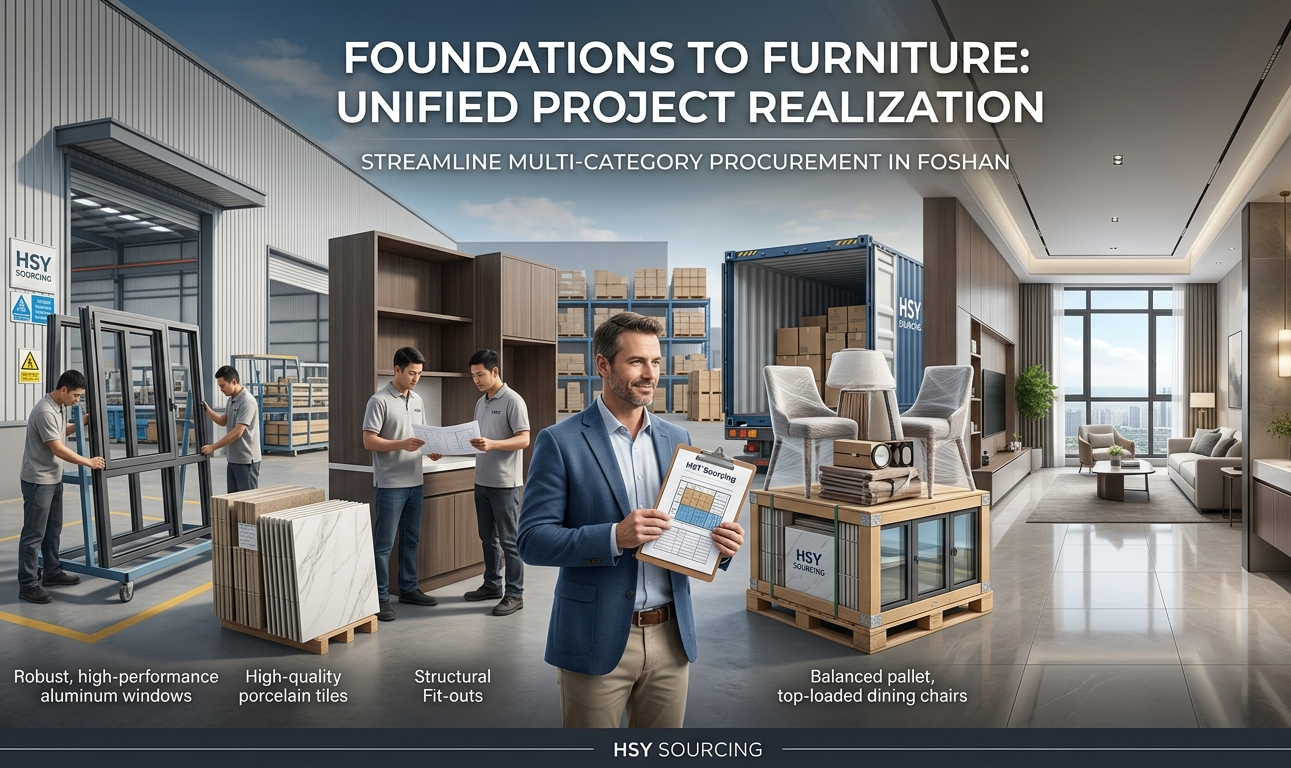
Most developers who attempt to source a multi-category project overseas quickly realize they haven’t just bought materials; they’ve bought a second full-time job. Managing the transition from rough-in structural materials like windows and tiles to the final finishing touches of custom cabinetry and FF&E (Furniture, Fixtures, and Equipment) is where profit margins are either maximized or completely destroyed.
When you are ordering thousands of SKUs for a hotel or apartment complex, a cheap unit price means nothing if the goods arrive in the wrong order, or worse, if they don’t fit together on-site. Here is a realistic look at how to manage the chaos of a multi-category building material project.
How do you prevent material mismatches before production even starts?
The most common disaster in a multi-category project happens when materials are ordered in silos. The procurement manager orders floor tiles from one factory and interior doors from another. Because there is no cross-communication, the finished floor height ends up being 15mm thicker than anticipated, and suddenly, 200 custom doors need to be trimmed on-site by expensive local labor.
To prevent this, you must treat your BOQ (Bill of Quantities) as an interconnected web, not a checklist. Before a single deposit is paid, your sourcing team must cross-reference shop drawings. The dimensions of the bathroom vanity must be checked against the specific plumbing fixtures you ordered. The depth of the aluminum window frames must align with the thickness of the drywall and cladding.
Why is timing more critical than the unit price?
Construction sites do not have infinite, climate-controlled storage space. If your container of custom upholstered sofas arrives at the site before the drywall is finished and the windows are sealed, those sofas are going to be ruined by dust and moisture. Conversely, if your shower enclosures are delayed by a month, the entire plumbing and tiling crew has to stop working.
Managing complexity means demanding phased production and phased shipping. Your sourcing partner needs to sequence the manufacturing so that structural items (steel, windows, doors, tiles) are loaded and shipped in Phase 1. Phase 2 should be your hard fit-outs (kitchen cabinets, wardrobes, sanitary ware). Phase 3 is your loose FF&E and lighting.
How do you maintain quality control across drastically different industries?
You cannot use the same inspection parameters for a heavy-duty curtain wall as you do for a velvet lounge chair. Relying on a generic “QC inspector” who simply counts boxes is a massive risk.
Multi-category projects require specialized, stage-by-stage inspections:
- For Windows/Doors: Verifying aluminum profile thickness, checking thermal breaks, and demanding water-leakage test reports.
- For Custom Woodwork: Checking the moisture content of the wood to prevent warping, and verifying the grade of the hardware (hinges, sliders).
- For Upholstery: Testing foam density, fabric rub-counts, and fire-retardant certifications. Your agent must be technically fluent in multiple manufacturing disciplines to catch defects while the goods are still on the factory floor.
What is the smartest way to consolidate heavy construction materials with fragile FF&E?
If you ship a 40HQ container filled only with porcelain tiles, you will hit the legal weight limit while the container is still half empty—wasting thousands of dollars in shipping space.
The secret to lowering your landed cost on a multi-category project is strategic container consolidation. By utilizing a local hub, you can play “logistics Tetris.” We build a heavy, stable base load using your floor tiles, quartz countertops, and hardware. We then top-load the container with your volumetric, lighter goods like custom cabinetry, mattresses, and lighting fixtures. This ensures you utilize 100% of the weight and volume you are paying for, without crushing your fragile items.
Key Takeaways
- Cross-Reference Shop Drawings: Never order interactive components (like sinks and vanities) without verifying the dimensions against each other.
- Phase Your Shipments: Align your container arrivals with your actual construction schedule to avoid site-level storage nightmares.
- Specialized QC is Mandatory: Ensure your inspectors have specific technical knowledge for the exact category they are reviewing.
- Mix Heavy and Volumetric Freight: Consolidate dense building materials with bulky furniture in a single container to drastically reduce shipping costs.
FAQ: Managing Multi-Category Procurement
Q: Should I just use a “One-Stop” factory that claims they can make everything?
A: No. A factory that produces excellent ceramics does not know how to build a safe, comfortable sofa. “One-stop” factories are usually just trading companies outsourcing your orders to hidden sub-contractors, which completely destroys your quality control. The right approach is to use a centralized agent (like in Foshan) who manages multiple specialized factories.
Q: What happens if my construction site faces delays, but my goods in China are ready?
A: This is a common scenario. It is significantly cheaper to hold your finished goods in a consolidation warehouse in China than to pay demurrage fees at a US or European port, or rent commercial storage near your site. A good sourcing partner will hold and stage your inventory until you give the green light.
Q: How do we handle damages if different categories are packed in the same container?
A: Prevention is the only real cure. We require export-standard packaging for everything: heavy-duty wooden crates for stone and glass, edge protectors for cabinets, and moisture-absorbing packets for textiles. Proper marine insurance covers the rest.
Total Project Control with HSY Sourcing
At HSY Sourcing, we specialize in bridging the gap between the architect’s vision and the factory floor. We understand that a hotel or apartment project isn’t just a list of materials; it is a synchronized operation.
Operating directly from Foshan—the world’s most complete building materials and furniture hub—we act as your off-site project managers.
- We align the shop drawings across dozens of suppliers.
- We enforce strict, category-specific quality control.
- We stage, consolidate, and phase your shipments to match your site’s exact readiness.