
If you’re planning a trip to China in 2026 to buy for your business, your GPS will tell you that Foshan is just a city next to Guangzhou. But if you’re a professional buyer, you know that “Foshan” is actually a massive jigsaw puzzle of specialized towns.
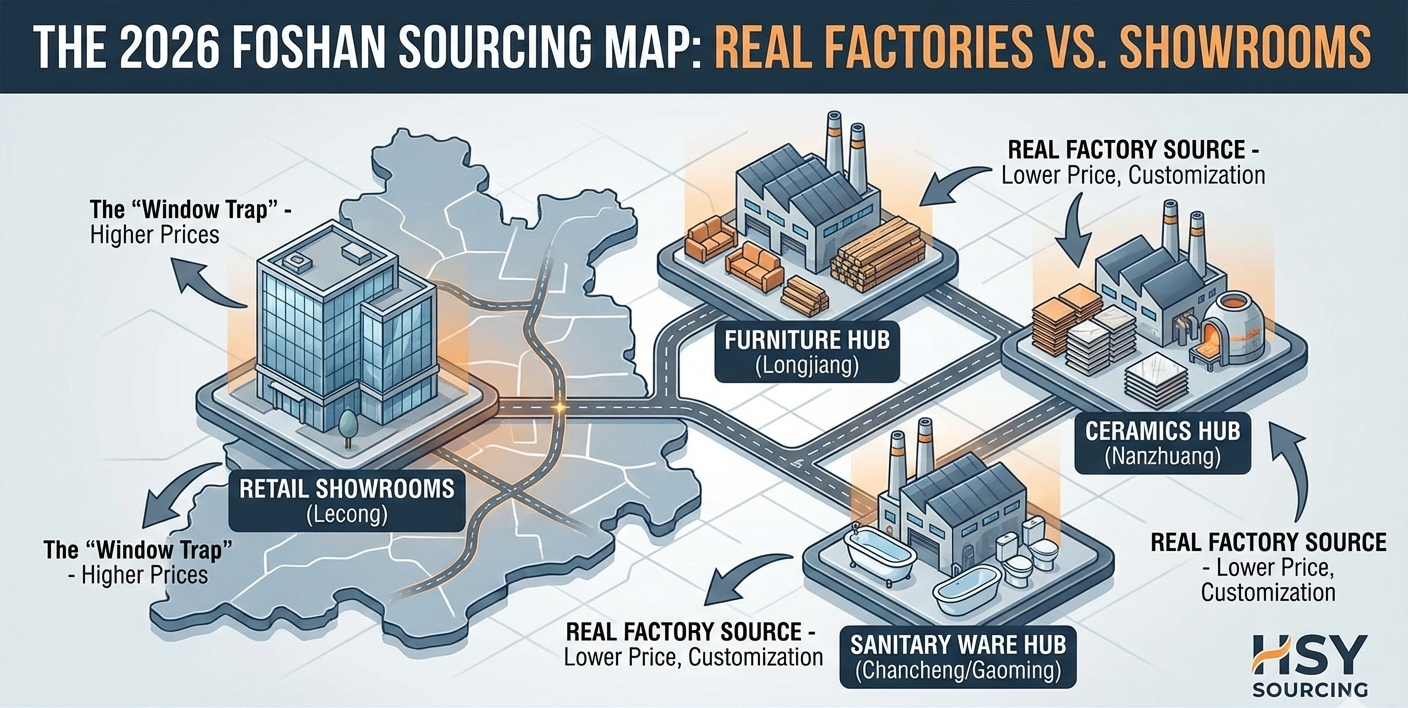
If you just tell a taxi driver to take you to “the furniture market,” you will likely end up at a flashy, air-conditioned mall where the prices are 30% higher than they should be. That’s because the real factories—the ones that actually own the machines and the molds—aren’t usually allowed to build giant glass showrooms on the main roads. They are tucked away in specific “townships” (Zhen) that focus on one thing and one thing only.
At HSY Sourcing, we’ve spent years navigating these backroads. By 2026, the map has shifted slightly. Some older factories have moved to more modern industrial parks on the outskirts to comply with new environmental laws, while the “headquarters” remain in the traditional hubs. Here is the realistic map of where you actually need to go to find the source.
Why do most buyers get stuck in the “Showroom Trap”?
When you arrive in Foshan, the most famous place people will mention is Lecong. It is home to the Louvre Furniture Mall and Sunlink. These places are incredible. They are bigger than any mall you’ve seen in Europe or the US.
But here’s the reality: Lecong is a window, not a factory floor. The showrooms in Lecong are primarily for retail customers or small-scale designers. While some big factories have a “flagship store” there, the prices include the massive rent of those buildings. If you are looking for five containers of sofas for a hotel project, you don’t place your order on the 5th floor of a mall. You use the showroom to check the “look,” and then you have to travel 15 to 30 minutes further south to see where the magic happens.
If you spend all your time in the malls, you aren’t sourcing; you are just shopping at a slightly cheaper retail price. To get the “Factory Price,” you have to go where the trucks are.
Where is the actual heart of the furniture industry?
If you want the real source for sofas, beds, and soft-upholstered furniture, you need to head to Longjiang.
Located just past Lecong in Shunde District, Longjiang is the “kitchen” of the furniture world. This is where the raw material markets are. If a factory in Longjiang needs a specific type of foam or a new leather supplier, they don’t call a sales rep; they drive five minutes down the street.
In 2026, Longjiang has become even more specialized. There are specific “villages” within the town that focus on different things. One area might be 90% office chairs, while another is 90% luxury marble dining tables.
The logic is simple: In Longjiang, you find the manufacturers who supply the showrooms in Lecong. You lose the fancy lighting and the free espresso, but you gain direct access to the people who can change the stitching, modify the frame, and—most importantly—give you the real wholesale price.
How do you find the real tile and sanitary ware manufacturers?
The map for “Wet Goods” (tiles and bathrooms) is different from the furniture map. For these, your compass should point toward Nanzhuang and Chancheng.
Nanzhuang is the king of ceramics. If you look at the tiles in your home right now, there is a very good chance they were either made in Nanzhuang or the factory’s headquarters is based there. By 2026, many of the actual high-pollution kilns (the ovens) have moved further out to cities like Qingyuan or Zhaoqing, but the Quality Control, Research & Development, and the Main Inventory are still in Nanzhuang.
For Sanitary Ware (Bathtubs, Toilets, Vanities), the “Sanitary Ware City” in the Chancheng area is the starting point. However, if you want the high-end acrylic and stone resin factories we discussed in previous guides, you’ll be looking at the industrial zones bordering Nanzhuang and Gaoming.
The benefit of these areas is the “ecosystem.” A bathtub factory in Nanzhuang has immediate access to the ceramic valve suppliers and the stainless steel drainage manufacturers. This proximity is why Foshan products are so much more consistent than those from other regions; the parts are all made within the same 10-mile radius.
Is the “old” Foshan still the best place in 2026?
As Foshan grows, the government has pushed for “Industrial Upgrading.” This means the messy, small workshops that used to be in the city center are being moved to the “new” outskirts.
If you are looking for high-tech, automated production lines—the kind that can handle 1,000-unit orders with zero defects—you will find yourself driving toward Gaoming or Sanshui. These are the “New Foshan.”
The factories here are bigger, cleaner, and more efficient. They are designed for the 2026 global market, with solar panels on the roofs and robotic arms doing the heavy lifting. While the “sales offices” might still be in the traditional centers of Shunde or Chancheng, the pros know that a visit to the “New Zones” is necessary to verify if a factory actually has the capacity they claim to have.
Why does the “Township” logic matter for your shipping container?
This is a logistics secret that most buyers ignore until they see their shipping bill.
If you buy your furniture in Longjiang (Shunde) and your tiles in Nanzhuang (Chancheng), you are dealing with two different administrative areas. While they are close on a map, your “Consolidation Point” (the warehouse where your container is loaded) needs to be strategically placed.
Most of our clients at HSY Sourcing use a warehouse near Lanshi or Lecong. Why? Because it sits right in the middle. It’s the “neutral ground” where the tile trucks and the furniture trucks can meet without spending 4 hours in Foshan’s famous traffic.
If you pick a factory that is too far out in the “New Zones” without planning your logistics, your “local trucking” fees will eat up all the savings you made on the factory price.
Foshan Industrial Cluster Quick-Reference
| Industry | The “Retail” Window | The “Real” Factory Hub | Why Go There? |
| Furniture | Lecong (Louvre, Sunlink) | Longjiang | Lower prices, customization, raw material access. |
| Tiles / Ceramics | China Ceramics City | Nanzhuang | Direct access to headquarters and massive inventory. |
| Sanitary Ware | Casa Mall | Chancheng / Gaoming | Check the molds and reinforcement quality. |
| Lighting | Guzhen (Next to Foshan) | Guzhen / Huatong | The world’s lighting capital is just 20 mins away. |
Frequently Asked Questions (FAQ)
Can I just use Google Maps to find these factories?
Honestly? No. Google Maps is not updated frequently in China, and many factory names are registered in Chinese. Most real manufacturers don’t have a “Google Business” profile. You are better off using local maps or, better yet, a sourcing agent who has the physical addresses of the workshops, not just the sales offices.
Do the factory owners in the townships speak English?
Rarely. In the fancy malls like Louvre, almost everyone speaks English. In the backstreets of Longjiang or Nanzhuang, you are talking to production managers and owners who speak Cantonese or Mandarin. This is where a sourcing partner is vital—not just for translation, but for “technical” communication.
Is it safe to visit these industrial townships?
Yes, it is very safe. Foshan is a business-first city. However, these areas are not built for pedestrians. There are no sidewalks, and there is a lot of truck traffic. You need a dedicated car and driver to move between factories efficiently.
How many factories can I realistically visit in one day?
In the malls, you can “see” 20 showrooms in a day, but you’ll learn very little. In the factory hubs, a realistic schedule is 3 factories per day. This gives you time to walk the production line, check the raw materials, and sit down with the boss to talk about pricing and MOQs.
Conclusion
The 2026 map of Foshan is a map of specialization. If you want the best results, you have to be willing to get your shoes a little dusty. You have to leave the high-end showrooms and head into the townships where the actual work is done.
Finding the “Real Factory” is about understanding the geography of the supply chain. Furniture is in the South, Tiles are in the Center, and the Future is in the West.
Feeling overwhelmed by the Foshan jigsaw puzzle?
At HSY Sourcing, we have the map memorized. We don’t just take you to the showrooms; we take you to the source. We know which “villages” specialize in your specific product and how to navigate the logistics of bringing it all together. Contact us today, and let’s plan your 2026 Foshan sourcing trip the right way.