
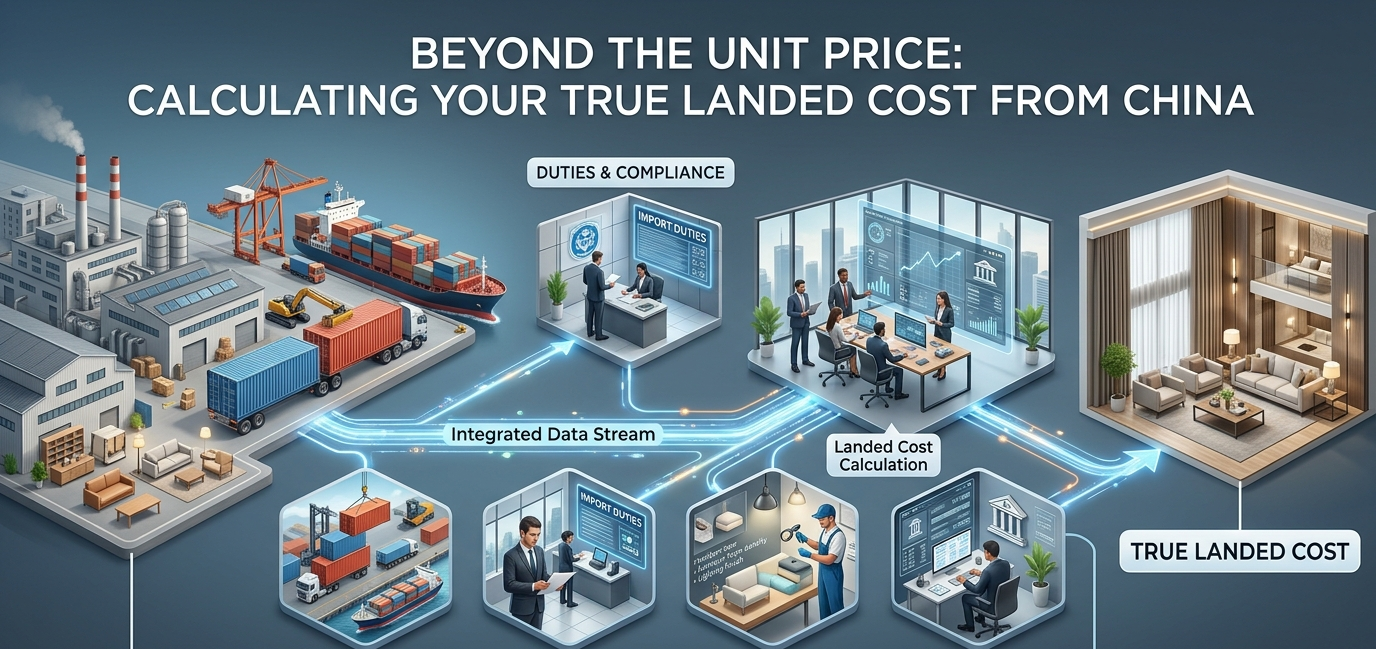
In the world of B2B procurement, the most dangerous number is the “unit price” you see on an Alibaba listing or a supplier’s initial quote. For many first-time buyers, the shock comes when the goods finally arrive, and the actual bill is 30% to 50% higher than expected.
To protect your margins, you must stop looking at the price tag and start calculating the Landed Cost. Here is the professional’s guide to the “hidden math” of sourcing from China
Why is the “Ex-Factory Price” a Dangerous Number?
The Unit Price (or Ex-Factory price) is simply the cost of the goods sitting at the factory gate. It tells you nothing about the cost of getting those goods onto your warehouse shelves.
The professional formula for success is:
$$Landed\ Cost = Unit\ Price + Logistics + Duties/Taxes + Inspection\ Fees + Financial\ Costs + Buffer$$
If you aren’t calculating every variable in this equation, you aren’t running a business—you’re gambling.
What are the Mandatory Logistics Costs Beyond Freight?
Logistics is much more than just the ocean freight rate. Depending on your chosen Incoterm, your costs will vary significantly:
- EXW (Ex Works): You pay for everything, including the trucking from the factory to the port.
- FOB (Free On Board): The supplier handles the transport to the port and export clearance. This is the gold standard for most B2B buyers.
- The “Last Mile”: Don’t forget destination terminal handling charges (THC), customs brokerage fees, and the final trucking from the port to your door. For bulky items like furniture, LCL (Less-than-Container Load) fees per cubic meter are often much higher than FCL (Full Container Load).
How Do Duties, Taxes, and Customs Fees Impact Your Bottom Line?
This is the area where most budgets fail.
- Import Duties: Every product has an HS Code. Depending on the code and your country, duties can range from 0% to 25% or more.
- VAT/GST: Most countries charge a Value Added Tax on imports. While this can often be reclaimed, it is a significant hit to your initial cash flow.
- Customs Exams: If your container is flagged for an X-ray or physical inspection by customs, you are responsible for those costs, which can range from $300 to $1,500 unexpectedly.
Which Hidden Costs Often Catch Buyers Off Guard?
Beyond the big bills, small “leakages” can erode your profit:
- Financial Fees: International wire transfer (SWIFT) fees and the “spread” on exchange rates.
- Sampling & Express: You may go through three rounds of samples via DHL/FedEx before the big order starts.
- Protective Packaging: Fragile building materials or hotel furniture require reinforced wooden crating. Factories often charge extra for this “Export Standard” packaging.
- Storage & Demurrage: If you are sourcing from 10 different factories, your goods will accrue storage fees while waiting to be consolidated into a single container.
Is Quality Control (QC) an Expense or an Investment?
Many buyers try to save $300 on an inspection fee, only to lose $30,000 on a container full of defective goods.
- Rework Costs: If a product is defective once it reaches your country, the shipping cost to send it back to China is often higher than the value of the goods.
- Delay Penalties: In real estate projects, one broken batch of tiles can halt a construction crew, costing thousands in labor delays.QC is not a cost; it is an insurance premium.
Key Takeaways
- Never Budget on Unit Price: Only the Landed Cost tells the truth about your profitability.
- Lock Your HS Code Early: Consult a customs broker before placing an order to confirm exact duty rates.
- Maintain a 5–10% Buffer: International logistics and customs are unpredictable; always leave a “safety margin” in your budget.
- Consolidate to Save: Using a professional agent to combine 10 LCL shipments into one FCL can save you 20% or more on logistics.
FAQ: Sourcing Cost Secrets
Q: Should I let the supplier handle the shipping (DDP/CIF)?
A: For small parcels, yes. For large projects, no. Suppliers often add a high “safety margin” to DDP quotes. Managing your own logistics via an agent or broker usually saves 10–15%.
Q: Why is my actual Landed Cost always higher than my estimate?
A: Usually, it’s due to ignored “local port charges” at the destination. Many buyers calculate ocean freight but forget the terminal handling and unloading fees in their home country.
Q: Can I ask the supplier to undervalue the invoice to save on taxes?
A: This is illegal and highly risky. Customs authorities use data analytics to spot undervalued goods. If caught, you face massive fines, seizure of goods, and a permanent “black mark” on your import record.
Meet the HY Sourcing Team: Your Supply Chain Architects
Calculating the cost is step one; controlling the cost is where HY Sourcing excels.
At HY Sourcing, we don’t play games with “low-price baiting.” Our goal is to provide you with a transparent, predictable supply chain.
- Transparent Cost Breakdown: We strip away the mystery, showing you every cent from the factory floor to the shipping container. No hidden kickbacks, no surprises.
- Quality Assurance: Our dedicated QC teams in Foshan and Zhongshan solve defects at the factory, eliminating the risk of expensive “rework” after the goods have crossed the ocean.
- Strategic Consolidation: We specialize in multi-supplier projects. We turn scattered LCL costs into streamlined FCL efficiency by consolidating your goods in our own facilities.