
Key Takeaways:
- Direct Sourcing is for Simple Retail: Buying standard consumer goods directly can save money. Managing custom building materials across 15 factories without a local presence usually results in costly errors.
- The Consolidation Advantage: A sourcing agent reduces logistics costs significantly by combining multiple factory orders (tiles, doors, lighting) into unified Full Container Loads (FCL).
- Technical Translation: A professional agent acts as your engineering liaison, ensuring the factory’s shop drawings match your architect’s exact specifications.
- Quality Control Bias: Buying directly means relying on the factory’s internal QC, which prioritizes shipping speed over your quality standards.
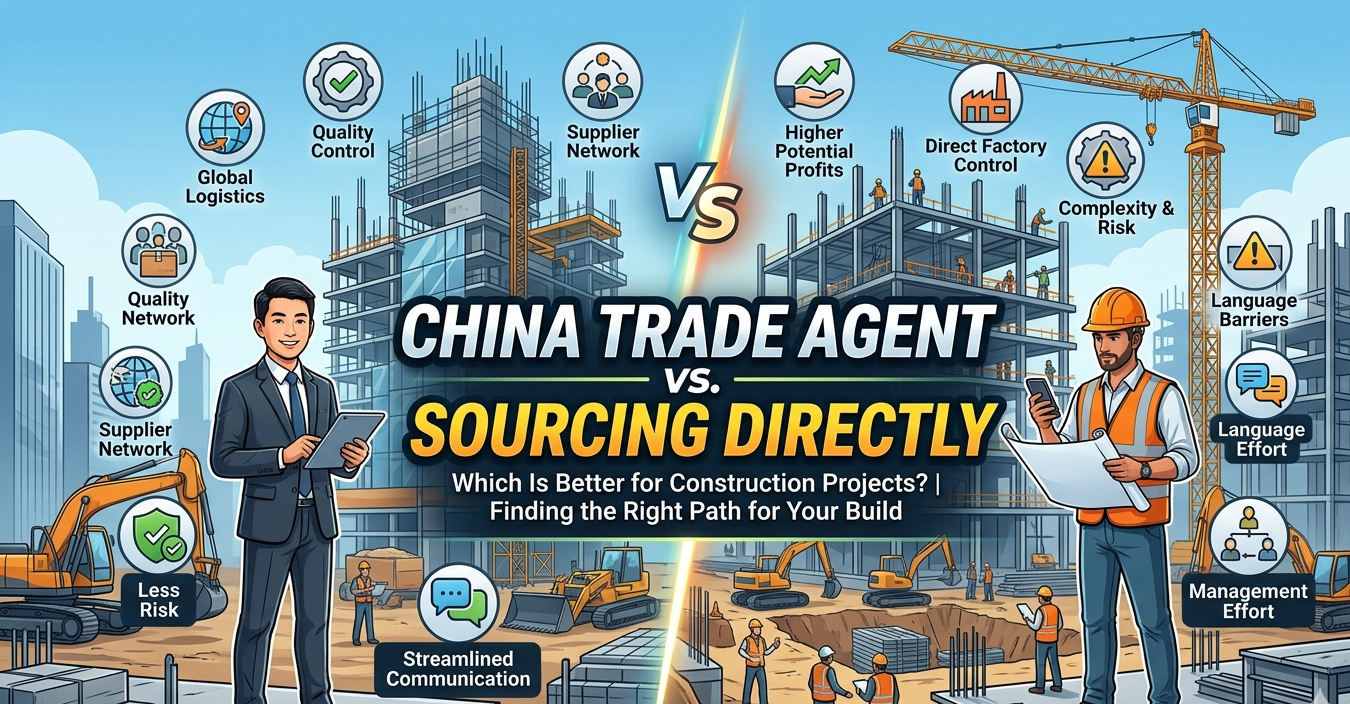
When international developers and hotel procurement managers look to reduce capital expenditure, buying materials from China is the logical first step. The immediate question that follows is whether to buy directly from the factories via platforms like Alibaba, or to hire a local China trade agent to manage the process.
While bypassing the middleman looks cheaper on a spreadsheet, large-scale construction procurement is entirely different from buying retail inventory. Here is a factual, experience-based breakdown of which method suits your project.
When Does Sourcing Directly from Chinese Factories Make Sense?
Sourcing directly from a manufacturer is a viable strategy, but it requires a very specific set of circumstances. It is generally the better option if:
- You are buying a single, standardized product: If you only need to buy 10,000 standard ceramic coffee mugs or basic PVC pipes, dealing directly with one factory is straightforward.
- You have an in-house China team: If your development company has the budget to employ full-time staff based in Guangdong to visit factories and manage shipments, an outsourced agent is redundant.
- You require no custom engineering: If the product does not require custom molds, shop drawings, or specific architectural tolerances, direct purchasing is low-risk.
Why Do Large Construction Projects Require a China Trade Agent?
Procuring materials for a 200-room hotel or a multi-tower apartment complex involves managing a Bill of Quantities (BOQ) with hundreds of line items. No single factory in China produces tiles, structural glass, cabinetry, and bathroom fixtures simultaneously.
To complete a project, you must split your BOQ among specialized manufacturers. Managing this complexity requires a local agent for several reasons:
- Supplier Qualification: A directory listing cannot tell you if a factory has the heavy-duty CNC machinery required for commercial-grade aluminum windows. An agent physically audits the factory floor.
- Technical Synchronization: The acoustic rating (STC) of an interior hotel door must align with the framing. An agent ensures that the engineering standards translate accurately across different factories so that all parts fit together on-site.
- Dispute Resolution: If a factory produces a batch of defective goods, a buyer located 10,000 miles away has very little leverage. An agent physically present in the industrial hub can halt the balance payment and force a rework.
How Does Quality Control Differ Between the Two Methods?
When you source directly, you are entirely dependent on the factory’s internal Quality Control (QC) department. Their primary objective is to get the goods out the door to make room for the next order. Minor defects—like slight color variations in tile batches or minor scratches on window frames—are often ignored.
A professional sourcing agent provides independent, third-party QC. They conduct:
- DUPRO (During Production Inspections): Catching a 5mm measurement error when only 10% of the custom hotel furniture is cut, preventing a total project delay.
- AQL Standard Enforcement: Using strict, mathematical defect limits to objectively reject bad batches before they are packed.
What is the Real Cost Difference When Factoring in Logistics?
The most deceptive aspect of “direct sourcing” is the hidden cost of logistics.
If you buy windows from Factory A, tiles from Factory B, and lighting from Factory C, shipping these directly means managing three separate LCL (Less than Container Load) shipments. LCL shipping is expensive, exposes your fragile materials to damage from other people’s cargo, and multiplies your customs clearance fees.
A Foshan-based sourcing agent manages Consolidation. They collect the goods from all three factories into a single local warehouse, pack them securely into one Full Container Load (FCL), and ship them under a single Bill of Lading. The freight savings from consolidation frequently cover the cost of the agent’s service fee.
Why Choose HSY Sourcing for Your Real Estate Projects?
At HSY Sourcing, we do not deal in cheap retail trinkets. We are a specialized project procurement office based in Foshan, the epicenter of China’s building materials and furniture manufacturing.
- Foshan Location Advantage: We are within a one-hour drive of the world’s top tile, door, window, and sanitary ware factories. This allows for frequent, unannounced site visits to keep your production on track.
- Engineering First: We speak the language of architects and contractors. We verify CAD drawings, monitor structural tolerances, and ensure compliance with your local building codes.
- Transparent Financials: We operate on a strict, zero-kickback policy. We secure the absolute lowest direct-factory pricing for you, and our compensation is purely based on a transparent service agreement.
- Project-Phased Logistics: We don’t just ship boxes; we align our logistics with your construction schedule, ensuring the drywall arrives before the lighting fixtures.
Visit www.hsysourcing.com to discuss your project’s BOQ and learn how we can protect your procurement budget.
Frequently Asked Questions (FAQ)
Q: Do factories charge a higher price if I use a sourcing agent?
A: No. In fact, a localized sourcing agent can often negotiate a lower price than a foreign buyer because they understand the true local cost of raw materials and speak the local dialect, eliminating the “foreigner premium.”
Q: What is the typical fee structure for a sourcing agent?
A: Legitimate agents usually charge a transparent percentage of the total order value (typically 5% to 10%, depending on the project’s scale and complexity) or a flat project management fee. Avoid agents who claim their services are “free,” as their margins are hidden in inflated factory prices.
Q: Can I use an agent just for inspection and shipping if I found the suppliers myself?
A: Yes. For project buyers who have already identified their factories, HSY Sourcing provides targeted QC, production monitoring, and warehouse consolidation services to ensure the final delivery is flawless.