
Sourcing building materials and furniture from Foshan for commercial developments—such as hotels, apartment towers, and private villas—typically involves dealing with multiple specialized manufacturers. A single project may require ceramic tiles from Nanhai, custom furniture from Lecong, sanitary ware from Shiwan, and aluminum windows from Lishui.
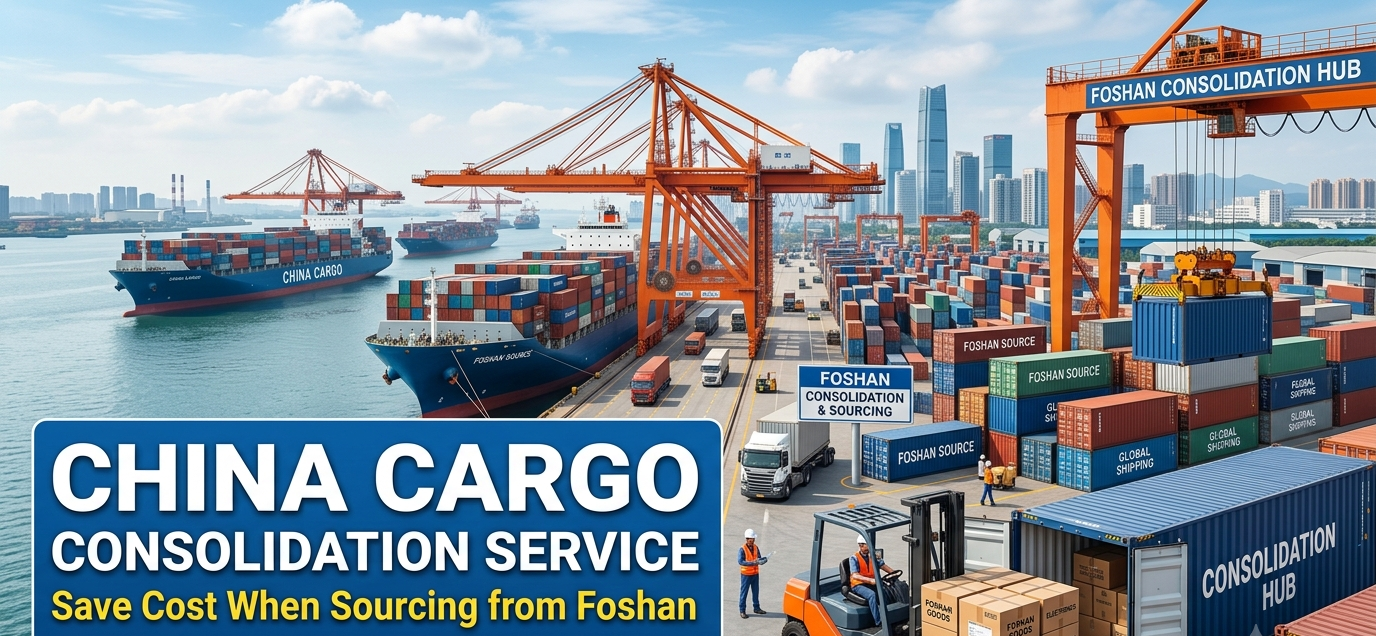
When each factory ships its goods independently, buyers face compounding origin fees, underutilized container space, and complex customs documentation. China cargo consolidation solves this by gathering shipments from multiple suppliers into a single, fully optimized container load before export.
Here is how cargo consolidation works in Foshan, how it reduces overall landing costs, and how to avoid common logistical mistakes when mixing diverse building materials.
Key Takeaways
- Lower Unit Freight Costs: Combining separate factory orders into full container loads (FCL) eliminates costly Container Freight Station (CFS) fees and high LCL (Less than Container Load) rates.
- Maximized Container Space: Professional warehouse stuffing routinely achieves 90–95% volumetric utilization, significantly reducing the cost per cubic meter ($/\text{CBM}$).
- Single-Window Customs Clearance: Consolidating multiple factory invoices into one unified set of export documents simplifies customs processing at both origin and destination ports.
- Pre-Shipment Quality Control: Centralized warehouse staging allows full inspection of goods before loading, preventing defective products from reaching the site.
- Reduced Damage Risks: Structured container loading—placing heavy ceramics at the bottom and lighter furniture on top—protects fragile items during maritime transit.
Why Do Unconsolidated Multi-Supplier Orders Inflate Project Budgets?
When importing building materials for a project, purchasing directly from 5 to 15 different suppliers without a consolidation strategy leads to hidden logistical overhead.
SEPARATE SHIPPING (LCL / MULTIPLE SHIPMENTS):
Factory A (Tiles)     ──> Local Port Fee A ──┐
Factory B (Furniture) ──> Local Port Fee B ──┼──> Multiple LCL / Partial Shipments ──> High Fees & Delay Risk
Factory C (Sanitary)  ──> Local Port Fee C ──┘

CONSOLIDATED SHIPPING (HSY WAREHOUSE):
Factory A ──┐
Factory B ──┼──> HSY Foshan Warehouse ──> Quality Inspection ──> Full Container (FCL) ──> Single Low Freight Fee
Factory C ──┘
1. Duplicated Local Origin Charges
Shipping via LCL requires each factory to send goods to a public Container Freight Station (CFS). Every individual shipment incurs separate document fees, origin handling charges (THC), warehousing fees, and customs declaration fees.
2. Underutilized Container Capacity
When factories handle their own container loading, they rarely optimize space for items outside their product category. A furniture factory loading half a 40ft High Cube (40HQ) container will often ship it half-empty, forcing you to pay for unused air.
3. High Risk of Demurrage and Site Delays
If 10 suppliers ship independently, shipments arrive at the destination port on different dates. Storing partial shipments at destination ports or job sites leads to high port storage fees (demurrage) and holds up construction crews waiting on missing components.
How Does Cargo Consolidation Work for Building Materials in Foshan?
A professional cargo consolidation service acts as a centralized logistics hub between your Foshan suppliers and your destination port.
+---------------------------+-------------------------------------------------------------------------+
| Consolidation Stage       | Operational Execution                                                   |
+---------------------------+-------------------------------------------------------------------------+
| 1. Production Tracking    | Synchronize readiness dates across all contracted factories.             |
| 2. Warehouse Staging      | Receive, label, and store goods in a centralized Foshan facility.       |
| 3. Incoming Inspection    | Verify quantities, dimensions, packaging integrity, and product quality.|
| 4. Stuffing Plan          | Calculate exact weight and CBM distribution using 3D loading software. |
| 5. Professional Loading   | Load containers by weight hierarchy (heavy bottom, light/fragile top).   |
| 6. Unified Documentation  | Issue one consolidated Bill of Lading, Packing List, and Commercial Invoice.|
+---------------------------+-------------------------------------------------------------------------+
The 5 Step Consolidation Workflow:
- Production Schedule Synchronization: Sourcing agents track completion timelines across all suppliers to ensure goods arrive at the consolidation warehouse within a tight time window.
- Centralized Receiving & Staging: Factories deliver finished goods directly to a specialized warehouse in Foshan.
- Pre-Loading Inspection: Goods are unboxed and checked for defect rate, material specification, finish, and packaging strength before they go into a container.
- 3D Loading Optimization: Software calculates the sequence of loading based on physical weight, box dimensions, and structural fragility to maximize container volume without exceeding road weight limits.
- Consolidated Customs Filing: A single customs entry is filed covering all items, reducing administrative friction and customs clearance costs.
What Are the Direct Cost Savings of Consolidating Containers in China?
The financial benefit of cargo consolidation comes from converting variable LCL fees into fixed FCL costs and maximizing cubic meter capacity.
| Expense Category | Individual LCL Shipments | Consolidated FCL Shipment | Financial Impact |
| Freight Rate Basis | Charged per CBM at higher tier rates | Fixed rate per 20GP / 40HQ container | 30% – 50% lower ocean freight per CBM |
| Origin Handling (THC) | Incurred per supplier shipment | Single fee per container | Eliminates duplicate handling charges |
| Customs Clearance | Paid per factory entry ($100–$150 each) | Single consolidated declaration | Reduces entry fees by up to 80% |
| Container Utilization | Average 60% – 70% space efficiency | Typically 90% – 95% space efficiency | Reduces total container count needed |
| Destination Clearance | Multiple Bill of Lading clearance fees | Single Bill of Lading (B/L) process | Prevents multiple agent administration fees |
How Do You Prevent Product Damage When Mixing Diverse Materials?
Building materials vary widely in weight and fragility. Loading dense porcelain tiles into the same container as soft leather sofas or delicate crystal lighting requires strict weight distribution rules.
┌──────────────────────────────────────────────────────────┐
│                   CONTAINER LOADING LAYOUT               │
├──────────────────────────────────────────────────────────┤
│ [Top Layer]    Lighting, Curtains, Foam Packaging        │
│ [Middle Layer] Wood Furniture, Vanities, Doors, Windows   │
│ [Bottom Layer] Ceramic Tiles, Sanitary Ware, Marble Slabs│
└──────────────────────────────────────────────────────────┘
Key Protection Standards for Mixed Building Materials:
- Weight Distribution Hierarchy: Heavy items (porcelain tiles, stone slabs, cast iron tubs) must sit flat on the container floor. Medium-weight items (cabinetry, wooden doors) go in the middle section. Light or bulky items (mattresses, sofa cushions, light fixtures) sit on top.
- Palletization and Strapping: Tiles and fragile sanitary ceramics must be fully palletized, shrink-wrapped, and strapped to prevent lateral movement during ocean transit.
- Moisture Management: Mixed materials—especially timber, leather, and fabric—are vulnerable to container rain (condensation caused by temperature shifts at sea). High-absorption industrial desiccants and vapor barriers are necessary inside the container.
- Physical Timber Barriers: Custom wooden bracing and plywood bulkheads are installed inside the container to separate heavy cargo zones from sensitive furniture packaging.
Why Choose HSY Sourcing for Cargo Consolidation in Foshan?
Managing cargo consolidation requires on-the-ground warehouse infrastructure, experienced loading crews, and strict quality control. HSY Sourcing provides dedicated consolidation and procurement management directly from Foshan.
- Local Foshan Warehousing: We operate specialized warehouse facilities in Foshan, giving suppliers easy local access to deliver goods without long inland freight delays.
- Strict Incoming Quality Control (QC): We do not just store your goods; we inspect them upon arrival. If a factory delivers damaged goods or incorrect finish colors, we catch it in Foshan—not at your job site thousands of miles away.
- Engineered Container Stuffing: Our loading teams use precise loading plans to maximize every cubic meter of space safely, keeping your freight cost per item as low as possible.
- Complete Export Documentation: We consolidate invoices, packing lists, certificates of origin (Form E, Form F, CO), and export licenses into a single, clean paperwork package for smooth customs clearance.
- Full Sourcing & Negotiation Support: Beyond logistics, HSY Sourcing assists developers, architects, and buyers with factory vetting, price negotiation, and production oversight across all interior building material categories.
Frequently Asked Questions (FAQ)
How long can my products be stored in your Foshan warehouse while awaiting consolidation?
We typically provide 15 to 30 days of free warehouse storage to allow all contracted suppliers to finish production and deliver their items to our staging facility.
What happens if one supplier experiences a production delay?
Our team monitors factory production schedules weekly. If a minor delay occurs, we adjust the receiving sequence at our warehouse. If a major delay occurs, we evaluate whether to dispatch the main container on schedule and ship the delayed item in a subsequent container or via LCL, depending on your project timeline.
How are customs declarations handled when sourcing from 10 different factories?
We compile all factory invoices into a single unified packing list and commercial invoice. Depending on your tax structure and export preferences, we handle the export declaration under our export license or manage individual factory refund declarations seamlessly.
Can fragile materials like custom glass shower doors and ceramic tiles be safely loaded together?
Yes. Ceramic tiles are palletized and placed on the floor as bottom cargo. Custom glass panels are placed in reinforced wooden crates, secured vertically against the container’s side walls, and strapped tightly to prevent vibration damage.