
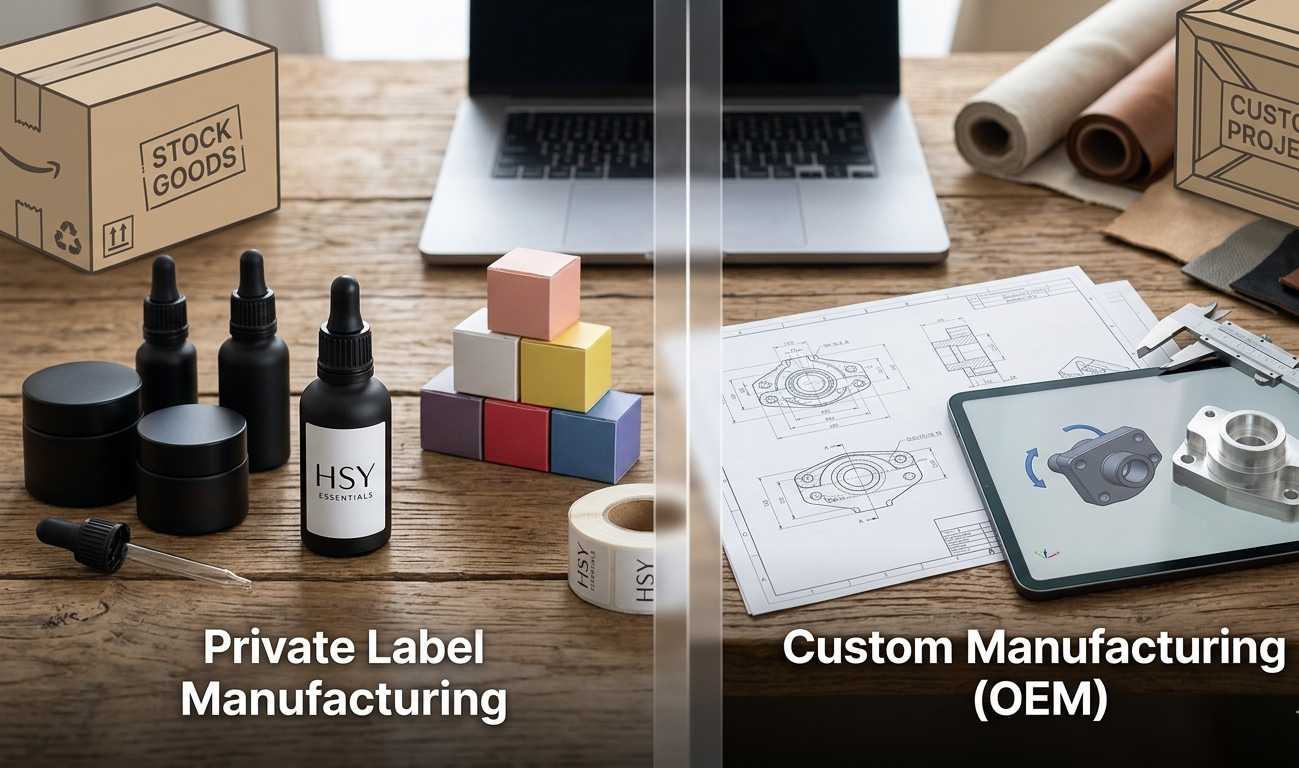
For startup clothing brands, Amazon FBA sellers, and B2B importers, deciding how to produce your goods in China is the first major hurdle. The choice usually comes down to two models: Private Label (often called White Label) or Custom Manufacturing (OEM/Original Equipment Manufacturer).
Choosing the wrong model can lead to bloated inventories, stretched budgets, or products that get lost in a sea of identical competitors. Here is a realistic breakdown of which path fits your current business stage.
What Exactly is Private Label Manufacturing?
Private label means purchasing a pre-existing, factory-designed product and adding your own branding (like a logo, custom tags, or specific packaging). The factory already has the molds, patterns, and materials ready. You are simply putting your name on their blueprint.
Best for: Businesses that need to test the market quickly, validate demand, or build a catalog without massive upfront research and development (R&D) costs.
When Does Custom Manufacturing (OEM) Make Sense?
Custom manufacturing requires building a product from scratch based on your technical specifications, tech packs, or 3D designs. If you are developing a unique baggy jort with a specific oz weight denim, or a custom-molded furniture piece, you are entering OEM territory. The factory executes your exact vision.
Best for: Established brands, businesses with patented designs, or sellers who want complete market differentiation and are willing to pay for custom molds and raw material sourcing.
How Do They Compare on MOQ, Investment, and Time?
The most critical differences lie in the numbers. Here is a direct comparison to help you evaluate your supply chain capabilities:
| Feature | Private Label (White Label) | Custom Manufacturing (OEM) |
| Minimum Order Quantity (MOQ) | Low to Medium (Often 50–200 pcs) | High (Usually 500–1,000+ pcs per design/color) |
| Initial Investment | Low. You only pay for the product and simple branding additions. | High. Requires paying for prototypes, custom molds, and specific raw materials. |
| Time to Market | Fast (15 to 30 days). Goods are often in stock or quick to assemble. | Slow (45 to 90+ days). Sampling, revisions, and custom production take time. |
| Customization Level | Minimal. Limited to logos, labels, and packaging. | Unlimited. You control the materials, dimensions, and functionality. |
| Intellectual Property | Zero Protection. Any competitor can buy the exact same product from the factory. | High Protection. You own the design, provided you use an NNN agreement. |
Which Strategy Protects Your Margins Better?
If cash flow is your priority, Private Label protects your margins by eliminating R&D costs and reducing warehousing needs due to lower MOQs. However, Custom Manufacturing often yields higher profit margins in the long run because you are selling a unique product that avoids a race-to-the-bottom price war on platforms like Amazon.
Key Takeaways
- Start with Private Label if you need to launch quickly, have limited capital, and want to test market viability.
- Pivot to Custom Manufacturing when you have proven sales data, need to stand out from competitors, and have the budget for higher MOQs and mold fees.
- Do not force OEM if you lack technical design files (tech packs); this will lead to endless sampling errors and delays.
FAQ: Navigating Production Models in China
1. Can I transition from private label to custom manufacturing later?
Yes. In fact, this is the most common and safest trajectory for successful e-commerce brands. Once a private label product generates consistent revenue, brands reinvest those profits into custom-designed versions to outpace competitors.
2. Do factories charge separately for custom molds or patterns?
Yes. For custom manufacturing, you will pay an initial “mold fee” or “sampling fee.” Many factories will refund this fee once your bulk order reaches a certain volume threshold (e.g., 5,000 units).
3. Will a factory sign an NNN (Non-Disclosure, Non-Use, Non-Circumvention) agreement for a private label product?
No. Since the factory owns the original design of the private label product, they will not agree to stop selling it to other buyers. NNN agreements are strictly for your own custom designs.
About HSY Sourcing Team
Whether you are placing your first private label order or developing complex custom molds, executing the strategy from thousands of miles away is risky. HSY Sourcing is your direct representation on the factory floor.
Based in Foshan, the heart of Guangdong’s manufacturing hub, we specialize in project management and supply chain transparency. Unlike massive, generalized sourcing directories that just forward emails, our team is on the ground. We negotiate realistic MOQs, verify mold ownership, conduct rigorous on-site quality control, and ensure your intellectual property is respected.
Stop guessing with overseas suppliers. Partner with the HSY Sourcing Team today at www.hsysourcing.com and build a supply chain you can trust.