
1. Map the Industrial Clusters (The Power of Geography)
In China, proximity is everything. Most high-end building materials are concentrated in specific “industrial clusters.” Sourcing within these hubs reduces transport costs and allows for easier cross-factory coordination.
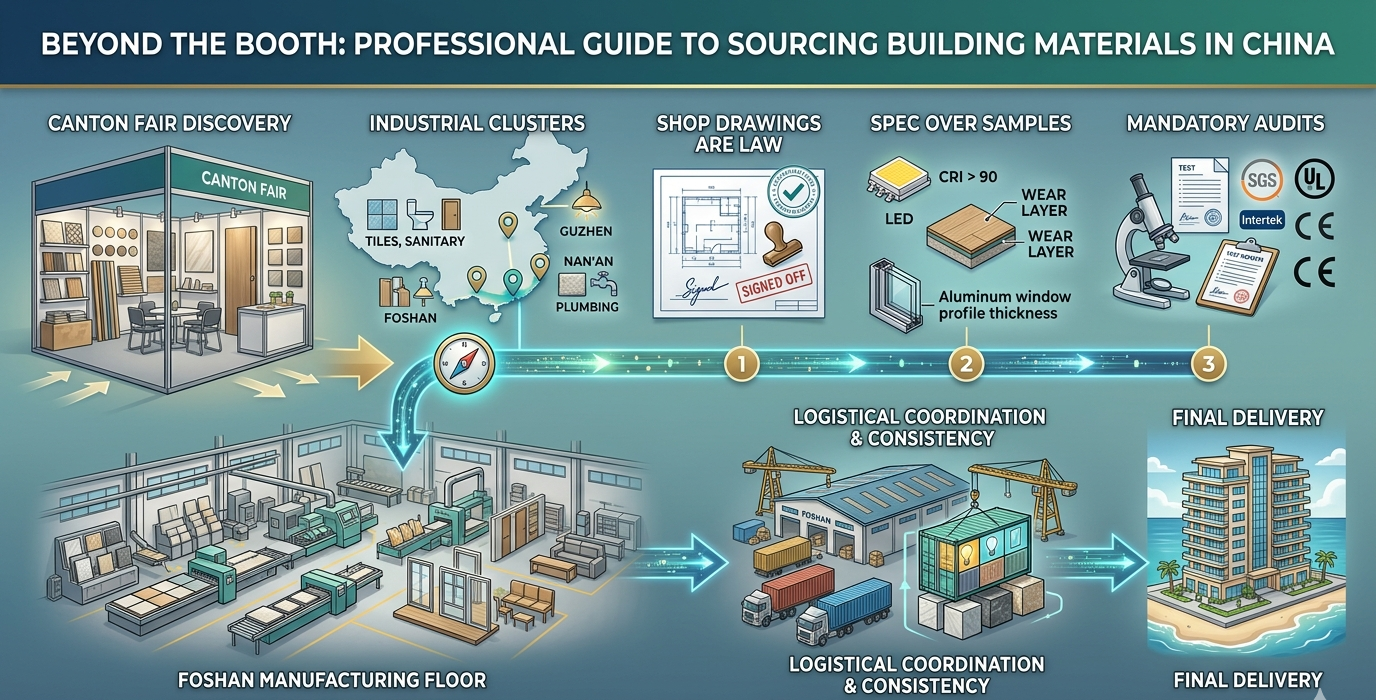
- Foshan (The Capital): This is the mandatory stop for tiles, sanitary ware, windows, doors, and furniture.
- Zhongshan/Guzhen: The global hub for architectural and decorative lighting.
- Nan’an/Quanzhou: Famous for stone, marble, and high-end plumbing fixtures.
The Strategy: Don’t bounce across the country. If your project is primarily interior-focused, 90% of your sourcing can be consolidated within a 50km radius of Foshan.
2. Technical Specs: What to Verify Before Buying
Building materials are technical products. If you don’t provide a precise Technical Specification Sheet, the factory will default to the cheapest possible raw materials.
- Ceramics & Tiles: Verify the water absorption rate (should be $<0.5\%$ for porcelain) and the PEI rating (wear resistance). Ask for a “Batch Control Plan” to ensure color consistency across a 10,000sqm order.
- SPC & LVT Flooring: Focus on the wear layer. Residential projects need 0.3mm; commercial/hotel projects require at least 0.5mm. Ask about the formaldehyde emission class (E1 or E0).
- Aluminum Windows/Doors: Look for “thermal break” technology. Ask for the thickness of the aluminum profile (1.4mm to 2.0mm is standard for quality projects) and the glass rating (Tempered, Low-E, or Double Glazed).
- Hardware & Plumbing: Insist on ceramic cartridges for faucets and PVD (Physical Vapor Deposition) finishes for high-traffic areas to prevent tarnishing.
3. The “Certification Trap”
- Third-Party Verification: Use companies like SGS, Intertek, or TUV to verify that the factory’s current production matches the certifications they claim (e.g., UL, CE, ASTM, or AS/NZS).
- Laboratory Testing: For structural materials like steel or fire-rated doors, send a random production sample to an independent lab before the final payment is made.
4. Logistics: The “Lego” of Shipping
Building materials are heavy, bulky, and fragile—the three most difficult things to ship.
- Container Loading Supervision: If you are buying tiles and glass, ensure they are crated in heat-treated wooden pallets. Heavy items must be on the bottom, with lighting and fragile hardware on top.
- Consolidation: Avoid shipping 10 separate LCL (Less-than-Container Load) shipments. Use a central warehouse in Foshan to consolidate everything into a few Full Container Loads (FCL). This reduces the risk of damage during handling at the port.
5. Why You Need Shop Drawings
In China, the “Standard Size” might not be your standard. Never order doors, cabinetry, or windows based on a catalog.
- The Process: You provide the architectural plans $\rightarrow$ The factory provides Shop Drawings $\rightarrow$ Your architect signs off $\rightarrow$ Production begins.
- Pro Tip: If a factory refuses to provide or follow shop drawings, they are a “retail-only” vendor and should be avoided for professional projects.
Key Takeaways
- Consolidate in Hubs: Focus on Foshan for 90% of your interior building material needs.
- Specs Over Samples: A beautiful sample means nothing without a technical data sheet (TDS).
- Mandatory Audits: Always verify certifications through third-party labs, not just the supplier’s word.
- Shop Drawings are Law: Never start production on custom building materials without signed-off technical drawings.
FAQ: Building Materials Sourcing
Q: Can I buy small quantities for a single house?
A: Yes, but be prepared for higher shipping costs. Many Foshan factories have “stock” items that don’t require high MOQs, but customization usually requires a minimum volume (e.g., 500sqm of tiles).
Q: How do I handle color matching between different suppliers?
A: Send a physical “control sample” to every vendor. For example, send a piece of your flooring to the door factory and the cabinetry factory to ensure the wood grains don’t clash.
Q: Is it cheaper to buy building materials in China including shipping?
A: Usually, yes—especially for high-end finishes like sintered stone, smart toilets, and aluminum systems. The savings are often 30% to 50% compared to local retail, even after freight and duties.