
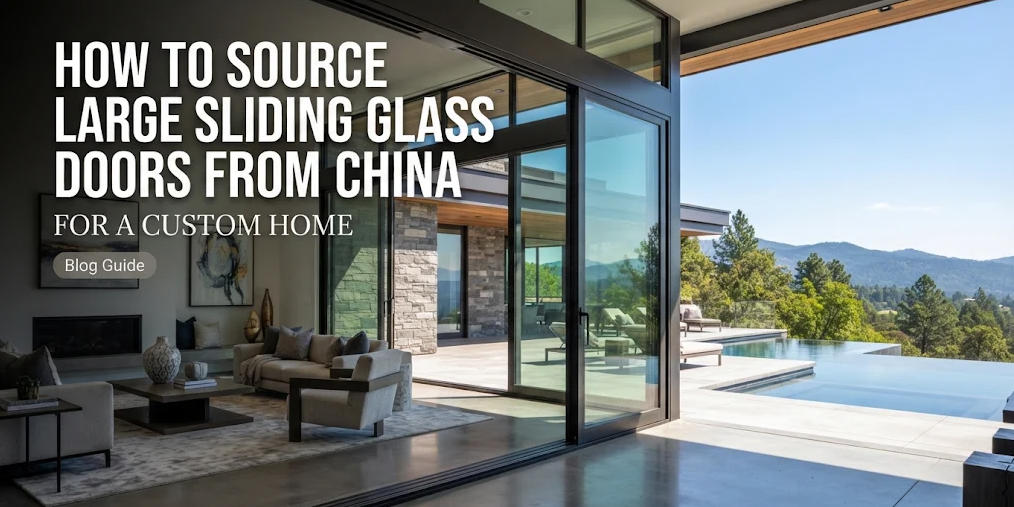
Large sliding glass doors are often one of the most visible and technically demanding elements in a custom villa.
They may connect a living room to a pool terrace, open a family room toward a garden, or create a continuous view across a sea-facing façade. Unlike standard residential doors, these openings can involve large glass panels, heavy operating loads, drainage requirements, structural coordination, and detailed installation conditions.
For a custom home, sourcing these doors from China is therefore not simply a matter of finding a factory with large glass doors in its catalogue.
The more practical approach is to start with the actual project requirements, define the door system and performance requirements, prepare the correct drawings, request comparable quotations, and then verify the supplier’s technical and production capabilities before placing the order.
This article explains the process from a villa procurement perspective.
Is Your Villa Project Ready to Source Large Sliding Glass Doors?
Before contacting Chinese suppliers, check whether you have enough project information to obtain meaningful quotations.
A supplier can usually quote a rough price from a simple opening size. That does not mean the quotation is suitable for placing an order.
For a serious custom-home project, the supplier should ideally receive:
- Project location and climate conditions
- Architectural floor plans and elevations
- Window and door schedule
- Opening dimensions
- Door type and opening direction
- Number of panels
- Approximate panel sizes
- Glass requirements
- Aluminium finish requirements
- Hardware preferences
- Threshold requirements
- Insect-screen requirements, if applicable
- Target order date
- Required delivery date
If your architect has already prepared a window and door schedule, that document is often a better starting point than sending screenshots or product photos.
If only a preliminary floor plan is available, the project may still be suitable for an initial feasibility review, but the quotation should be treated as preliminary rather than a production-ready price.
Start With the Door Opening, Not the Catalogue
A common mistake is to start with a supplier’s catalogue and choose a sliding door based on the largest size shown in the product brochure.
For a villa project, the opening should come first.
For example, a project may require a six-panel sliding door connecting a living room to an outdoor terrace. The architectural opening might look straightforward on a floor plan, but the supplier still needs to consider:
- Overall frame dimensions
- Individual panel width and height
- Panel weight
- Number of tracks
- Frame configuration
- Opening direction
- Fixed versus operable panels
- Meeting stile configuration
- Threshold height
- Drainage
- Glass thickness and weight
- Hardware load capacity
- Installation access
The question is therefore not simply:
“Can this factory make a 6-metre sliding door?”
A more useful question is:
“Can this supplier manufacture this specific door configuration with the required glass, hardware, frame, drainage and installation conditions?”
That distinction becomes increasingly important as the opening gets larger.
Choose the Sliding Door System Before Comparing Prices
“Large sliding glass door” can describe several different systems.
A conventional sliding system and a lift-and-slide system may look similar in photographs, but their operating mechanisms, hardware, panel weights, thresholds and pricing can be very different.
For a villa project, the specification should identify the intended system before comparing supplier quotations.
Depending on the design, the project may require:
- Standard aluminium sliding doors
- Heavy-duty sliding doors
- Lift-and-slide doors
- Multi-panel sliding systems
- Minimal-frame sliding systems
- Thermally broken aluminium systems
- Large fixed glass combined with sliding panels
- Corner-opening configurations
The system should be selected based on the opening size, operating requirements, climate, performance expectations and architectural design.
Do not ask five factories to quote “the same large sliding door” if each factory interprets the specification differently. You may receive five prices for five different products.
That makes the comparison almost meaningless.
What Should You Specify in the RFQ?
A useful RFQ should give suppliers enough information to quote the same basic scope.
1. Aluminium Frame
Specify the required system or at least the basic performance requirements.
Depending on the project, this may include:
- Aluminium alloy/system
- Profile series
- Frame depth
- Thermal-break requirement
- Surface finish
- Colour reference
- Exterior/interior finish
- Frame configuration
If the architect has already specified an aluminium system, send the specification instead of asking the supplier to choose an alternative without approval.
2. Glass
Glass should be specified separately from the frame.
Depending on the project, requirements may include:
- Glass thickness
- Tempered or laminated glass
- Double or triple glazing
- Low-E coating
- Solar-control requirements
- Clear, tinted or other glass appearance
- Acoustic requirements
- Safety requirements
For very large panels, glass weight becomes a practical issue because it affects hardware, handling, transportation and installation.
The correct glass specification should also be checked against the project’s local building requirements and the actual size and configuration of the panel.
3. Hardware
Hardware should not be treated as a minor detail.
For large sliding doors, confirm:
- Brand
- Hardware model or series
- Maximum supported panel weight
- Number of rollers
- Locking system
- Handle type
- Operating mechanism
- Replacement availability
If a supplier says its hardware can carry a particular panel weight, ask which hardware configuration is being used rather than relying only on a general catalogue statement.
4. Threshold
Threshold design can affect both appearance and construction.
For a flush or low-profile threshold, the supplier and project team need to consider:
- Drainage
- Waterproofing
- Floor finish
- Structural opening
- Exterior paving level
- Interior finished-floor level
A low threshold that looks attractive in a showroom can create problems if the surrounding waterproofing and drainage details have not been coordinated.
This is one reason why sliding-door procurement should be connected with the architectural and interior drawings rather than handled as an isolated product purchase.
What Drawings Should You Send to Chinese Suppliers?
The more customized the door, the more important the drawings become.
Ideally, send the supplier:
- Floor plans
- Elevations
- Window and door schedule
- Door opening dimensions
- Door numbering
- Section details
- Finished floor levels
- Relevant wall sections
- Structural opening information
- Exterior paving information
- Interior floor finish information
- Glass specifications
- Colour/finish schedule
If the project includes several different door types, use clear door numbers.
For example:
- D01 — 3-panel living room sliding door
- D02 — 6-panel pool-facing lift-and-slide door
- D03 — 4-panel bedroom terrace door
- D04 — corner-opening sliding system
This allows the supplier to quote and later produce shop drawings against a defined schedule.
It also makes supplier comparison much easier.
How to Request Comparable Quotations
Do not simply send:
“Please quote large sliding glass doors.”
Instead, create an RFQ schedule that gives each supplier the same information.
| Item | Information |
| Door No. | D02 |
| Location | Living room to pool terrace |
| Opening | 7,200 × 3,000 mm |
| Configuration | 6 panels |
| System | Lift-and-slide |
| Glass | Laminated / Low-E / project specification |
| Frame | Thermally broken aluminium |
| Finish | Exterior/interior colour |
| Threshold | Low threshold |
| Screen | Required / not required |
| Quantity | 1 set |
| Project location | Country / city |
| Required delivery | Target date |
The exact dimensions and specifications will vary from project to project. The important point is that every supplier receives the same information.
Otherwise, the lowest quotation may simply be based on a lighter frame, different glass, different hardware, or a different door configuration.
How to Compare Chinese Sliding Door Suppliers
Price should be only one part of the comparison.
For a custom villa, compare at least five areas:
Product System
Is the supplier quoting a system designed for the required opening size and panel weight?
Technical Specification
Does the quotation clearly identify the frame, glass, hardware, finish and threshold?
Manufacturing Capability
Has the factory produced doors with similar dimensions and configurations?
Shop Drawing Process
Will the supplier prepare detailed shop drawings before production?
Project Support
Can the supplier communicate effectively with your architect, designer, or project team when technical questions arise?
A factory may have excellent-looking showroom products but limited experience with unusually large configurations.
Conversely, a factory with less polished marketing material may have strong technical and production experience.
The comparison should therefore be based on the actual project rather than the appearance of the supplier’s website or showroom.
What Should Be Checked in the Technical Quotation?
Before comparing the final prices, check whether the quotation is technically complete.
Look for:
- Door dimensions
- Number of panels
- Opening configuration
- Aluminium system
- Frame dimensions
- Glass specification
- Glass thickness
- Glass configuration
- Hardware brand/model
- Surface finish
- Colour
- Threshold type
- Drainage arrangement
- Screens
- Accessories
- Packaging
- Loading method
- Delivery terms
- Any excluded items
Also check whether installation is included.
A factory quotation may cover manufacturing and export packing but not local unloading, lifting, installation, waterproofing, adjustment, or finishing work at the destination.
These costs should not be mixed together when comparing suppliers.
Why Shop Drawings Matter More Than the Initial Quotation
The initial quotation tells you approximately what the supplier intends to sell.
The shop drawings show what the supplier intends to manufacture.
That difference matters.
Before production, the shop drawings should allow the project team to review:
- Overall frame dimensions
- Panel dimensions
- Opening direction
- Fixed and sliding panels
- Glass specification
- Mullions and meeting stiles
- Handles and locks
- Threshold
- Drainage
- Frame connections
- Installation interfaces
- Relevant section details
If the project uses floor-to-ceiling doors, the drawings should also be coordinated with the surrounding floor and ceiling construction.
For complex villa projects, shop drawing approval should happen before production rather than after the factory has started manufacturing.
If you want to understand the broader shop-drawing approval process, see:
[What Should a Villa Owner Do Before Approving Window Shop Drawings?]
Who Should Take the Final Measurements?
This is one of the areas where procurement responsibility needs to be clearly separated from installation responsibility.
Architectural drawings may show the intended opening size, but the actual site condition can differ.
For a renovation, this difference can be substantial.
Even in a new-build villa, the final opening may change after structural work, plastering, waterproofing, flooring or other construction stages.
The person responsible for final site measurement should therefore be clearly agreed between the project team, local installer and supplier.
A sourcing company should not simply assume that the preliminary architectural dimension is automatically the final manufacturing dimension.
This is particularly important for large doors because a small dimensional discrepancy can become difficult to correct after production.
For related guidance, see:
[Who Should Take the Final Measurements for Villa Windows and Doors?]
Coordinate Sliding Doors With Flooring and Stone
Large sliding doors often sit directly beside expensive flooring, marble, or exterior stone.
The door threshold therefore needs to be coordinated before the materials are ordered.
Questions include:
- Where is the finished floor level?
- Does the threshold sit above or below the finished floor?
- How will the exterior paving meet the frame?
- Where does water drain?
- How is waterproofing connected to the door system?
- Is the interior floor flush with the threshold?
- Will marble or stone cover part of the frame?
- Does the flooring installation sequence affect the door installation?
This is especially important for pool-facing doors and large openings exposed to rain.
A visually minimal threshold is not automatically the correct construction detail.
For more on this issue, see:
[How Should Villa Windows Be Coordinated With Flooring and Stone?]
What About Very Large Glass Panels?
Large sliding doors create another technical question: the glass itself.
As panel dimensions increase, glass weight can increase significantly depending on thickness and configuration.
That affects:
- Hardware loading
- Rollers
- Frame design
- Transportation
- Lifting equipment
- Site access
- Installation method
- Replacement difficulty
Before approving an unusually large panel, ask the supplier to confirm the actual panel configuration and hardware capacity.
Do not rely only on a marketing statement such as “oversized glass available.”
The relevant question is whether the complete door assembly can be manufactured, transported, installed and operated under the conditions of your project.
If the villa is in a high-wind, coastal, tropical, cold or otherwise demanding environment, the performance requirements should be reviewed accordingly.
How to Verify a Factory’s Real Capability
A supplier’s website can show a product that looks suitable without proving that the factory can produce your specific configuration.
For a high-value villa project, ask for evidence that is relevant to your order.
Useful information may include:
- Previous projects with similar door dimensions
- Actual production photos
- Completed door photos
- Shop drawings from similar projects
- Hardware information
- Glass configuration
- Factory production facilities
- Quality-control procedures
- Packaging method
- Loading method
If the project is technically complex, a factory visit or independent inspection can provide additional information.
The purpose is not simply to see whether the factory looks large.
It is to verify whether the supplier’s actual production process matches the requirements of your project.
What Should Be Inspected Before Shipping?
For large custom doors, inspection should focus on the finished product rather than only the quantity.
Depending on the agreed inspection scope, checks may include:
Dimensions
Compare the finished products with the approved shop drawings.
Configuration
Confirm the correct number and arrangement of panels.
Glass
Check the glass specification, appearance, markings where applicable, and any visible damage.
Frame Finish
Check colour, surface finish, scratches, dents and other visible defects.
Hardware
Confirm the agreed hardware, handles, locks, rollers and accessories.
Operation
Where practical, verify that the panels move and operate as intended.
Packaging
Check whether the packaging protects the frames and glass adequately for the planned transportation.
Labelling
Make sure door numbers or other identification marks correspond with the project schedule.
This is particularly useful when a villa has many different door sizes and configurations.
Shipping Large Sliding Glass Doors From China
Large sliding doors require more attention during packing and loading than ordinary building materials.
The logistics plan should consider:
- Door dimensions
- Glass dimensions
- Number of packages
- Package weight
- Package volume
- Container loading
- Protection against movement
- Moisture protection
- Unloading requirements
- Site access
- Lifting equipment
Do not wait until production is complete to ask how the doors will be unloaded at the project site.
A large glass door may be perfectly suitable for the building but difficult to handle if the site has restricted access or limited lifting equipment.
For multi-category villa procurement, door and window packages can also be consolidated with other products, but loading must be planned around the dimensions, weight and protection requirements of each product.
A Practical Order Sequence for a Custom Villa
A large sliding-door procurement project normally works better when the steps are kept in order:
1. Architectural Drawings
Identify all relevant openings.
2. Window and Door Schedule
Assign door numbers and quantities.
3. Define Specifications
Confirm system, glass, aluminium finish, hardware and threshold requirements.
4. RFQ
Send the same project information to shortlisted suppliers.
5. Technical Comparison
Compare the specifications behind the prices.
6. Supplier Shortlisting
Check capability, previous work, communication and production process.
7. Shop Drawings
Ask the selected supplier to prepare drawings.
8. Technical Review
Review the drawings with the architect, designer and relevant project team.
9. Final Measurement
Confirm actual site dimensions according to the agreed measurement responsibility.
10. Production Approval
Release production only after the required specifications and drawings are approved.
11. QC
Inspect the completed products before shipment.
12. Packing and Loading
Check packaging, identification and loading arrangements.
13. Shipping
Arrange international transportation and destination delivery.
14. Local Installation
The local project team or installer handles installation according to the project’s construction requirements.
Keeping these stages separate reduces the risk of treating a preliminary quotation as a final manufacturing specification.
Common Mistakes When Sourcing Large Sliding Doors From China
Choosing the Lowest Price
A lower quotation may reflect a different aluminium system, glass specification, hardware package or scope.
Comparing Different Door Systems
A standard sliding door should not be compared directly with a lift-and-slide system simply because both are described as “sliding doors.”
Ordering From Catalogue Dimensions
A catalogue example does not automatically mean the same configuration is suitable for your project.
Ignoring Final Site Measurement
Architectural dimensions and actual construction openings are not always identical.
Treating Glass as a Separate Detail
Glass weight, thermal performance, safety and hardware capacity are connected to the complete door system.
Forgetting Installation
A factory can manufacture the door correctly while the project still faces installation problems if local construction conditions were not considered.
Approving Production Too Early
Once customized aluminium frames and glass are manufactured, changes can become expensive or impractical.
Buying From Too Many Suppliers Without a Clear Specification
If every supplier quotes a different configuration, collecting more quotations does not necessarily improve the purchasing decision.
When Does It Make Sense to Source Large Sliding Doors From China?
China sourcing can make practical sense when the project has a substantial custom door package, non-standard dimensions or several related building-material requirements.
It can also be useful when the project team is willing to spend time on technical comparison, shop-drawing review, production follow-up and inspection.
The decision should not be based only on the factory price.
Compare the expected landed cost:
Product Price + China Inland Costs + Export Charges + International Freight + Insurance + Import Duties/Taxes + Port/Customs Charges + Local Delivery + Inspection/Coordination Costs
Then consider the local installation cost separately.
For a private villa, the relevant question is not:
“Is the Chinese factory quotation cheaper?”
It is:
“After comparing equivalent specifications, logistics, installation and project requirements, does sourcing from China make sense for this particular villa?”
For a small number of standard doors, an urgent project, or a project where local technical support is particularly important, buying locally may be the better option.
How HSY Sourcing Can Help With a Villa Sliding-Door Package
For overseas villa owners, the difficult part is often not finding a Chinese supplier. It is coordinating several suppliers and making sure the quotations, drawings, specifications, production and shipping stay aligned with the project.
For a custom villa sliding-door package, our work can include:
- Reviewing the available project drawings and specifications
- Identifying suitable Chinese suppliers
- Requesting comparable quotations
- Communicating technical requirements with suppliers
- Comparing supplier specifications and pricing
- Coordinating shop-drawing discussions
- Following production
- Arranging factory visits or inspections when required
- Coordinating QC and inspection
- Receiving and consolidating products in China
- Arranging loading and shipping coordination
For larger villa projects, the sliding-door package can also be coordinated with other categories such as kitchens, wardrobes, stone, furniture, flooring and sanitary ware.
The objective is not to replace the architect, engineer or local installer. Those parties remain responsible for the professional design, structural requirements, local approvals, final site conditions and installation work within their scope.
FAQs
Can I source large sliding glass doors from China if I only have architectural drawings?
Yes, you can start with an initial supplier review and preliminary quotation. However, architectural drawings may not contain all the information needed for final production. Door configuration, glass specification, hardware, threshold details and final site measurements may still need to be confirmed.
Can Chinese factories make very large sliding doors?
Some Chinese manufacturers can produce large custom sliding-door systems, but capability varies by system, configuration, glass size, hardware and production equipment. Do not judge capability from a catalogue maximum alone. Ask for examples and technical details relevant to your actual door configuration.
Should I choose a standard sliding door or a lift-and-slide door?
It depends on the opening size, panel weight, operating requirements, architectural design and project specifications. Lift-and-slide systems can be useful for large and heavy panels because the operating mechanism is designed around lifting the panel before sliding it, but the complete system should be evaluated rather than choosing based on the name alone.
Do I need final measurements before ordering?
For production, the supplier normally needs confirmed dimensions according to the agreed measurement responsibility. The architectural opening shown in early drawings should not automatically be treated as the final manufacturing dimension.
Can sliding doors be shipped together with other villa materials?
Yes, depending on package dimensions, weight, container planning and the protection requirements of the other products. For a whole-villa procurement project, consolidation can be useful, but large glass and aluminium packages need careful loading and protection planning.
Should my architect review the factory shop drawings?
Yes, where the shop drawings affect architectural design, dimensions, interfaces or specified performance, they should be reviewed by the appropriate project professional. The sourcing company can coordinate communication with the factory, but it should not replace the architect, engineer or other responsible professional.
How many Chinese sliding-door suppliers should I compare?
There is no universal number. The objective should be to compare a manageable number of suppliers that can actually meet the project’s technical requirements. Five quotations for five different door systems are less useful than a smaller group quoting the same defined specification.
What Information Should You Prepare Before Asking for a Quote?
If you are already preparing to source large sliding glass doors for a custom villa, the following information will make the initial discussion much more productive:
- Project country and city
- Architectural floor plans
- Elevations
- Window and door schedule
- Door opening dimensions
- Door quantities
- Door configuration
- Glass requirements
- Aluminium finish
- Hardware requirements
- Threshold requirements
- Project stage
- Expected order date
- Required delivery date
If you already have a complete drawing package, send the actual project documents rather than only product reference photos.
The more closely the quotation reflects the real project, the more useful the supplier comparison becomes.
Key Takeaway
Large sliding glass doors should be sourced as part of the villa’s construction and architectural requirements, not as an isolated catalogue product.
A reliable procurement process starts with the actual opening and project drawings, defines the required door system and specifications, obtains comparable quotations, verifies supplier capability, reviews shop drawings, confirms final measurements, inspects the finished products and plans shipping and installation before production begins.
For a custom villa, the cheapest quotation is rarely enough information to make the decision.
The better comparison is between suppliers offering the same project requirements, technical specifications and scope.
If you already have your villa drawings or window and door schedule, the next step is to review the openings and specifications before approaching suppliers. HSY Sourcing can help coordinate the supplier quotation and procurement process in China based on the actual project requirements.