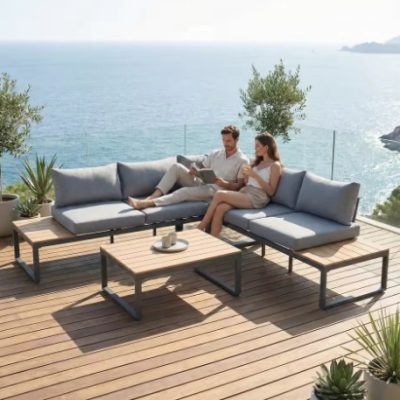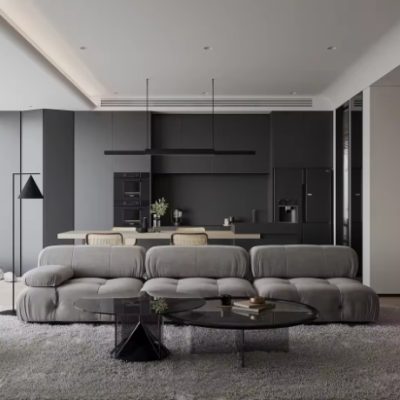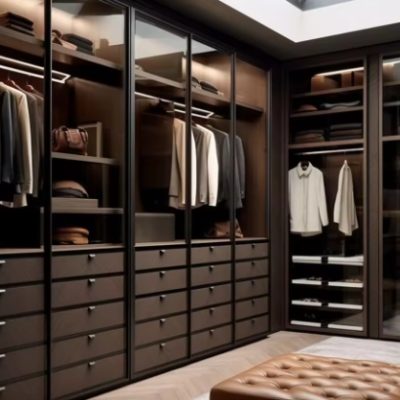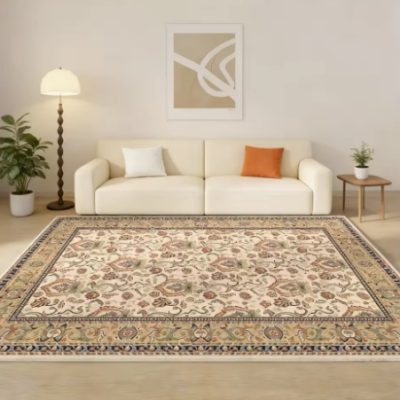

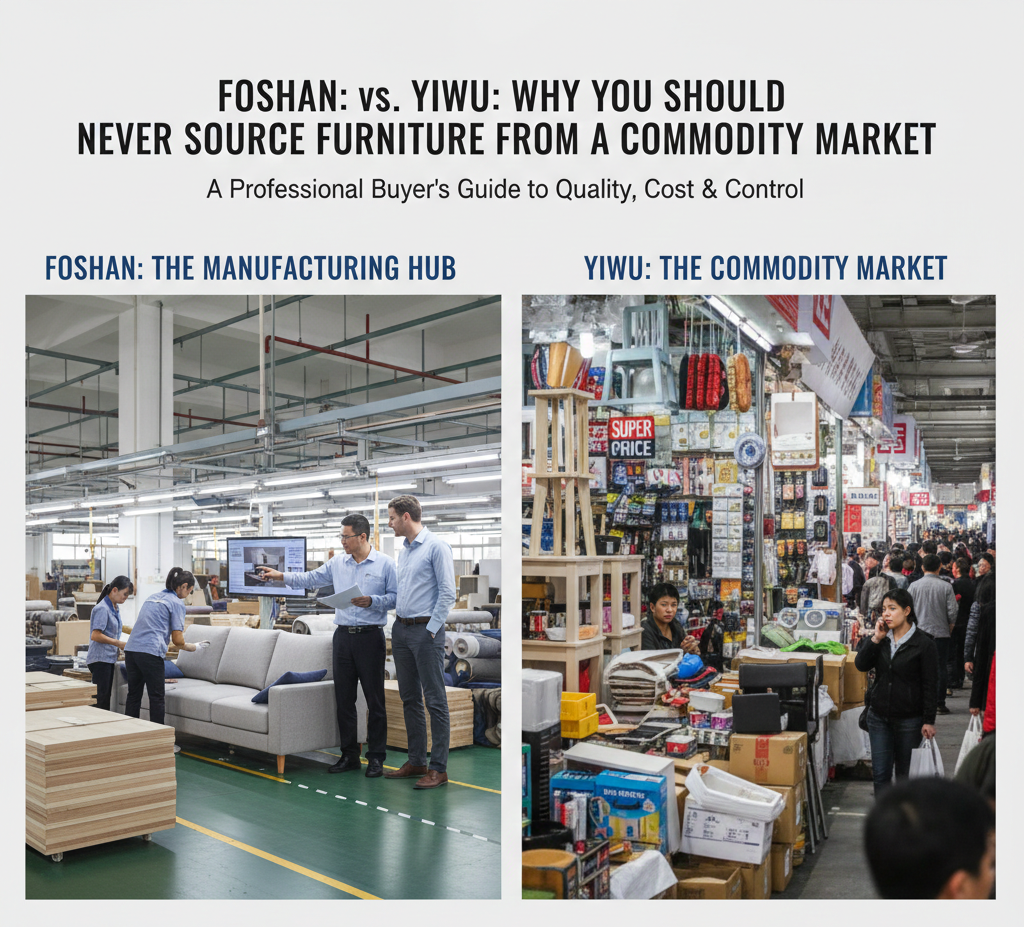
If you are new to the world of Chinese sourcing, you have almost certainly heard of Yiwu. It’s a city that has earned its title as the “World’s Small Commodity Capital.” The Yiwu International Trade City is a marvel—miles of booths filled with everything from Christmas ornaments to hair ties. For a first-time buyer, it feels like the ultimate one-stop shop.
Because Yiwu is so famous, many buyers make a logical but expensive mistake: they assume that because Yiwu is the “market for everything,” it must be a good place to buy furniture too.
However, if you talk to any experienced furniture importer or a professional sourcing agent, they will tell you the same thing: Never buy furniture in Yiwu. At HSY Sourcing, we are based in Foshan, the actual “Furniture Capital of the World.” We’ve seen many clients come to us after a frustrating experience in Yiwu, realized they’ve wasted time and money. Here is the honest, unfiltered truth about why the commodity market is a trap for furniture buyers and why the manufacturing hub of Foshan is the only logical choice.
Why is Yiwu so famous, and does that fame apply to furniture?
Yiwu is brilliant for what it was designed for: small commodities. If you are looking for items that can fit in a shoebox, items that are made by the millions, or items that are sold by the pallet, Yiwu is unbeatable. The ecosystem there is built for “ready-to-ship” goods with low MOQs (Minimum Order Quantities).
But furniture is not a small commodity. A sofa or a dining table is a complex, bulky, and high-value engineering project.
The fame of Yiwu attracts thousands of “trading booths.” When you see a beautiful bed or a modern wardrobe in a Yiwu showroom, you are almost never talking to the manufacturer. You are talking to a trader who has rented a small booth. That trader likely bought that furniture from a factory in Foshan, added a 20% to 30% markup, and transported it hundreds of miles to Yiwu just to display it to unsuspecting tourists and generalist buyers.
In Yiwu, you are paying a “convenience tax” to a middleman who doesn’t actually control the production. You get the price of a retailer with the service of a trader, which is the worst of both worlds for a B2B buyer.
What is the real difference between a “trading hub” and a “manufacturing hub”?
The most important concept in Chinese sourcing is the Industrial Cluster. In China, industries don’t spread out; they huddle together.
Foshan (specifically the Shunde and Longjiang districts) is a manufacturing hub. This means that within a 20-kilometer radius, you have the factory that cuts the wood, the factory that tans the leather, the factory that molds the foam, and the factory that assembles the final sofa.
When you source in Foshan, you are at the source. If there is a quality issue, we can drive to the workshop in 15 minutes and talk to the person holding the staple gun. We can see the raw materials before they are covered by fabric.
In Yiwu, you are in a trading hub. There are no large-scale furniture factories in Yiwu. The city doesn’t have the specialized labor, the raw material markets, or the industrial history for furniture. When you buy in Yiwu, the “supply chain” is invisible to you. If the table arrives with a scratch, the Yiwu trader has to call a factory in Foshan, who then has to ship a replacement part to Yiwu, who then ships it to you. Every step adds cost, time, and the risk of miscommunication.
Can you actually customize your designs in a commodity market?
Most of our clients aren’t just looking for “a chair.” They are looking for their chair. They want a specific fabric, a specific density of foam, a custom leg finish, or a modification to the dimensions to fit a specific hotel project.
In the Yiwu market, the motto is: “What you see is what you get.” Because the sellers are traders, they usually deal in “stock items.” They buy what is popular and sit on it. If you ask for a modification, they will either say “No” or they will say “Yes” just to get your deposit, and then struggle to explain your requirements to a factory they don’t actually own.
In Foshan, customization is the default. Since you are dealing with the people who actually build the furniture, we can talk about the internal structure. We can discuss whether to use a solid wood frame or a plywood frame to meet your budget. We can choose from ten different grades of velvet. This level of control is impossible in a general commodity market like Yiwu.
Why do logistics and packaging become a nightmare in Yiwu?
Furniture is “air and volume.” Shipping it is the most expensive part of the process.
Foshan has a massive, highly specialized furniture logistics infrastructure. The truck drivers here know how to handle 2.5-meter marble slabs. The container loaders in Foshan are “Tetris masters”—they know exactly how to stack a sofa on top of a dining table without crushing the cushions. They use specialized bracing and high-density foam because they do this every single day.
If you buy furniture in Yiwu, the goods have likely already traveled hundreds of miles from a factory to the Yiwu warehouse. That is double handling. Every time a piece of furniture is moved, the risk of damage increases by 50%.
Furthermore, Yiwu logistics are geared toward small boxes and pallets. They aren’t used to the specific requirements of heavy, oversized furniture. We have seen many “Yiwu-sourced” containers arrive at their destination with collapsed boxes and snapped table legs because the loaders treated a delicate buffet cabinet like a box of plastic toys.
Is the “lowest price” in Yiwu actually a hidden cost?
Yiwu is famous for being cheap. But in furniture, “cheap” is dangerous.
To compete with the direct-factory prices of Foshan, Yiwu traders often have to find the absolute lowest-end versions of products. They look for furniture that looks like a premium Foshan design but uses “cost-down” materials.
- They might use MDF instead of Plywood.
- They might use Recycled Foam instead of High-Resiliency Foam.
- They might use thin 201-grade steel instead of 304-grade stainless steel.
Because you are in a crowded market hall, you can’t see these hidden details. You see a low price, and you think you’ve found a bargain. But when the furniture arrives at your project and the sofa starts sagging after three months, that “bargain” becomes a massive liability.
In Foshan, because we have a relationship with the factories and we can walk onto the production floor, we can ensure that the price you pay matches the quality you need. We don’t look for the “cheapest” furniture; we look for the best value—the highest quality for every dollar spent.
How does HSY Sourcing navigate the Foshan market for you?
Foshan is a better market than Yiwu, but it is also more overwhelming. There are over 5,000 furniture factories in the Shunde area alone. Some are world-class; some are small family workshops that shouldn’t be exporting.
This is where having a local partner makes the difference. We don’t just “find a supplier.” We manage the entire lifecycle of your furniture project:
- Factory Auditing: We check if the factory actually has the machines and the workers they claim to have.
- Material Verification: We check the wood, the fabric, and the foam before they are assembled.
- Order Consolidation: If you are buying a bed from one factory and a sofa from another, we bring them together in our Foshan warehouse and load them into one container perfectly.
- Final QC: We perform a “real” inspection, checking every joint, every stitch, and every drawer glide.
Conclusion
Yiwu is a wonderful place to buy pens, umbrellas, and cheap electronics. It is a miracle of modern trade. But when it comes to furniture, the logic of the commodity market falls apart.
Buying furniture in Yiwu means paying more for a middleman, losing the ability to customize, and taking a massive risk with logistics and quality. Foshan is where the expertise is. It is where the materials are. It is where the real prices are.
If you are serious about building a furniture brand or furnishing a commercial project, go to the source. Skip the middleman in Yiwu and come to the heart of the industry.
Frequently Asked Questions: Sourcing from Foshan vs. Yiwu
If I only want to buy a few samples, isn’t Yiwu more convenient?
It seems that way on the surface, but it is often a trap. Yiwu’s strength is “ready-made stock,” but that stock is usually produced for the low-end domestic market. If you have specific quality requirements (like wood moisture content or eco-friendly fabric ratings), Yiwu traders can rarely give you a guarantee. In Foshan, while large factories have MOQs, there are thousands of workshops specialized in high-end customization and small batches. Through a local agent, you can get higher quality and lower prices in Foshan even for “sample-sized” orders.
How far apart are Foshan and Yiwu? Can I visit both in one trip?
They are very far apart. Foshan is in Guangdong Province (near Hong Kong/Guangzhou), while Yiwu is in Zhejiang Province (near Shanghai). They are over 1,200 km apart—about a 6-7 hour high-speed train ride or a 2-hour flight. If you only have one week in China, do not try to do both. If your goal is furniture, tiles, lighting, or sanitary ware, fly directly to Guangzhou/Foshan and spend all your time there. Going to Yiwu will only distract you and waste your budget on travel.
Is consolidating different items into one container harder in Foshan than in Yiwu?
Actually, it’s easier and safer in Foshan. Because Foshan is the global hub for furniture exports, the freight forwarders and warehouse managers here are specialists. They know exactly how to secure a heavy stone bathtub and a leather sofa in the same container without damage. In Yiwu, most logistics are geared toward small boxes and “parcel” goods. If you give high-end furniture to a generalist Yiwu forwarder, they may over-stack your items to save space, leading to crushed frames or ruined finishes upon arrival.
Are the prices in Yiwu truly lower?
If you only look at the price tag in a booth, it might look cheap. But you have to consider the “Landed Cost.” Since most of the furniture in Yiwu was originally shipped from Guangdong, the price you pay includes that long-distance domestic freight and the trader’s booth rent. By ordering directly from a Foshan factory, you cut out the double shipping costs and the middleman’s markup. You are getting factory-direct pricing at the source.
How do I actually start my sourcing journey in Foshan?
Don’t just search “furniture factory” on a map; you will get lost in the 5,000+ factories here. The best way is to first define your style (Modern, Classic, Minimalist, or Contract/Hotel grade). Foshan’s industrial zones are highly specialized—for example, Longjiang is famous for sofas, while Lecong is the massive distribution hub. If you aren’t sure where to start, send us your Bill of Quantities (BOQ). We can filter the factories based on your specific budget and quality level, taking you directly to the industrial parks that matter rather than wasting time in roadside showrooms.