
Building or renovating a high-end luxury villa in Florida, Texas, or California presents distinct architectural and regulatory challenges. While all three states favor expansive floor-to-ceiling glass, ultra-narrow sliding systems, and seamless indoor-outdoor living, their regional building codes, climate demands, and municipal inspection standards could not be more different.
A glass system engineered for a coastal estate in Miami will fail municipal inspection in the Texas Hill Country or violate energy compliance in Malibu.
Foshan, Guangdong, is the manufacturing center for top-tier custom architectural glazing. Local export facilities produce minimalist aluminum sliding doors and curtain wall systems capable of meeting North America’s strictest building standards at a direct-factory cost basis.
However, for private homeowners purchasing high-spec glazing packages for their personal residences, importing directly requires navigating state-specific compliance, engineering sign-offs, and custom factory quality control.
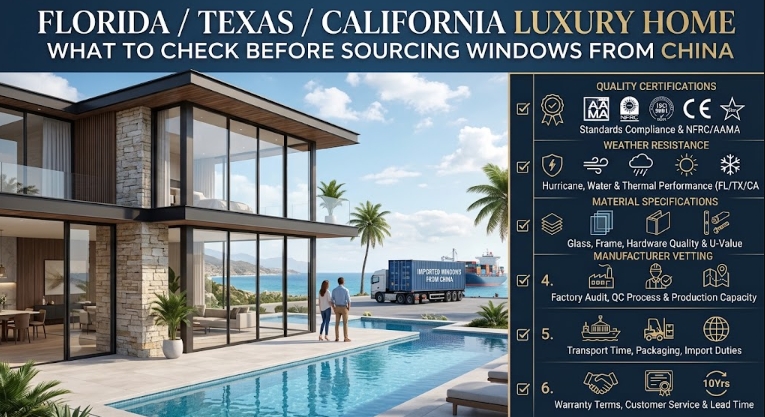
This technical guide breaks down exactly what private homeowners in Florida, Texas, and California must audit before ordering custom architectural windows and doors from Foshan.
Key Takeaways
- State Codes Dictate Frame & Glass Engineering: Florida requires Florida Building Code (FBC) / HVHZ impact certification; Texas demands TDI windstorm resistance; California mandates strict Title 24 thermal insulation (low U-Factors and SHGC). One window specification does not fit all three states.
- Mandatory Glass & Frame Markings: US municipal inspectors will fail uncertified jobsite installations. Windows must carry visible, corner-etched SGCC (ANSI Z97.1) safety marks and third-party laboratory test reports (NFRC or AAMA/WDMA/CSA 101/I.S.2/A440) matching jobsite engineering drawings.
- Structural Aluminum Specifications: High-load panoramic sliding doors (10 to 14 feet tall) require primary 6063-T6 aluminum extrusions with a minimum wall thickness of 2.5mm to 3.0mm, paired with PA66 GF25 polyamide thermal break bars. Never accept thin commercial profiles or PVC thermal strips.
- Comprehensive Landed Budgeting: Direct factory production in Foshan typically costs 40% to 60% less than US luxury boutique showroom quotes. Even after custom ISPM-15 A-frame crating, ocean shipping, Section 301 tariffs, and customs clearance, net landed savings for a private villa project usually sit between 35% and 50%.
State-by-State Breakdown: What Must Your Windows Pass in FL, TX, and CA?
Before selecting window profiles or requesting factory quotes in Foshan, your architectural plans must be reconciled against your state’s environmental and municipal mandates.
+-----------------------------------------------------------------------------------+
|                  US REGIONAL WINDOW COMPLIANCE REQUIREMENTS                       |
+-------------------+-----------------------------------+---------------------------+
| Target State      | Primary Regulatory Focus          | Key Certifications Needed |
+-------------------+-----------------------------------+---------------------------+
| Florida           | High-Velocity Hurricane Zones     | FBC Approval, HVHZ,       |
| (FL)              | (HVHZ), Wind-Borne Debris, SGP    | TAS 201/202/203, ASTM E1996|
+-------------------+-----------------------------------+---------------------------+
| Texas             | Gulf Coast Windstorm / Inland Heat| TDI (Texas Dept of Ins),   |
| (TX)              | Solar Heat Gain Coefficient (SHGC)| ASTM E330 Structural      |
+-------------------+-----------------------------------+---------------------------+
| California        | Title 24 Energy Efficiency,       | NFRC Certified U-Factor,  |
| (CA)              | Wildfire Zone (WUI) Compliance    | CALGreen, Tempered Glass  |
+-------------------+-----------------------------------+---------------------------+
1. Florida: Hurricane Impact & HVHZ Testing
Florida maintains the strictest wind-borne debris regulations in North America, particularly in High-Velocity Hurricane Zones (Miami-Dade and Broward counties).
- Glass Spec: Laminated insulated glass units (IGUs) utilizing structural interlayers like Kuraray SentryGlas® (SGP) rather than standard PVB interlayers. SGP stays rigid even if both glass panes shatter under high winds.
- Testing Standards: Assemblies must be tested under TAS 201 (Large Missile Impact), TAS 202 (Uniform Static Air Pressure), and TAS 203 (Cyclic Wind Pressure Loading). Look for valid Florida Product Approvals (FBC) or Miami-Dade NOAs (Notice of Acceptance).
2. Texas: Windstorm Resistance & High-Heat Loads
Texas coastal builds (such as Galveston or Corpus Christi) fall under Texas Department of Insurance (TDI) windstorm inspection requirements, while inland luxury builds in Austin, Dallas, and Houston focus heavily on solar radiation control.
- Glass Spec: Double-glazed units combining Low-E coatings (such as Solarban 60/70) with Argon gas fills to achieve low Solar Heat Gain Coefficients (SHGC ≤ 0.23), preventing air conditioning overload during extended 100°F+ summer heatwaves.
3. California: Title 24 Energy Code & Wildfire Safety
California prioritizes thermal insulation, strict energy conservation, and fire safety (WUI zones).
- Glass & Frame Spec: Double or triple-pane units integrated into deep PA66 GF25 polyamide thermal break frames to hit demanding U-Factors (≤ 0.24 to 0.28).
- WUI Zones: For villas built in Wildfire-Urban Interface zones (e.g., Malibu, Santa Barbara, Lake Tahoe), exterior glass panes must be fully tempered to withstand thermal shock from radiant wildfire heat.
What Technical Frame Details Separate Luxury Villa Glazing from Commercial Grade?
Private homeowners often assume all aluminum window profiles look and perform the same. On the factory floor in Foshan, structural design varies dramatically between builder-grade profiles and custom residential systems.
+-------------------------------------------------------------------------+
|                STRUCTURAL ALUMINUM PROFILE CROSS-SECTION                |
|                                                                         |
|  [Exterior Aluminum Profile (6063-T6)]                                  |
|         │                                                               |
|         ▼                                                               |
|  [PA66 GF25 Polyamide Thermal Break Bar]  ◄── Blocks Heat Bridge        |
|         ▲                                                               |
|         │                                                               |
|  [Interior Aluminum Profile (6063-T6)]                                  |
|                                                                         |
|  * Minimum Wall Thickness: 2.5mm – 3.0mm for Large Sliding Doors        |
|  * Surface Finish: AkzoNobel / PPG PVDF Fluorocarbon Coating            |
+-------------------------------------------------------------------------+
Profile Alloy and Wall Thickness
Large panoramic glass panels place immense structural load on bottom tracks and side stiles.
- Alloy Grade: Primary aluminum extrusions must be 6063-T5 or 6063-T6 architectural grade aluminum.
- Profile Thickness: While commercial export windows use 1.4mm to 1.8mm aluminum wall thickness, luxury villa sliding doors require 2.5mm to 3.0mm primary wall thickness to prevent frame deflection under sustained wind pressures.
Thermal Isolation Material
Never permit cheap PVC insulation bars inside your window frames. High-spec profiles utilize PA66 GF25 (25% glass fiber reinforced polyamide) struts. PA66 shares the same thermal expansion rate as aluminum, meaning the frame will not crack, warp, or lose seal integrity when ambient temperatures shift.
Exterior Surface Finishes
For coastal estates in Florida or California, standard powder coating oxidizes under salt spray and intense UV exposure within a few years. Specify AkzoNobel or PPG PVDF (fluorocarbon) spray coatings, which carry 15- to 20-year color-fast and anti-corrosion performance warranties.
How Do Private Homeowners Avoid Jobsite Permit and Inspection Rejections in the US?
The biggest fear for a private homeowner importing custom windows is having their local US municipal building inspector issue a stop-work order due to missing label certifications.
+-----------------------------------------------------------------------------------+
|                        MANDATORY JOBSITE INSPECTION CHECKLIST                      |
|                                                                                   |
|  [Glass Corner Markings]   ──> Permanent SGCC (ANSI Z97.1) logo etched on glass    |
|  [Thermal Test Verification] ──> Third-party NFRC lab test reports for energy code|
|  [Structural Performance]  ──> AAMA/WDMA/CSA 101/I.S.2/A440 testing documentation |
|  [Shop Drawing Sign-Off]   ──> Sealed CAD shop drawings detailing structural anchors|
+-----------------------------------------------------------------------------------+
1. Verify Permanent Glass Safety Etching
All tempered and laminated glass panels installed in doors, wet areas, or low-sill windows must feature a permanent logo etched into the glass corner showing SGCC (Safety Glazing Certification Council) or ANSI Z97.1 compliance. Inspectors physically examine glass corners before closing framing permits.
2. Match Architectural CAD Shop Drawings
Do not allow the factory to begin cutting aluminum extrusions based on preliminary 3D architectural renderings. Require complete metric CAD shop drawings that detail:
- Exact rough opening (R.O.) deductions and shim spaces.
- Nail fin setbacks or flush-mount installation flanges tailored to US wood frame or concrete block construction.
- Sub-floor recessed track drainage weep-holes and flashing integration.
What Is the Real Landed Cost Advantage for Private Villa Builds?
Sourcing direct from Foshan is an investment in higher material specifications, direct customization, and financial efficiency.
+-------------------------------------------------------------------------+
|                  TOTAL LANDED COST BREAKDOWN FOR US IMPORT              |
|                                                                         |
|  [Direct Factory Price]     ──> Custom Thermal Break Frames + IGUs + HW |
|             +                                                           |
|  [Export Packaging]        ──> Fumigated Solid Plywood A-Frame Skids    |
|             +                                                           |
|  [Ocean Freight & Transit]  ──> 40ft HQ FCL Container + Marine Insurance|
|             +                                                           |
|  [US Import Clearance]     ──> HTS Customs Duty + Section 301 + Drayage |
+-------------------------------------------------------------------------+
Cost Comparison Scenario
For a 7,500-square-foot luxury estate requiring 220 square meters (approx. 2,360 sq. ft.) of custom architectural glazing (including 12-foot-tall pocketing glass doors and slim-frame casement windows):
- US Boutique Showroom Quote: $160,000 to $280,000 (excluding local tax and installation).
- Foshan Direct Factory Cost (Tier-1 Export Spec): $48,000 to $78,000 EXW.
- Landed Expenses (Packaging, Shipping, Tariffs, Brokerage): $18,000 to $28,000.
- Total Landed Cost: $66,000 to $106,000.
By sourcing directly from Foshan, private homeowners achieve 35% to 50% net project savings, while upgrading their material specs to thicker aluminum extrusions, SGP laminated glass, and German concealed hardware.
Why Choose HSY Sourcing as Your Private Villa Procurement Partner in Foshan?
Navigating engineering specifications, factory floor quality control, and export logistics from across the globe requires a dedicated team on the ground. HSY Sourcing acts exclusively as your private representative, technical engineer, and quality auditor in Foshan.
- Dedicated Homeowner Representation: We represent private villa owners—not the factories. We operate on a transparent, flat service fee with zero hidden factory commissions or inflated material quotes.
- US Code & Blueprint Reconciliation: We review your architectural plans, convert imperial measurements into metric shop drawings, and verify that frame setbacks, structural anchors, glass SGCC logos, and thermal profiles comply with Florida, Texas, or California codes before manufacturing begins.
- Rigorous On-Site Quality Control: Our engineers conduct multi-stage physical inspections at the factory in Foshan:
- Caliper & Material Audits: Measuring aluminum wall thickness and testing PA66 polyamide bar integrity.
- Water & Assembly Testing: Verifying corner crimping tightness, EPDM rubber seal alignment, and drainage channel functionality.
- Trial Mock-Up Assembly: Checking 100% factory pre-assemblies of large sliding door systems to test structural rigidity, roller action, and gap tolerances.
- Supervised Staging & Export Packaging: We manage goods at our Foshan staging facility, inspecting solid plywood A-frame skids and supervising container loading with ratchet lashing and dunnage air bags to ensure zero ocean transit damage.
Frequently Asked Questions (FAQ)
Will my local US general contractor know how to install custom windows imported from Foshan?
Yes. Professional window installation crews in FL, TX, and CA follow standard structural flange or anchor-block installation methods. HSY Sourcing provides comprehensive metric-to-imperial CAD shop drawings, installation elevation guides, and hardware breakdown sheets so your local installation crew can execute the install seamlessly.
How are glass samples approved before full factory production starts?
Prior to production, HSY Sourcing dispatches a physical sample package via express air courier directly to your address in the US. This includes aluminum profile cross-sections in your specified anodized or PVDF color finish, glass performance swatches, thermal bar samples, and hardware mock-ups for your physical sign-off.
What happens if a glass panel breaks during ocean shipping?
By enforcing solid ISPM-15 fumigated plywood A-frame crating, corner protective guards, and supervised container lashing, shipping damage is extremely rare. Additionally, every shipment is covered by full-value marine transit insurance. Should a panel arrive damaged, HSY Sourcing holds your project’s exact metric CAD specs on file, allowing us to re-fabricate the glass panel in Foshan within 5 business days and express ship it to your jobsite.
Can we integrate motorized sliding doors and smart-home controls?
Yes. Top-tier window fabricators in Foshan specialize in concealed motorized sliding door systems. These units feature heavy-duty hidden motors capable of moving 500kg (1,100 lbs) glass panels silently, fully compatible with home automation systems like Control4, Crestron, or smartphone app controllers.