
If you sell online, you already know the story: The air fryer is the undisputed king of kitchen appliances. Everyone wants a piece of the pie, and 80% of those air fryers come from one place: Shunde, China.
Because of this “Gold Rush,” finding an air fryer factory in Shunde is incredibly easy. But finding one that won’t get your Amazon account banned or destroy your brand with 1-star reviews? That is the hard part.
The days of simply picking a random air fryer off Alibaba, slapping your logo on it, and making easy money are over. The market is saturated, and the rules are strict. Here is the unfiltered reality of sourcing air fryers today, and what you actually need to watch out for.
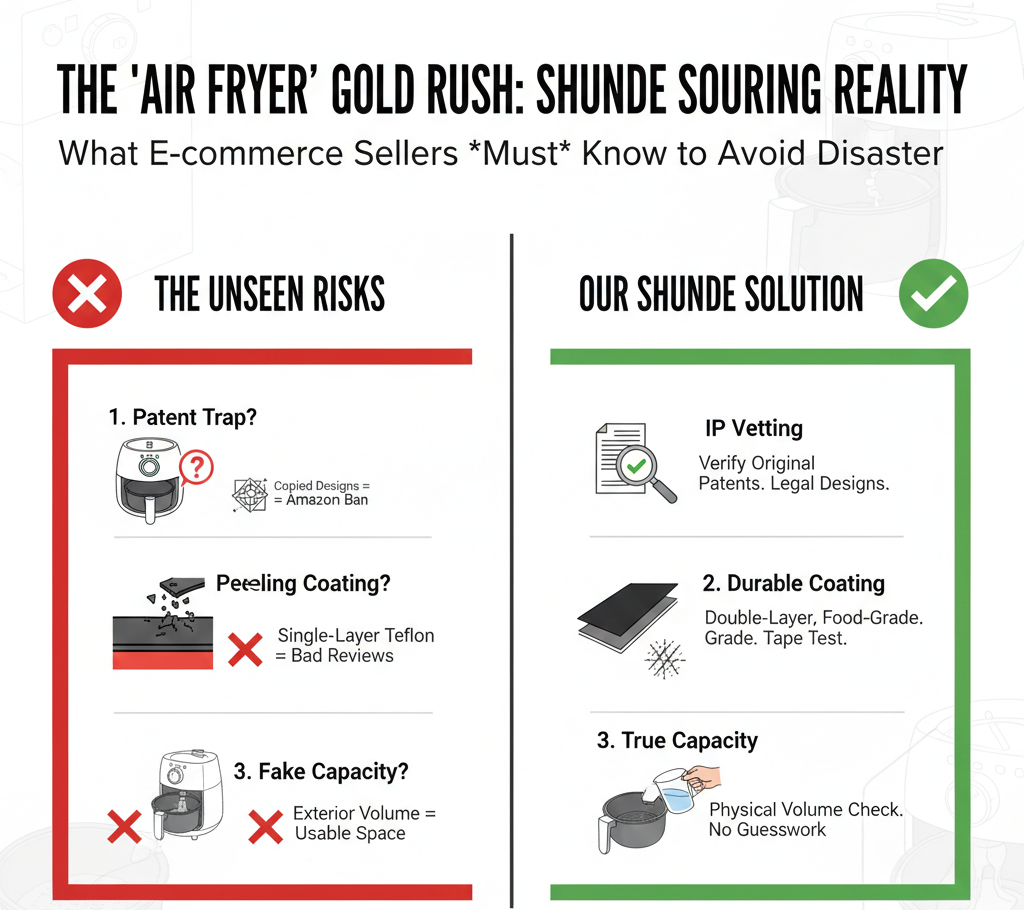
1. The Patent Minefield: Don’t Get Sued
This is the fastest way to lose your business. Big brands like Philips and Ninja hold massive patents on air fryer technology—specifically things like the “starfish” bottom design that circulates air, or certain dual-basket shapes.
The Reality: Many smaller factories in Shunde want quick orders, so they just copy these patented designs. They will tell you, “Don’t worry, it’s fine to sell.” But it’s not fine. As soon as your listing gets traction on Amazon, the big brands will file an IP (Intellectual Property) complaint. Amazon will freeze your funds and delete your listing. What We Do: We don’t just look at the product; we ask the factory for their own design patents. If the internal basket looks exactly like a Philips, we walk away. You need an “open mold” that is legally safe.
2. The Peeling Basket: The 1-Star Review Magnet
If you read the bad reviews on cheap air fryers, 90% of them say the same thing: “The non-stick coating started peeling off into my food after two weeks.”
The Reality: The basket is the most expensive part of the air fryer. To cut costs, bad factories use a single, thin layer of low-grade Teflon. It looks great in the showroom, but it fails in the dishwasher. What We Do: We negotiate the coating specs directly. We insist on double-layer, high-temperature food-grade coatings (or ceramic). During our mid-production inspections, we perform the “Cross-Cut Tape Test”—we literally scratch the coating and use strong tape to see if it peels off.
3. The “Fake Capacity” Trick
You order a 5-Quart (5L) air fryer to compete with the bestsellers. But when customers get it, they complain it’s too small to fit a whole chicken.
The Reality: Factory math can be tricky. A dishonest factory will measure the entire inside of the machine (including the space around the heating element) to claim it is 5 Quarts. But the actual, usable food basket is only 3.5 Quarts. Customers aren’t stupid; they will return it. What We Do: We don’t trust the spec sheet. We take a measuring jug and physically pour water into the food basket at the factory to verify the true, usable volume. If they quote 5 Quarts, you are getting 5 Quarts.
4. Temperature Liars (Soggy Fries)
An air fryer is basically a powerful fan and a heating element. To get that “fried” crispiness, it needs to hit 400°F (200°C) quickly and maintain it.
The Reality: Cheaper models use underpowered heating elements and cheap thermostats. The digital screen might say 400°F, but the inside is only hitting 350°F. The result? The food comes out soggy and wet, not crispy. What We Do: During our factory audit, we run the machines with digital thermocouple probes inside the basket to track the real temperature curve. We make sure the heating element has the actual wattage they promised.
The Bottom Line
Shunde has the best appliance factories in the world, but it also has plenty of bad ones trying to make a quick buck off the air fryer trend.
If you are an e-commerce seller, your reputation is everything. You cannot afford to be the “guinea pig” for a factory’s cheap coating or stolen design. You need someone on the ground in Shunde who knows how to open the machine, test the basket, and check the paperwork before you wire a single dollar.
FAQ: Sourcing Air Fryers in Shunde
Q: Can I still make money selling air fryers on Amazon?
A: Yes, but not with generic, cheap models. The money is in “niche” upgrades: unique colors, glass-basket air fryers (toxin-free), smart-app integration, or dual-zone fryers. We help you find factories capable of these upgrades.
Q: What is the typical MOQ for a customized air fryer?
A: If you just want your logo and a custom box on an existing safe design, the MOQ is usually 1,000 units. If you want a custom plastic color (Pantone match), it might be 1,500 to 2,000 units depending on the factory.
Q: Do I need FDA testing for the basket?
A: Absolutely. If you are selling to the US, anything that touches food must pass FDA (or LFGB for Europe) food-contact testing. We ensure the factory provides valid, recent test reports for the exact coating material they are using on your batch.
Q: How long does it take from ordering to shipping?
A: For a first-time order with a new logo and custom packaging, expect 40 to 45 days for production. Repeat orders usually drop to 30 days.