
If you’re planning to sell physical products—whether on Amazon, in retail, or as a wholesaler—you’ll come across the term product sourcing very early.
But what does it actually mean in real business?
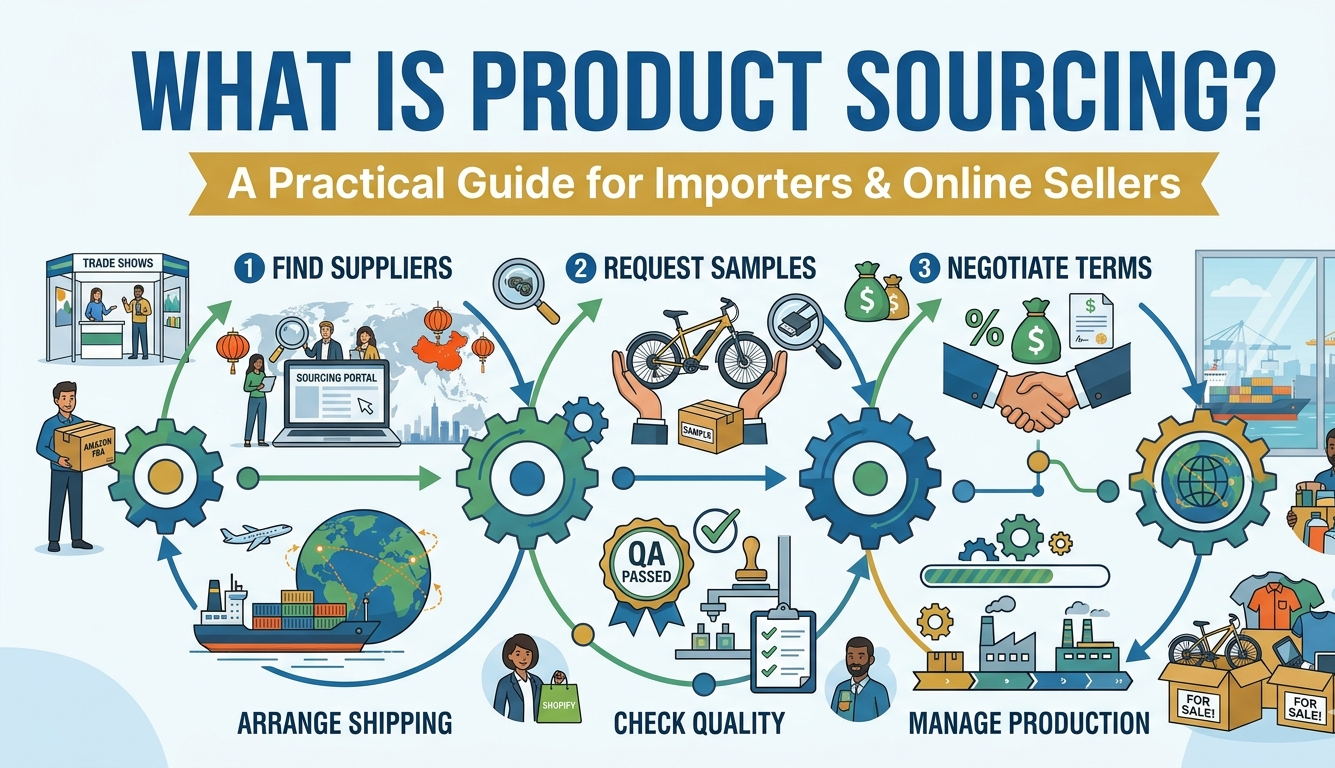
In simple terms, product sourcing is the process of finding suppliers, negotiating terms, and getting products ready for sale.
In reality, it involves much more than just “finding a factory.”
What Does Product Sourcing Actually Include?
Product sourcing is not just one step—it’s a process.
It usually includes:
- finding suppliers (factories or trading companies)
- comparing prices and capabilities
- requesting samples
- negotiating terms
- managing production
- checking product quality
- arranging shipping
Why Is Product Sourcing More Difficult Than It Looks?
At first, sourcing seems simple.
You search online, contact a supplier, and place an order.
But in practice, common problems include:
- suppliers not matching their claims
- unclear communication about specs
- inconsistent product quality
- delays in production
- hidden costs (packaging, shipping, rework)
Many of these issues only show up after you’ve already paid or started production.
Where Do Most Importers Source Products From?
China remains one of the main sourcing destinations.
Reasons include:
- large manufacturing base
- competitive pricing
- wide product categories
- mature export experience
Other countries (like Vietnam, India) are also used, but China still dominates for many categories.
For products like e-bikes, electronics, and consumer goods, supply chains are still heavily based in China.
How Do Buyers Actually Find Suppliers?
There are several common methods:
Online platforms
- Alibaba
- Made-in-China
Trade shows
- Canton Fair
- industry exhibitions
Direct factory search
- Google search
- referrals
Working with sourcing agents
- local teams in China
- supplier networks
Each method has pros and cons, depending on your experience and product type.
What Is the Difference Between a Factory and a Trading Company?
This is one of the most confusing parts for new buyers.
Factory:
- produces goods directly
- more control over production
Trading company:
- sources from multiple factories
- offers flexibility and variety
In reality, many suppliers are a mix of both.
This is why supplier verification becomes important during sourcing.
What Role Does a China Sourcing Agent Play?
A sourcing agent helps manage the sourcing process locally.
Typical support includes:
- supplier identification
- price negotiation
- sample follow-up
- production tracking
- quality inspection
- shipping coordination
For buyers who are not familiar with the Chinese market, this can reduce communication gaps and save time.
However, working with an agent also adds cost and requires clear expectations.
How Do You Reduce Risk in Product Sourcing?
There is no risk-free sourcing.
But you can reduce problems by:
- starting with small orders
- testing samples carefully
- verifying suppliers
- setting clear specifications
- checking quality before shipment
Most sourcing issues happen due to unclear communication or unrealistic expectations.
Is Product Sourcing Only for Large Businesses?
No.
Today, many small businesses and e-commerce sellers are involved in product sourcing.
Examples include:
- Amazon FBA sellers
- Shopify store owners
- small wholesalers
The process is similar—the difference is order size and experience level.
What Are the Most Common Mistakes in Product Sourcing?
Some typical mistakes include:
- choosing suppliers based only on price
- skipping sample testing
- not confirming product details clearly
- ignoring quality control
- underestimating shipping complexity
These mistakes can lead to higher costs later.
Key Takeaways
- Product sourcing is more than just finding a supplier
- It includes negotiation, production, quality, and logistics
- China remains a key sourcing hub for many industries
- Risks can be reduced but not eliminated
- Clear communication and testing are critical
FAQ: Product Sourcing Explained
What is product sourcing in simple terms?
Product sourcing is the process of finding suppliers and getting products ready for sale.
This includes not just choosing a supplier, but also managing pricing, quality, production, and shipping.
For example, an Amazon seller sourcing from China needs to confirm product specs, test samples, and ensure consistent quality before selling.
What is the difference between product sourcing and procurement?
Product sourcing focuses on finding and evaluating suppliers.
Procurement is a broader process that includes purchasing, contracts, and supply chain management.
In small businesses, these terms are often used interchangeably, but in larger companies, procurement is more structured and involves multiple departments.
Is product sourcing from China still a good option?
For many products, yes.
China still offers:
- competitive pricing
- large supplier base
- flexible production
However, buyers should also consider factors like shipping costs, tariffs, and supplier reliability.
The key is not just choosing China, but choosing the right supplier.
How do beginners start product sourcing?
A common approach is:
- choose a product
- search for suppliers online
- contact multiple suppliers
- request samples
- compare quality and pricing
- start with a small order
This helps reduce risk while gaining experience.
Do I need a sourcing agent in China?
Not always.
If you have experience and reliable suppliers, you may manage sourcing yourself.
But for complex products or first-time buyers, a sourcing agent can help with communication, coordination, and quality control.
What are the risks of product sourcing?
Some of the most common risks include:
- product quality issues
- supplier miscommunication
- delayed shipments
- unexpected costs
These risks can be reduced with better planning and supplier management.