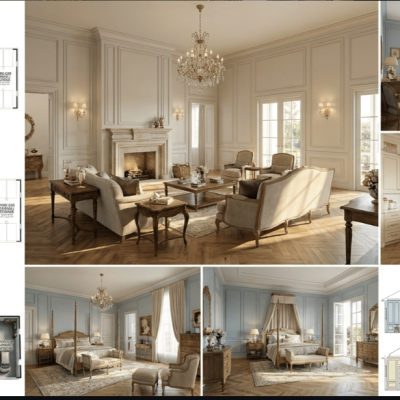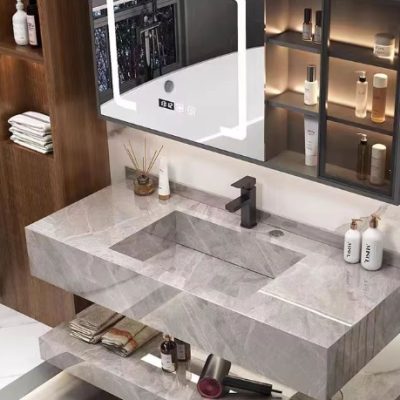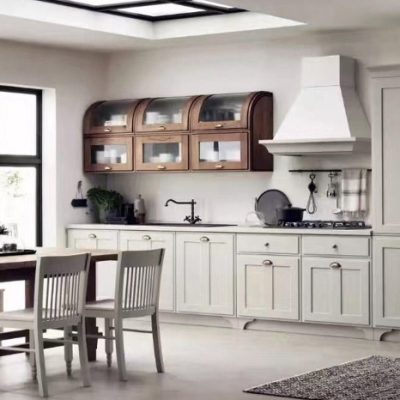

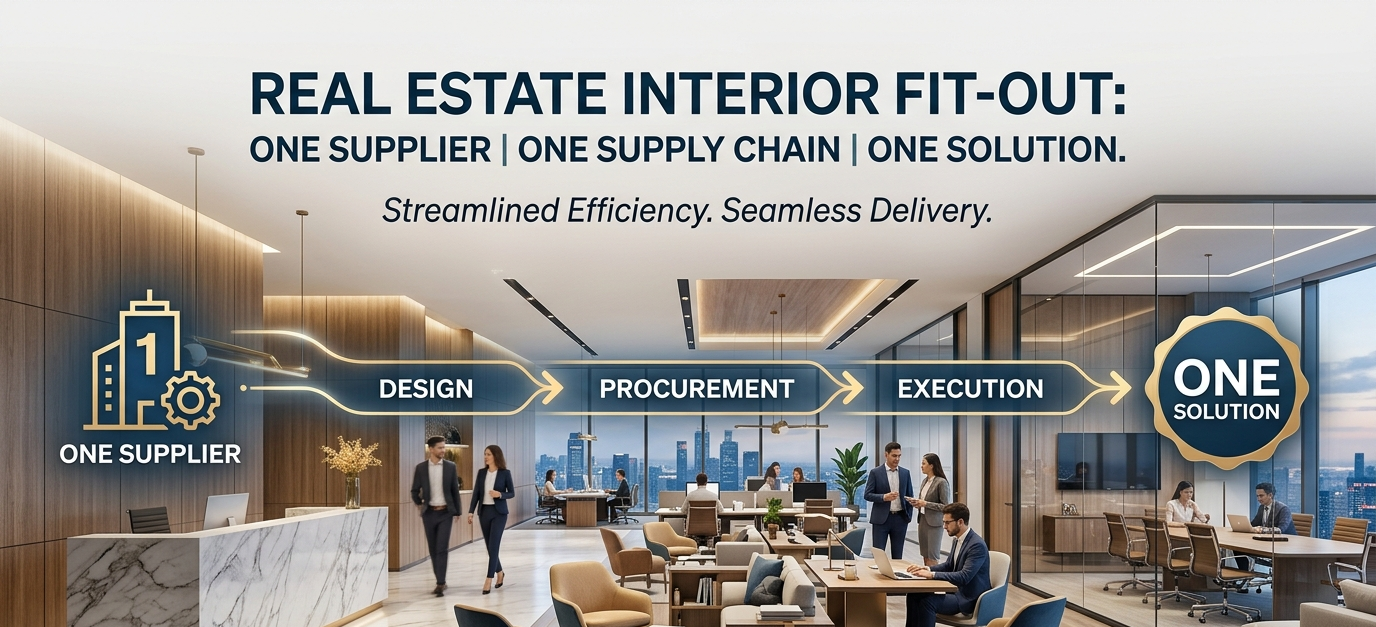
Executing an interior fit-out for a hotel development, a multi-family apartment block, or a luxury villa community requires managing a highly fragmented Bill of Quantities (BOQ). A standard hospitality or residential interior package spans multiple distinct manufacturing sectors: custom millwork, upholstered seating, porcelain flooring, vitreous china sanitary ware, architectural aluminum, and decorative lighting.
In a traditional procurement model, a developer assigns these packages to separate specialized factories, often scattered across different regions. While this might appear to secure baseline factory-level pricing for individual items, it introduces significant structural friction into the broader project lifecycle.
Mismatched production schedules lead to compounding storage fees, communication gaps result in dimensional misalignments between adjacent materials, and fragmented shipping creates substantial less-than-container-load (LCL) port handling premiums.
Centralizing these disparate categories into a unified, single-source supply chain framework in Foshan, China, solves these coordination issues, allowing developers to manage specification, quality control, and export logistics through an integrated operation.
Key Takeaways
- Interface Risk Reduction: Managing multiple interior finishes under one localized engineering framework eliminates dimensional and aesthetic mismatches between separate factory outputs before export.
- Logistical Optimization: Consolidating heavy structural components (porcelain tiles) and volumetric items (cabinetry and sofas) into engineered Full Container Loads (FCL) lowers total ocean freight costs by up to 40% compared to fragmented LCL shipping.
- Schedule Synchronization: Staggering factory deposit releases based on specific manufacturing lead times ensures that separate material packages arrive at the loading dock within a single, coordinated 72-hour window.
Why does single-source procurement reduce execution risks in real estate fit-outs?
The most critical vulnerabilities in real estate fit-outs occur where different material categories physically meet on-site. When a procurement director sources a custom bathroom vanity from a furniture mill in one district, the undermount ceramic sink from a sanitary ware plant in another, and the brass tapware from a third plumbing hub, they inherit the role of a manufacturing integration engineer.
Minor discrepancies in shop drawings—such as an incorrect diameter for a faucet mounting hole, a misaligned waste pipe cutout, or a variance in stone countertop edge profiling—are rarely caught via email. When these components arrive independently at a construction site in New York, London, or Dubai, correction requires expensive field modifications, field repairs, or complete remanufacturing, all of which push back tenant handover or hotel opening dates.
A single-source procurement framework establishes centralized interface control. It allows physical component validation to occur during active production. Sample faucets can be dispatched directly to the vanity assembly line for real-time fitting tests, and custom wood veneer panels can be cross-checked against adjacent aluminum door trims under standardized lighting, resolving finish and dimensional issues on the factory floor.
How does a unified Foshan supply chain optimize project timelines?
Time drift in multi-vendor procurement is caused by the geographical and operational separation of independent factories. Different interior finishing products have fundamentally different production cycles:
- Custom Casegoods & Joinery: Requires 40 to 45 days for technical shop drawing approval, veneer sourcing, core preparation, and multi-stage finishing.
- Porcelain Tiles & Stone Surfaces: Can typically be manufactured, sorted, and packed within 15 to 20 days depending on kiln scheduling.
- Standard Sanitary Ware & Hardware: Often available from production runs or locked inventory frameworks within 10 to 15 days.
Without ground-level synchronization, releasing all factory deposits simultaneously creates warehouse clutter. The tile and plumbing manufacturers will complete their runs early and send their pallets to an export dock warehouse, where they accumulate steep storage fees while waiting for the custom joinery to finish production.
Centralizing operations in Foshan leverages the region’s geographical density. Because the world’s primary furniture hub (Shunde), ceramic center (Chancheng), and aluminum sector (Nanhai) are located within a 50-kilometer radius, a single local office can stagger procurement releases.
By reverse-engineering the final shipping date, production is synchronized so that all distinct material packages arrive at a central consolidation yard within the same 48 to 72-hour window, eliminating unnecessary storage costs.
What logistical frameworks prevent transit damage and CBM waste?
Shipping building materials internationally requires balancing container weight limits against total cubic meter (CBM) volume. Ocean freight costs are calculated per container unit (e.g., a 40-foot High Cube container provides roughly 68 CBM and a maximum safe weight payload of 26 to 28 metric tons).
Sourcing materials via separate, uncoordinated paths results in severe container space or weight wastage:
[Fragmented Tile Shipment] ──> Hits 26-Ton Weight Limit ──> 45% of Container CBM Remains Empty Air
[Fragmented Sofa Shipment] ──> Fills 68-CBM Spatial Volume ──> Uses Only 25% of Available Weight Payload
A unified supply chain allows for precise mixed-container load planning. Heavy cargo—such as large-format porcelain floor tiles, stone thresholds, and vitreous china toilets—is packed onto fumigated pallets and loaded flat across the floor of the container to establish a low, stable center of gravity.
The remaining vertical air space is then packed with lightweight, volumetric items like flat-pack kitchen cabinetry, wardrobes, mattresses, and upholstered seating. This logistical structure ensures that you maximize both the weight and volume capacities you are paying for, driving down the landed unit cost of every material on your BOQ.
Why choose HSY Sourcing as your institutional fit-out partner in Foshan?
Navigating thousands of contract manufacturers across the South China industrial zone requires deep technical competence, localized contract enforcement, and completely independent ground representation. HSY Sourcing operates strictly as your dedicated procurement, engineering, and logistics office in Foshan, engineered to protect the commercial interests of developers and asset managers.
- Comprehensive BOQ Technical Auditing: We do not simply pass files to a factory. We audit your architectural layouts, material schedules, and shop drawings to verify that fire retardancy (e.g., BS5852, ASTM E84), structural density, and plumbing certifications (CUPC, WaterMark, CE) are explicitly embedded into the manufacturing contracts.
- Direct Access to Primary OEM Lines: We bypass local trade brokers, sourcing agents, and speculative showrooms, placing your institutional real estate orders directly with primary manufacturers equipped for large-scale commercial volume.
- Milestone-Based Quality Enforcement: Our QC engineering team conducts rigorous, physical inspections at multiple manufacturing stages—including substrate moisture content testing (ensured between 8% and 12%), hardware mechanical testing, and color-batch auditing under calibrated lighting.
- Turnkey Consolidation Logistics: From our centralized Foshan staging facility, we manage incoming factory deliveries, enforce rigid export-grade packaging standards (such as reinforced crating and corner protectors), and execute engineered mixed-loading plans to guarantee safe transit.
Frequently Asked Questions (FAQ)
How do you handle changes to a design or BOQ after production has started?
Once a production line is active, modifications require tight, localized management to prevent errors. If a design revision occurs, HSY Sourcing immediately issues a formal stop-work notice to the affected factories. We audit the raw material state, calculate any contract adjustments based on real-world inputs, update the master integration drawings, and require signed physical control samples from the factory floor before clearing the line to resume manufacturing.
How can we ensure that furniture fabrics and timber finishes match across different factories?
Aesthetic variations are common when different mills source sub-materials independently. To prevent color drift, we establish a single factory control master. We source the baseline finishing material—such as a specific wood laminate or commercial-grade upholstery fabric—from a centralized source and distribute physical, batch-locked swatches to all participating factories, mandating visual and chemical alignment during our QC inspections.
What compliance metrics do you check for multi-family or hotel projects?
We review your destination country’s municipal building codes during the initial request for quotation (RFQ) phase. We filter out manufacturers that lack active, independently verified laboratory certifications. We verify emissions standards (such as CARB Phase 2 or E0 for cabinetry cores), slip resistance metrics (DCOF) for commercial flooring, and electrical safety markings (UL, CE, SAA) for all integrated lighting elements.
How does HSY Sourcing protect fragile materials inside a mixed container?
We enforce a strict load-segregation protocol at our local consolidation warehouse. Heavy masonry and tile pallets are securely blocked and braced at floor level using industrial timber and airbags to prevent lateral shifting. Fragile items, such as custom tempered glass shower partitions or mirrored vanity panels, are packed in heavy plywood crates and vertically lashed to the container’s structural tie-down points using high-tensile strapping.