
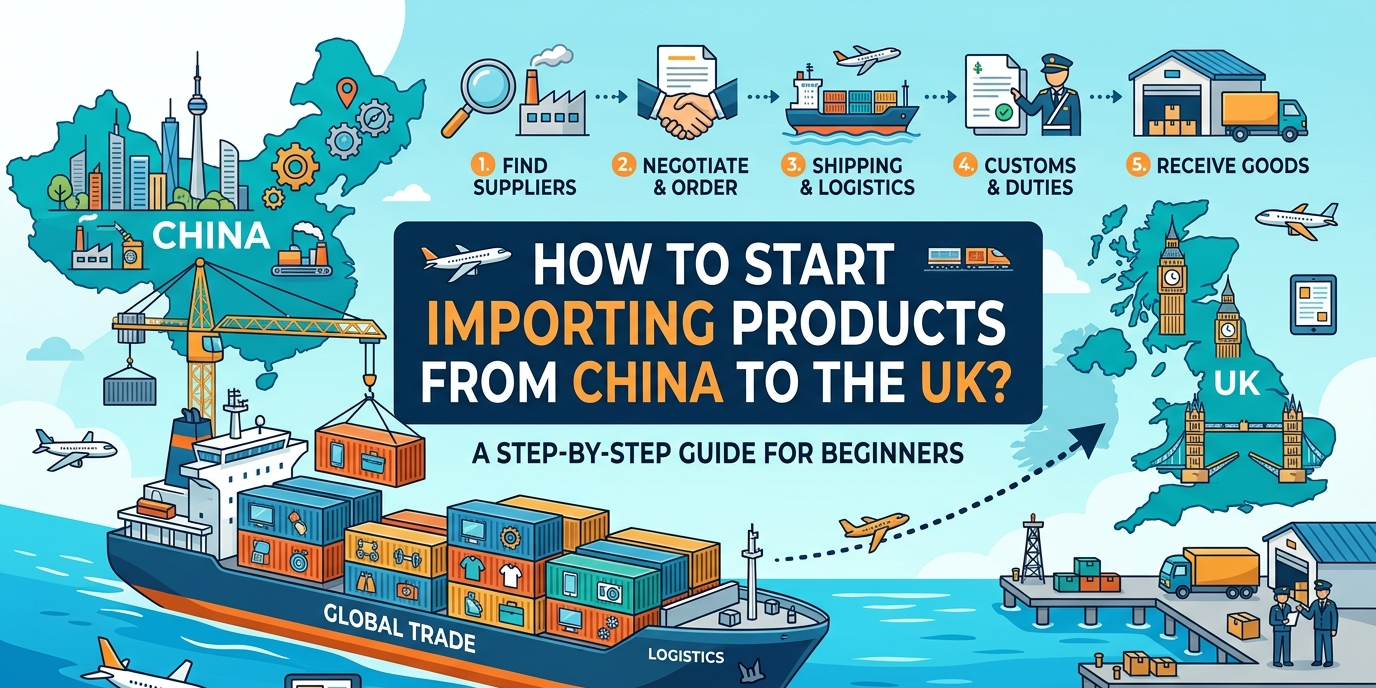
For UK-based retailers, Amazon sellers, and wholesalers, sourcing from China remains the most effective way to scale margins. However, since Brexit, the “rules of the game” for UK imports have shifted. It is no longer enough to just find a supplier on Alibaba; you need to understand the mechanical process of moving goods through UK Customs (HMRC) to avoid costly delays or seizures.
Importing is a technical process of compliance and cost control. This guide outlines the essential steps to get your first shipment from a Chinese factory to a UK warehouse.
What are the legal requirements for a UK business to import from China?
Before you even place a sample order, your UK business must be legally prepared to receive international cargo.
- EORI Number: You must have an Economic Operator Registration and Identification (EORI) number starting with “GB”. Without this, you cannot clear customs. It takes about 5-10 minutes to apply on the GOV.UK website.
- VAT Registration & PVA: While you can import as a non-VAT registered business, most professional importers use Postponed VAT Accounting (PVA). This allows you to account for and “postpone” the import VAT on your VAT return rather than paying it upfront at the port, significantly improving your cash flow.
- Duty Deferment Account: If you import regularly, setting up a duty deferment account with HMRC allows you to pay customs duties monthly via direct debit instead of per shipment.
How do you identify the correct HS Code and UK Duty rates?
The “price” the factory gives you is not your final cost. You must calculate the Landed Cost by identifying your product’s HS Code (Commodity Code).
The UK Integrated Tariff determines the percentage of duty you will pay.
- The Risk of Misclassification: If you use the wrong code, you might underpay (leading to fines later) or overpay (killing your profit).
- Anti-Dumping Duties: Be aware that certain products (like some aluminum extrusions or bicycles) may have high anti-dumping duties in the UK.
- Trade Preferences: Check if your product qualifies for lower rates under specific UK trade schemes.
Which product compliance standards (UKCA vs. CE) must you follow?
Post-Brexit, the UK has transitioned from the European “CE” mark to the UKCA (UK Conformity Assessed) marking for most goods placed on the market in Great Britain.
- Electronics & Toys: These require strict UKCA certification. You must ensure your Chinese factory can provide a Declaration of Conformity (DoC) that references UK standards, not just EU ones.
- Garments & Textiles: Must comply with UK textile labeling regulations (fiber content in English).
- Furniture: If you are importing furniture from clusters like Foshan, it must meet UK Fire Safety Regulations (BS 5852), which are much stricter than many other international standards.
How should you manage logistics and UK customs clearance?
Choosing the right Incoterms (International Commercial Terms) dictates where your responsibility begins and the factory’s ends.
- FOB (Free On Board): The standard for most professional buyers. The factory gets the goods to the Chinese port; you control the shipping and UK customs via your own freight forwarder.
- DDP (Delivered Duty Paid): Convenient but risky. Many Chinese “DDP” shipping lines use “grey clearance” methods that may not provide you with the necessary C79 certificate to reclaim VAT.
- Sea vs. Air: For heavy items like furniture or large batches of textiles, Sea Freight to ports like Felixstowe or Southampton is standard. For high-value electronics or small test batches, Air Freight to LHR is faster but significantly more expensive.
Key Takeaways
- Get Your GB EORI Early: You cannot clear UK customs without it.
- Use Postponed VAT Accounting: It’s a massive cash-flow advantage for UK businesses.
- Verify UKCA Compliance: Don’t assume a “CE” certificate is enough for the UK market in 2026.
- Know Your HS Code: Use the UK Trade Tariff tool to calculate exact duty before you wire a deposit.
- Control Your Logistics: Avoid “all-in” DDP prices unless you are certain they are HMRC-compliant.
Why Choose HSY Sourcing?
Navigating the gap between a factory in Foshan and a warehouse in the UK requires a partner who understands both ends of the chain. HSY Sourcing acts as your eyes and ears on the ground in China.
- Technical Compliance Check: We don’t just check if a product looks good; we verify that the labeling and documentation meet UKCA or UK Fire Safety standards.
- Factory Auditing in Guangdong: We are located in the heart of the manufacturing hub (Foshan/Guangdong). We physically visit factories to ensure they are legitimate manufacturers, not just middleman traders.
- Precision QC: From checking the inseam tolerance of denim to the structural integrity of furniture, our team ensures the “Quality Fade” never happens.
- Logistics Support: We work with UK-specialist freight forwarders to ensure your goods are packed in compliant wooden crates (ISPM-15) and that you receive the correct documentation for your VAT returns.
Start your UK import journey with a professional team. Contact the HSY Sourcing team today.
FAQ
Q1: Do I need a license to import from China to the UK?
A: Most “general” goods (clothing, furniture, electronics) don’t require a specific import license, but you always need an EORI number. Only restricted goods like firearms, chemicals, or some foodstuffs require specific licenses.
Q2: How much is the import duty from China to the UK?
A: It depends entirely on the HS Code. It can range from 0% (for many electronics) to 12% or more (for certain garments or footwear). You must check the “UK Integrated Trade Tariff” website for your specific item.
Q3: Can I import to the UK as a private individual?
A: Yes, but you will still have to pay VAT and Duty, and the process is often more expensive as you cannot use Postponed VAT Accounting. It is usually better to import through a Limited Company.
Q4: How long does shipping take from China to the UK?
A: Sea freight typically takes 35-45 days to reach UK ports. Air freight takes 5-10 days depending on the service level.