

Procuring kitchen cabinets for a 300-unit apartment complex or a luxury hotel development is a high-risk structural investment. Unlike freestanding furniture, built-in cabinetry must integrate perfectly with plumbing rough-ins, electrical layouts, and built-in appliances. A dimensional error of just a few millimeters, or the selection of an inadequate core material, can stall a project handover and trigger massive on-site remediation costs.
Foshan, China, alongside the neighboring Shunde district, represents the highest concentration of bespoke millwork and cabinetry manufacturing in the world. While the geographical advantage of sourcing directly from this hub offers significant cost reductions, overseas buyers frequently make technical errors by treating cabinetry as a commodity rather than an engineered architectural component. To protect your capital investment, you must move beyond aesthetic choices and enforce strict mechanical and material baselines before mass production begins.
Key Takeaways
- Match Substrates to Moisture Zones: Never use standard MDF or particleboard for under-sink units; mandate multi-layer, water-resistant plywood to prevent irreversible swelling.
- Audit Edge-Banding Adhesives: Specify PUR (Polyurethane) hot-melt adhesive over standard EVA glue to ensure a watertight, heat-resistant seal around all cabinet doors and carcass edges.
- Require a 1:1 Physical Mockup: Do not sign off on mass production based solely on 2D shop drawings. Demand a full-scale physical prototype to test appliance integration and hardware tolerances.
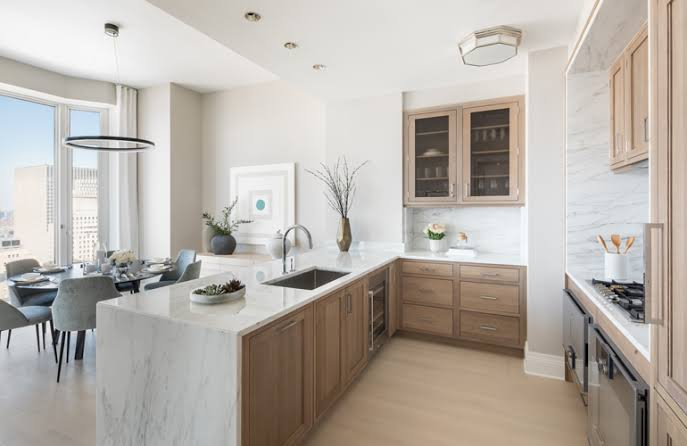
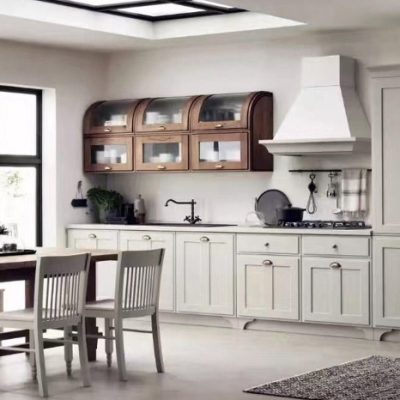
Integrated Built-In Cabinetry for Commercial Real Estate Projects. Source: Interior Design Magazine
What substrate errors cause cabinet failure in commercial projects?
The most common mistake overseas buyers make is selecting a cabinet core based on generic terms like “solid wood” or “composite board” without defining the specific technical grade. Different engineered boards have drastically different capacities for screw retention, structural deflection, and moisture resistance.
Using the wrong core in a high-humidity zone guarantees failure. When auditing a factory’s Bill of Materials (BOM), you must specify the substrate layer by layer:
- Under-Sink & Wet Zones (Mandatory Plywood): Base cabinets housing plumbing fixtures must be constructed from multi-layer plywood bonded with water-resistant resin. Plywood resists thickness swelling when exposed to minor leaks, preventing the cabinet box from disintegrating.
- Cabinet Carcasses (High-Density MFC): For standard dry wall and base cabinets in multi-family projects, high-density Melamine Faced Chipboard (MFC) is structurally stable and cost-effective, provided it exceeds a density of 700 kg/m3.
- Decorative Doors (MDF): Medium-Density Fiberboard (MDF) should be reserved strictly for cabinet doors requiring high-gloss lacquer, PVC thermofoil wrapping, or CNC router profiling, as its uniform surface lacks grain texture. It should never be used for the structural box.
Why is generic hardware the biggest hidden liability?
Cabinet boxes rarely fail under normal use; it is the moving parts that dictate the lifespan of the kitchen. In commercial apartments or hotel suites, drawers and hinges face repetitive kinetic stress. Accepting generic, unbranded hardware to shave a fraction of a percent off the total project cost is a critical procurement error.
Within six months of tenant occupancy, cheap slide systems will result in sagging drawer fronts, misaligned doors, and soft-close mechanisms that stick permanently open.
Your purchasing contract must explicitly name the hardware brand and its mechanical cycle rating. Mandate tier-one international brands like Blum, or high-grade domestic equivalents like DTC. The contract must stipulate that hinges are certified for a minimum of 80,000 to 100,000 open-close cycles and feature a 3-way adjustment matrix. This adjustability allows your on-site installation crew to correct minor wall deviations during the final fit-out.
How does improper edge banding lead to moisture damage?
The protective strip applied to the exposed edges of a cabinet board—the edge banding—is the primary defense against internal moisture. The mistake occurs not in the banding material itself, but in the adhesive used to apply it.
Many factories default to EVA (Ethylene Vinyl Acetate) glue because it is cheap and easy to process. However, EVA can soften and reactivate when exposed to continuous heat and steam from ovens, dishwashers, and boiling pots, causing the edge banding to peel away and exposing the wood core to moisture.
To prevent this, you must explicitly enforce the use of PUR (Polyurethane) hot-melt adhesive in your manufacturing contract. PUR utilizes a chemical curing process that forms an unbreakable, water-resistant, and heat-resistant bond. It applies in a much thinner line, resulting in a seamless visual finish while permanently sealing the core board against humidity.
Why must you insist on a 1:1 physical mockup before mass production?
Approving a 500-unit cabinet order based solely on digital CAD files or PDF shop drawings leaves too much room for physical interface errors. A 2D drawing will not reveal if an oven door collides with a drawer handle when opened, or if the factory’s standard plumbing cutouts align with your specific destination country’s pipe rough-ins.
Before clearing the factory for mass production, you must mandate a 1:1 scale physical mockup of a complete kitchen configuration. A local engineering team must inspect this prototype to:
- Test the structural rigidity of the assembled carcass.
- Drop in actual sink basins and appliance templates to verify cutout dimensions.
- Confirm the tactile finish of lacquers or laminates under calibrated lighting.
- Evaluate the smoothness and dampening of all drawer runners under physical weight.
Why choose HSY Sourcing as your cabinet procurement partner?
Managing complex millwork specifications across hundreds of units cannot be effectively handled via email or through generic trading companies. HSY Sourcing operates as your dedicated, on-the-ground engineering and purchasing office directly within the Foshan and Shunde manufacturing clusters.
- Direct Factory Access: We bypass decorative showrooms and high-markup intermediaries, placing your project directly with automated, primary manufacturing facilities equipped with precision CNC nesting machinery.
- Technical Contract Enforcement: We translate your architectural layouts into strict manufacturing contracts. We physically audit the factory lines to ensure PUR edge-banding is used, hardware brands are authentic, and substrates match your exact moisture requirements.
- Geographical Consolidation Advantage: By utilizing our centralized Foshan warehouse, we leverage the region’s one-stop supply chain. We consolidate your flat-pack kitchen cabinets into engineered mixed-containers alongside your porcelain tiles, sanitary ware, and loose furniture. We load heavy masonry at the floor level and cabinetry on top, maximizing your ocean freight spend while completely preventing transit damage.
Frequently Asked Questions (FAQ)
What is the standard production lead time for commercial kitchen cabinets in Foshan?
For a standard multi-unit apartment or hotel project, production typically requires 40 to 45 days after the final shop drawings and 1:1 physical mockups are approved. This timeline accommodates raw board conditioning, custom lacquer or veneer finishing, and rigorous pre-shipment quality control.
Should we ship our cabinets flat-packed (RTA) or fully assembled?
This depends entirely on your local site labor costs. Flat-pack (Ready-to-Assemble) shipping maximizes container volume, significantly lowering your ocean freight cost per unit, but requires skilled labor to assemble on-site. Rigid, pre-assembled cabinets reduce installation time at the project site but consume substantially more container space. We run a cost-analysis on both methods for every project.
How do we handle dimensional variations if our construction site walls are uneven?
Site walls are rarely perfectly plumb. To prevent installation gaps, we engineer specialized “filler panels” or scribing pieces that match the cabinet door finishes. These are installed at the ends of cabinet runs or against ceilings. Your on-site carpenters trim these panels to follow the exact irregular contours of the wall, ensuring a flawless built-in look.
How do you ensure the cabinet finishes match our approved design intent?
Aesthetic drift is prevented through physical control samples. Once you approve a specific wood veneer, melamine texture, or lacquer color, we split the physical sample. You keep one half, and our QC team retains the other half on the factory floor in Foshan. During mass production, we conduct randomized batch testing, comparing the active production run directly against the master control sample under calibrated lighting.