
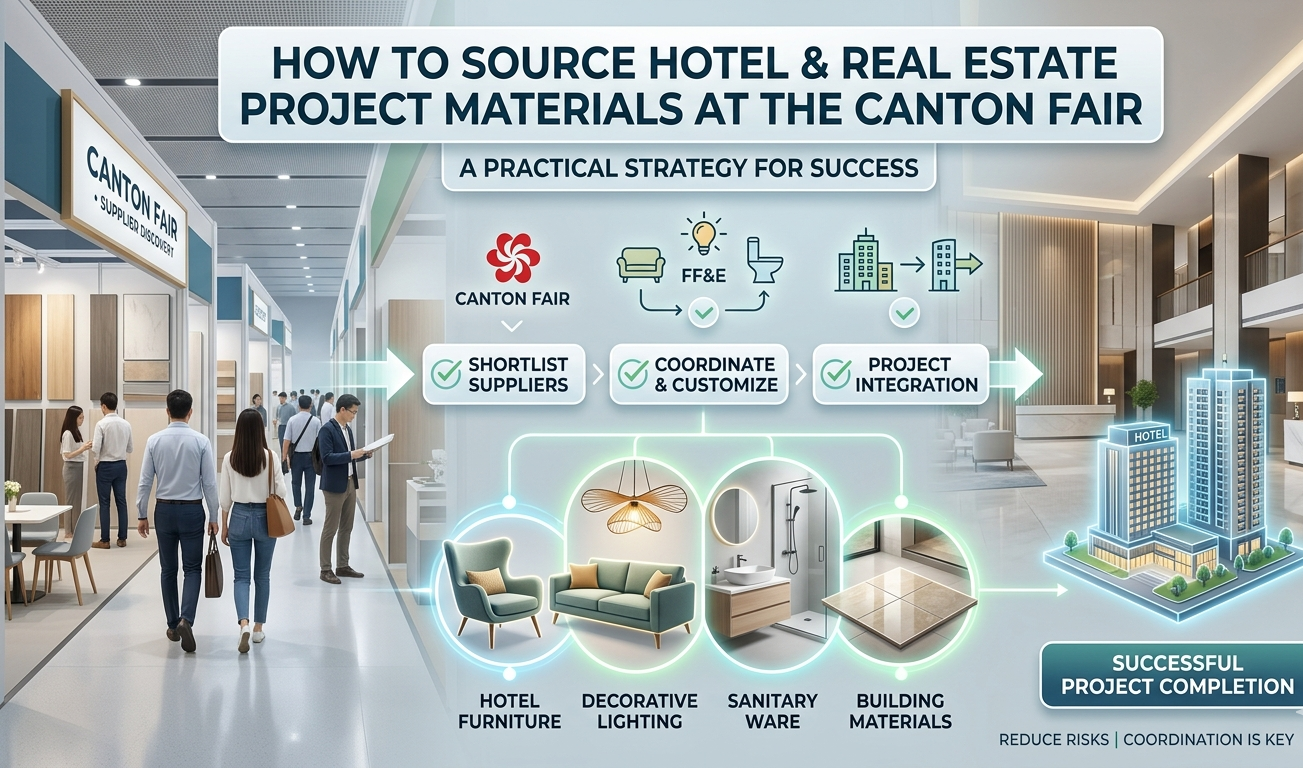
The Canton Fair is one of the largest trade shows in China, attracting thousands of global buyers every year. For hotel developers, construction companies, and real estate investors, it offers a unique opportunity to explore suppliers for furniture, building materials, and project solutions in one place.
For many overseas buyers, the Canton Fair is one of the first stops when sourcing products from China.
But for hotel projects, apartment developments, or villa construction, sourcing is not about buying a single product.
It’s about managing a full list of materials—furniture, lighting, sanitary ware, building materials—and making sure everything works together in terms of quality, cost, and delivery.
So the real question is not just “what to buy at the Canton Fair”, but:
How to use the Canton Fair as part of a complete project sourcing strategy
Why Is Sourcing for Hotel and Real Estate Projects More Complicated?
Project procurement is very different from regular product sourcing.
Instead of ordering one SKU, you are dealing with:
- multiple product categories (FF&E, lighting, tiles, hardware)
- multiple suppliers
- different production timelines
- strict project deadlines
Common issues include:
- inconsistent quality across suppliers
- mismatched styles or specifications
- delays that affect the whole project
- difficulty managing communication across factories
This is why many project buyers realize that sourcing is more about coordination than just pricing.
What Can You Actually Source at the Canton Fair for Projects?
Typical sourcing categories include:
- hotel furniture (beds, sofas, cabinets)
- lighting (decorative and functional)
- sanitary ware (toilets, sinks, showers)
- building materials (tiles, flooring, hardware)
- home décor and accessories
However, it’s important to understand:
Most exhibitors are not full-solution providers
They specialize in one category only.
So while the fair helps you find suppliers, it does not solve project integration.
How Do You Find the Right Suppliers at the Canton Fair?
Walking through booths is not enough.
Some practical tips:
- focus on suppliers with export experience
- ask about project references (not just retail orders)
- check product consistency, not just samples
- avoid making decisions based only on booth appearance
A large or well-designed booth does not always mean a strong factory.
Many experienced buyers use the fair to shortlist suppliers, not finalize them.
Why Is the Canton Fair Only the First Step?
This is where many buyers misunderstand the process.
The Canton Fair helps you:
✔ discover suppliers
✔ compare options
✔ understand pricing levels
But after the fair, you still need to:
- verify suppliers
- develop samples
- align specifications
- manage production
- coordinate delivery
For project sourcing, most of the real work happens after the exhibition.
What Happens After the Canton Fair?
Once you shortlist suppliers, the next steps usually include:
- factory visits (often in places like Foshan, Zhongshan, or Guangzhou)
- sample development and confirmation
- price negotiation and contract terms
- production scheduling across suppliers
- quality inspections
For hotel or real estate projects, coordination becomes critical at this stage.
Why Is Foshan Important for Project Sourcing?
Foshan is one of the key sourcing hubs in South China, especially for:
- furniture manufacturing
- lighting supply chain (near Zhongshan)
- building materials and home products
Its location offers advantages:
- close to Guangzhou (Canton Fair location)
- dense supplier network
- easier factory visits after the fair
Many buyers combine:
Canton Fair visits + Foshan factory sourcing
to complete their supplier selection.
How Does a Foshan Sourcing Agent Help with Project Procurement?
For project buyers, the main challenge is not finding suppliers—it’s managing them.
A sourcing agent in Foshan can help with:
- consolidating multiple product categories
- coordinating communication with different factories
- aligning specifications across suppliers
- tracking production timelines
- arranging quality inspections
- managing combined shipments
This does not eliminate risks, but it can make the process more structured and manageable.
What Are the Common Mistakes Project Buyers Make at the Canton Fair?
Some typical mistakes include:
- trying to finalize orders during the exhibition
- focusing too much on price, not consistency
- working with too many suppliers without coordination
- skipping supplier verification after the fair
- underestimating logistics complexity
For project sourcing, small mistakes can scale into bigger issues later.
How Can You Plan a More Efficient Canton Fair Sourcing Trip?
A more practical approach:
Before the fair:
- define product categories clearly
- prepare supplier questions
- set realistic expectations
During the fair:
- shortlist suppliers
- collect detailed information
- compare options
After the fair:
- visit factories
- test samples
- finalize suppliers
- start small before scaling
This structured approach is more effective than trying to do everything during the exhibition.
Key Takeaways
- The Canton Fair is useful for supplier discovery, not full project sourcing
- Hotel and real estate projects involve multi-category procurement
- Most sourcing work happens after the fair
- Foshan is a key hub for furniture, lighting, and building materials
- Managing multiple suppliers is the biggest challenge in project sourcing
Need help sourcing hotel or real estate project materials from China?
Our Foshan-based sourcing team supports:
- supplier verification
- factory visits
- multi-category sourcing
- quality control and shipment
Contact us to discuss your project.
FAQ: Canton Fair Sourcing for Hotel & Real Estate Projects
Can I complete a full hotel project sourcing at the Canton Fair?
In most cases, no.
The Canton Fair is useful for finding and comparing suppliers, but it is not designed for completing full project sourcing.
Hotel and real estate projects usually involve many product categories and suppliers. You will need additional steps after the fair, such as factory visits, sample development, and production coordination.
Think of the fair as a starting point rather than a complete solution.
What is the best strategy for sourcing building materials at the Canton Fair?
A practical strategy is to use the fair to shortlist suppliers and understand market pricing.
Instead of placing orders immediately, focus on:
- identifying reliable suppliers
- comparing product quality
- collecting detailed specifications
After the fair, you can follow up with factory visits and sample testing before making final decisions.
How do I manage multiple suppliers for a property project in China?
Managing multiple suppliers is one of the biggest challenges.
It usually involves:
- aligning product specifications
- coordinating production timelines
- maintaining consistent quality standards
Without coordination, delays or inconsistencies from one supplier can affect the whole project.
Some buyers handle this internally, while others work with sourcing agents to manage the process locally.
Is it better to visit factories after the Canton Fair?
Yes, in most cases.
Factory visits help you:
- verify production capabilities
- check real working conditions
- understand quality control processes
Many suppliers exhibiting at the Canton Fair are based in regions like Foshan or nearby areas, making factory visits a practical next step.
Do I need a sourcing agent for hotel or real estate projects?
It depends on your experience and project complexity.
For small purchases, you may manage sourcing yourself.
For larger projects involving multiple product categories, a sourcing agent can help with coordination, communication, and quality control.
However, working with an agent still requires clear instructions and active involvement from your side.
What are the biggest risks when sourcing project materials from China?
Some common risks include:
- inconsistent quality across suppliers
- delays in production or delivery
- miscommunication on specifications
- logistics complications when combining shipments
These risks can be reduced with better planning, supplier verification, and structured follow-up after the Canton Fair.