
You are walking through the CIFF Guangzhou halls in March 2026. You see a stunning booth with marble floors, luxury sofas, and ten sales reps in sharp suits. You ask, “Are you a factory?” and without blinking, they say, “Of course, we are a manufacturer based in Longjiang.”
Here’s the cold truth: About 30% to 40% of the exhibitors at CIFF are trading companies. They don’t own a single sewing machine or a wood lathe. They are experts at marketing and curation, but they aren’t the source.
There’s nothing wrong with trading companies if you need small quantities of many items, but if you’re a wholesaler or an Amazon seller, you need the factory price and direct control. Here is how we, as Foshan locals, separate the “Showmen” from the “Makers.”
Why do trading companies pretend to be factories?
It’s simple: Trust and Price. They know that international buyers want to “cut out the middleman.” If they admit they are a trading company, they fear you’ll walk to the next booth. So, they rent a big booth, borrow samples from three different workshops they work with, and print business cards that say “Manufacturing Co., Ltd.”
How can you spot a “Middleman” just by looking at their catalog?
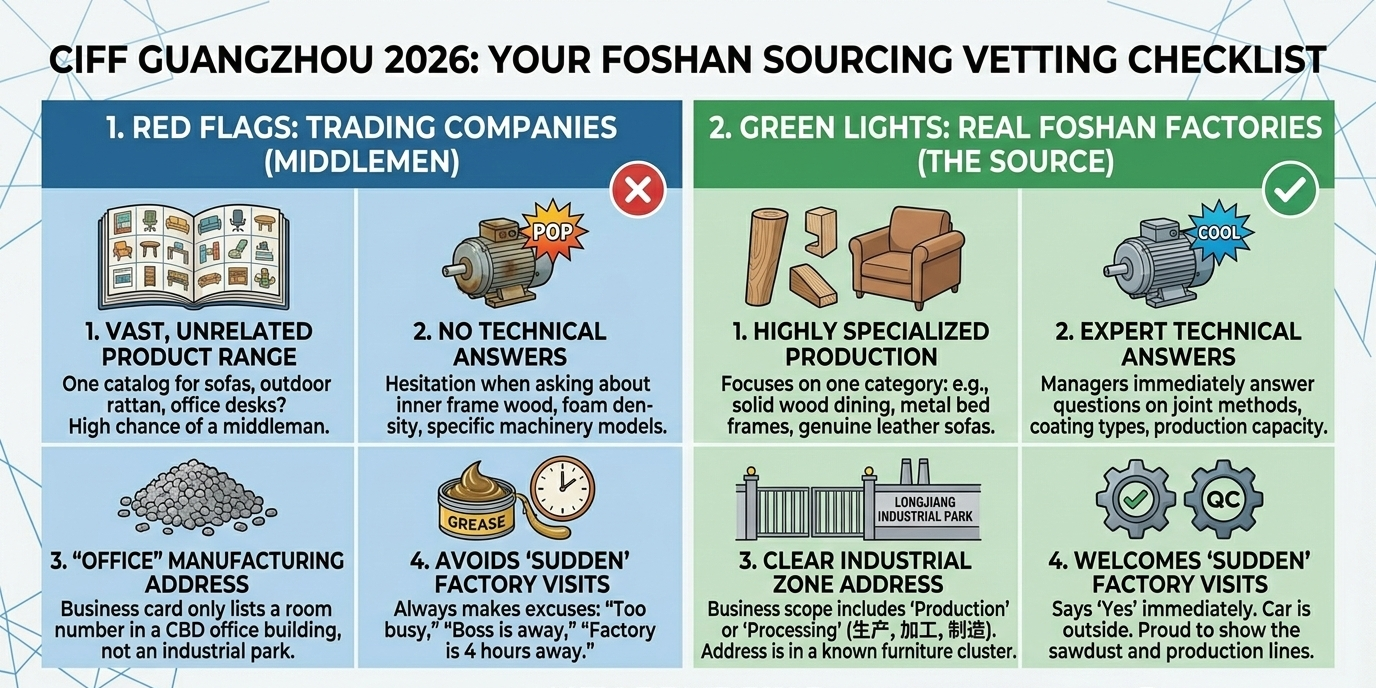
If a company’s catalog has everything—from outdoor plastic chairs to luxury leather sofas to office desks—and they all look like they were photographed in different studios, they are almost certainly a trading company.
Real factories in Shunde specialize. A sofa factory rarely makes office chairs. A solid wood table factory doesn’t usually make outdoor rattan. If the product range is too “perfect” and covers too many categories, they are just sourcing from the local market and adding their margin.
What “trap” questions should you ask the sales rep?
We don’t ask, “Are you a factory?” We ask technical “work-in-progress” questions.
- “Can we change the internal frame from pine to eucalyptus wood?” * “What brand of CNC machine do you use for your wood cutting?” * “If I send my own QC team tomorrow morning to your workshop, is that okay?” A real factory manager will answer instantly. A trading company rep will often hesitate, look at their boss, or say, “We need to check with the production department.” That hesitation is your first warning sign.
Does the Business License reveal the truth?
Yes, but you have to know what to look for. During CIFF, we often ask to see the Chinese version of their business license (not just the English one). We look at the “Business Scope” . If it only says “Sales” or “Export” , they aren’t a manufacturer. If it says “Production” or “Processing” , they are legally allowed to make things. However, even this can be faked, which leads to the most important step…
Why is a “Sudden” factory visit the ultimate test?
Trading companies hate “The Surprise Visit.” They will try to delay you: “Our factory is 2 hours away,” or “The boss is not there today,” or “We are too busy during the fair.” Longjiang and Shunde are only 45-60 minutes from the CIFF hall. As your agents, we tell them: “Our car is outside. Let’s go now.” A real factory is proud to show you their sawdust, their workers, and their warehouse. If they keep making excuses to keep you in the Guangzhou showroom, it’s because there is no factory to show.
How do we vet them before you even land in China?
As Foshan locals, we have a “Blacklist” and a “Whitelist.” We know which factories are struggling and which trading companies are notorious for switching high-quality samples with low-quality bulk orders. Before you spend a dollar on a flight, we can pre-vet your list of exhibitors.
The Bottom Line
CIFF 2026 is a great place to find inspiration, but it’s a tricky place to find the source. You need a partner who knows the local Longjiang industrial parks like the back of their hand. Don’t pay a 20% “Middleman Tax” just because someone had a pretty booth.
Want us to vet your CIFF supplier list? [Contact us] before the fair starts. We’ll tell you who’s real and who’s just putting on a show.