
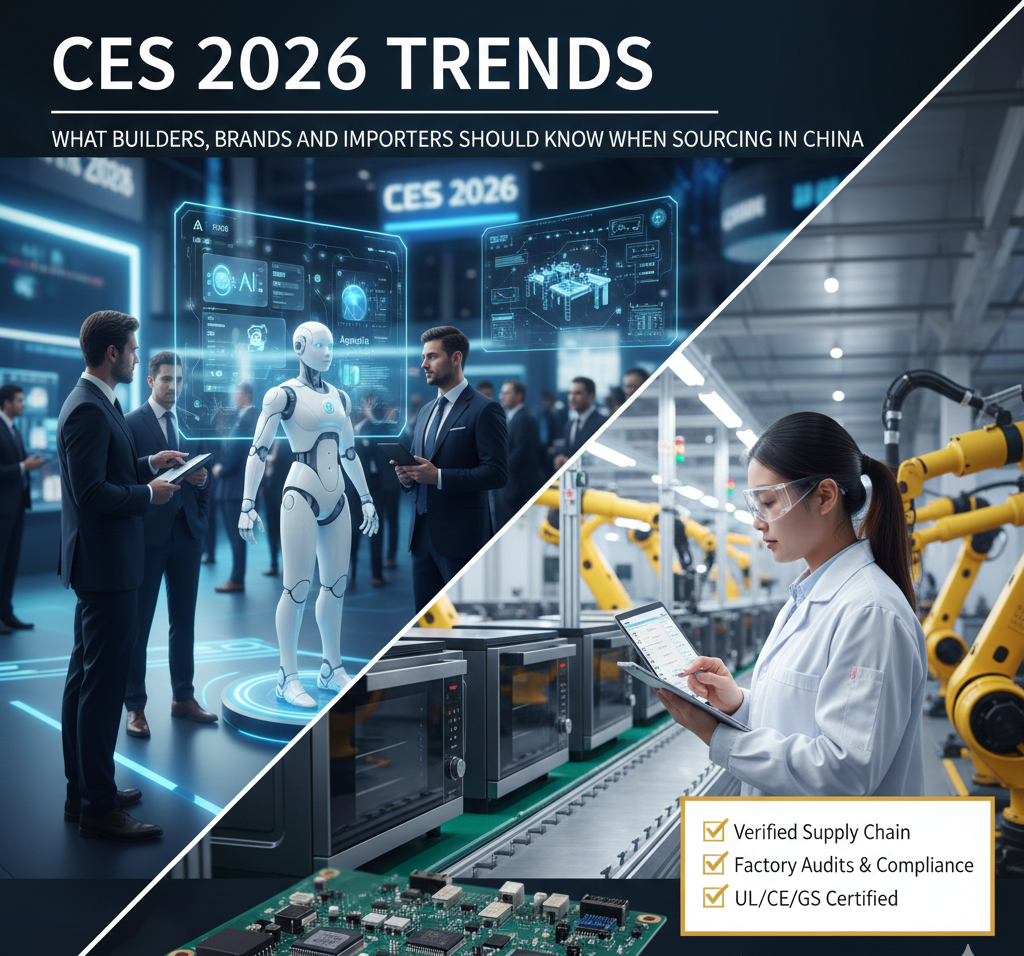
CES 2026 again made one thing very clear: AI and connectivity are moving from “cool features” into the basic expectations for many products. Builders, consumer brands and importers now have to think not only about design and price, but also about software, updates and long‑term reliability when they source in China.
This article looks at key CES 2026 trends from a buyer’s perspective and explains what they mean for sourcing from Chinese manufacturers, and how a local sourcing partner can help you reduce risk and move faster.
How Is AI Changing the Products You Source from China?
At CES 2026, AI showed up in robots, appliances, smart home devices, security systems, wearables and even simple accessories. For sourcing, this means many categories that used to be “dumb hardware” now include chips, sensors and basic AI logic.
For builders and project owners, this touches smart locks, building controls, energy management and security cameras. For brands and importers, it means more SKUs with apps, cloud connections and data handling, even in mid‑price segments.
What this means for your sourcing in China:
- You rarely buy “only hardware” anymore. Even simple devices may need firmware updates, app integration and cloud services.
- You cannot judge suppliers only by metal and plastic samples. You also need to understand their software capability, update roadmap and support process.
- Communication between your tech team and the factory’s engineers becomes as important as communication with sales.
When you work with Chinese suppliers on AI‑enabled products, it is useful to ask:
- Who actually develops and controls the firmware and app?
- How will updates be delivered and supported after launch?
- What happens if there is a bug in the field?
A local sourcing partner can help verify if the factory truly owns and understands its software, or if it simply buys modules from others without deep control.
What Do CES 2026 Smart Home Trends Mean for Builders and Project Buyers?
Smart home at CES 2026 is less about “gimmick gadgets” and more about comfort, safety and energy saving. Many systems are designed to disappear into the background: integrated sensors, door and window devices, lighting controls and security products that work together.
For builders, hotel and apartment projects, this means:
- More components in doors, windows, lighting and HVAC need to be “smart ready”.
- Device compatibility and long‑term support matter more than one‑time wow effect.
- You may need to combine traditional building materials with electronics in the same specification package.
When sourcing in China, this changes how you select suppliers:
- You may work with one supplier for the physical door or window, and another for the smart lock or sensor.
- You need to confirm how these suppliers will cooperate, or how your sourcing agent will coordinate them.
- Testing at project level (not just product level) becomes important before a full roll‑out.
A practical approach is to start with a small pilot: equip a limited number of rooms or units with a complete “smart package” sourced from China, collect real‑world feedback, then scale with the same or improved supplier set.
How Do CES 2026 Trends Change the Way You Evaluate Chinese Suppliers?
After CES 2026, many buyers will receive new proposals from Chinese factories that add “AI”, “smart”, “connected”, or “sustainable” labels to their products. The challenge is to separate real capability from marketing words.
You can think about supplier evaluation with a simple comparison:
| Evaluation Aspect | Traditional Hardware Supplier | CES‑Style Smart/AI Product Supplier |
|---|---|---|
| Focus | Materials, machining, assembly | Hardware + firmware + app + cloud |
| Key Risks | Finish, tolerance, packaging | Bugs, updates, security, compatibility |
| What to Check | Workshop, QC, material sources | Dev team, version control, certifications |
| Typical Documentation | Basic specs, material list | API docs, test reports, update policy |
| Type of Support Needed | Replacement for defects | Ongoing technical support and troubleshooting |
For brands and importers, this means supplier visits and audits should now include:
- Meeting technical staff, not only sales
- Asking for real test reports, certifications and version histories
- Checking if the factory supports UL, CE, FCC or similar standards where needed
A sourcing agent in China can help by arranging meetings with engineers, translating technical questions, and verifying that test reports and certificates are traceable and valid.
How Should Brands and Importers Turn CES 2026 Inspiration into Real Products in China?
For many brands and importers, CES is a place to collect ideas, not to place orders directly. The real work starts when you go back to your office and try to connect those ideas with your existing product lines and supplier base.
A useful three‑step way to move from CES inspiration to real sourcing in China is:
| Step | Key Question | What to Do in Practice |
|---|---|---|
| 1 | What is the real opportunity for my market? | Pick 2–3 product ideas that fit your customers and channels. |
| 2 | What specs and standards are non‑negotiable? | Define target price, quality level, certifications, lifetime. |
| 3 | Which sourcing path in China makes most sense? | Choose between off‑the‑shelf, ODM customization or joint dev. |
In practical terms:
- If you are an importer or wholesaler, you may start with off‑the‑shelf or lightly customized versions of CES‑style products that Chinese manufacturers already produce.
- If you are a brand owner, you might co‑develop a modified version with selected Chinese factories, using their existing platforms but with your own design details.
- If you are a builder or project owner, you may integrate new CES‑type components (for example, smart locks, sensors or controls) into your hotel or apartment specifications.
Working with a sourcing agent in China can help you identify which factories already have similar products and how much modification is realistic within your target timeline and budget.
What Practical Risks Should Builders and Importers Watch When Sourcing CES‑Style Products in China?
New technology always brings new risks. After CES 2026, the main sourcing risks are not only late shipments or cosmetic defects, but also functional and support problems.
Key risks include:
- Over‑promised features that are not stable in real use
- Incomplete or weak documentation and after‑sales processes
- Hidden changes in components over time, which can affect performance or compliance
- Data and privacy questions for connected devices
To manage these risks, builders, brands and importers can:
- Insist on clear specifications and feature lists in contracts
- Require pilot batches or trial installations before full roll‑out
- Use inspections that include basic functional tests, not only visual checks
- Ask about how long the supplier plans to support firmware and app updates
A local sourcing team can help set up acceptance criteria, organize on‑site tests and coordinate corrective actions with the factory if problems appear.
How Can a China‑Based Sourcing Partner Help Builders, Brands and Importers After CES 2026?
After a show like CES, many buyers have more ideas than time. A China‑based sourcing partner can help filter, test and implement those ideas in a structured way.
For builders and project owners, a sourcing partner can:
- Translate project needs (for example, hotel rooms, apartments, mixed‑use buildings) into clear product packages that combine building materials and smart components.
- Shortlist factories for both traditional items (doors, furniture, fixtures) and new CES‑style components (smart locks, sensors, devices).
- Coordinate samples, mock‑ups and on‑site trials before large orders.
For brands and importers, a sourcing partner can:
- Scan existing supplier networks in China for factories already producing similar CES‑style products.
- Compare multiple manufacturers on capability, quality systems and export experience.
- Arrange lab testing, compliance checks and packaging confirmation for your target markets.
In both cases, the goal is the same: use the energy and new ideas from CES 2026, but execute them through a controlled, step‑by‑step sourcing process in China, instead of rushing into large orders based only on trade‑show impressions.
What Is the First Concrete Step If You Want to Source CES 2026‑Style Products from China?
If you are a builder, brand or importer and want to act on CES 2026 trends, the first step is not to search randomly for “new suppliers”, but to structure your own requirements.
A practical starting list includes:
- Which 2–3 product ideas from CES fit your customers or projects best
- Your target price range and volume for a test order and for scale‑up
- The certifications and safety standards your market requires
- The level of customization you really need, versus what can stay standard
- Your timeline from sampling to first shipment or project installation
With this information, a sourcing team in China can move quickly: checking which manufacturers are realistic candidates, what lead times look like, and what kind of pilot order makes sense.
In the end, CES 2026 is most valuable to builders, brands and importers who combine inspiration with disciplined sourcing. By using a structured process and the right partners in China, you can turn new trends into products and projects that are not only exciting on stage, but reliable in real‑world use.