
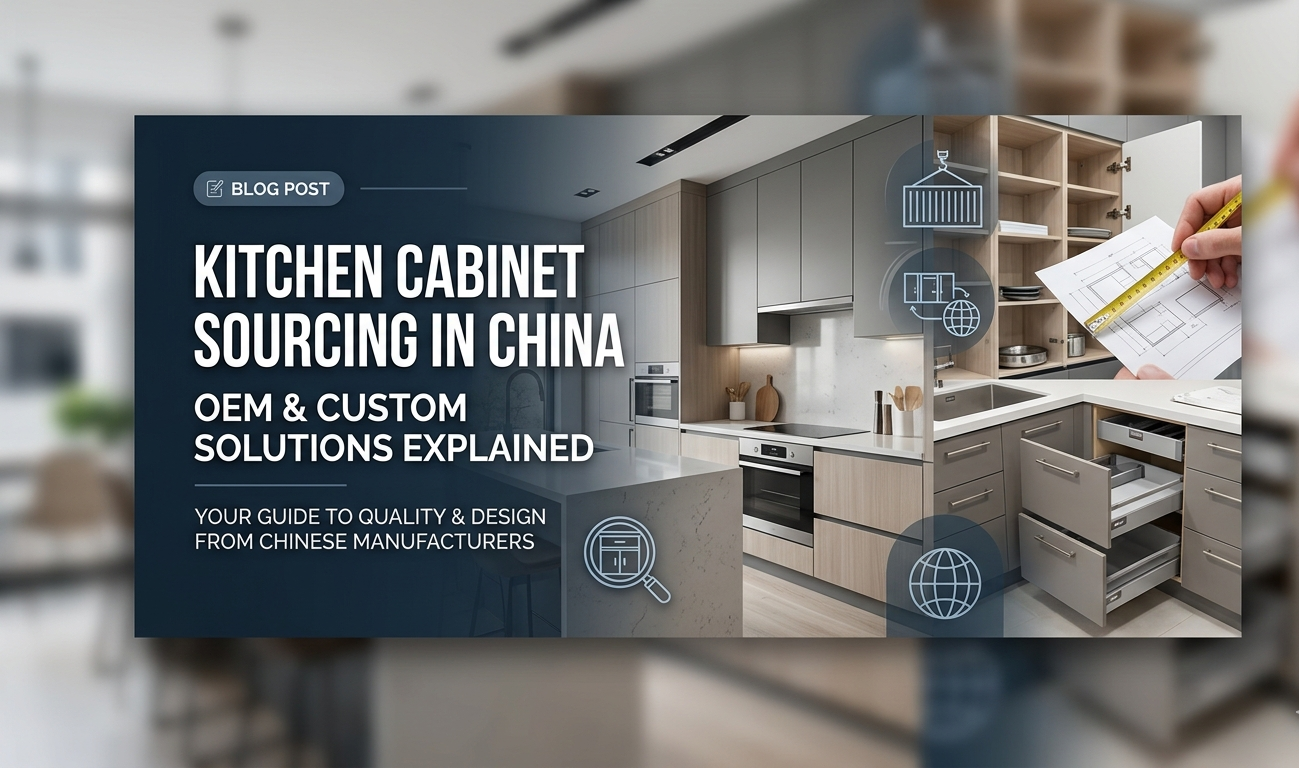
For property developers, contractors, and kitchen brands, cabinet sourcing is one of the highest-risk categories in any project. Unlike loose furniture, kitchen cabinets are fixed architectural elements. If the dimensions are off by a few millimeters, or if the factory uses cheap particleboard that swells upon contact with moisture, the entire installation halts, and site labor costs skyrocket.
China’s manufacturing clusters—particularly in the Foshan and wider Guangdong region—dominate the global supply of modular cabinets, bathroom vanities, and whole-house customization joinery. However, successfully buying from these factories requires knowing exactly how to define your technical specifications and choosing the correct production model: OEM or Custom.
What does “OEM” actually mean for kitchen cabinets?
In the cabinet industry, OEM (Original Equipment Manufacturer) does not mean the factory designs a kitchen from scratch for you. OEM means Standardized Modular Production based on your brand’s specifications. * The Process: You provide your standard catalog of cabinet box sizes (e.g., standard 30-inch or 600mm widths). The factory produces these exact modular boxes using their highly efficient, automated CNC lines.
- The Buyer: This is ideal for kitchen retail brands, wholesalers, or developers building hundreds of identical apartment units.
- The Benefit: Because the sizes are standardized, production is fast, material waste is minimal, and the cost per unit is highly competitive.
How does “Custom Sourcing” differ from OEM?
Custom sourcing (often tied to “whole-house customization”) is architectural millwork. Instead of pulling from a catalog of standard boxes, the factory builds the cabinetry to fit the exact, often irregular, dimensions of a specific room.
- The Process: You submit architectural floor plans. The factory’s CAD team generates detailed shop drawings. Once approved, the CNC machines are programmed for those specific, non-standard cuts.
- The Buyer: This is required for luxury villas, boutique hotels, and premium residential projects where every room has a different layout.
- The Reality: Custom sourcing is slower and more expensive. It requires intense back-and-forth communication regarding filler panels, exact appliance cutouts, and corner angles.
What technical specifications must you define to avoid cheap substitutes?
If your RFQ (Request for Quote) simply says “white kitchen cabinets,” you are inviting quality fade. Factories will default to the cheapest materials to win your order. Your technical package must define:
- Carcass Material (The Box): Do not accept standard MDF for kitchens. Specify Moisture-Resistant Particle Board or Plywood.
- Emission Standards: This is a legal requirement. You must specify the formaldehyde emission grade: CARB P2 / EPA TSCA Title VI for the US market, or E0 / ENF grade for premium global markets.
- Hardware Brands: The hinge is the first thing to break in a cheap kitchen. Explicitly specify the brand. Blum or Hettich for high-end; DTC (a top-tier Chinese brand) for a reliable, cost-effective alternative.
- Edge Banding Technology: Specify PUR (Polyurethane) edge banding over traditional EVA. PUR creates a waterproof seal that prevents the edge of the cabinet door from peeling when exposed to kitchen steam.
RTA (Flat-Pack) vs. Assembled: Which shipping method is better?
Freight costs and site labor are the two opposing forces in cabinet sourcing.
| Shipping Method | Pros | Cons | Best For |
| RTA (Ready-To-Assemble) | Maximizes container space. Lowest shipping cost per unit. | High labor cost on-site to assemble boxes. Higher chance of missing screws. | Wholesalers, budget apartments, retail brands. |
| Fully Assembled | Drastically reduces job-site installation time. Factory controls the structural integrity. | Ships a lot of “air.” Container freight cost per kitchen is much higher. | Luxury projects, hotels, areas with extreme local labor costs. |
How do you prevent installation nightmares on the job site?
The most common disaster in overseas cabinet sourcing is opening the container on the job site and not knowing which box goes to which room.
A professional sourcing process mandates strict labeling and packing protocols. Every single flat-pack carton or assembled box must have a label detailing:
- Project Name / Unit Number (e.g., Tower B, Apt 402)
- Room Type (e.g., Master Kitchen, Guest Bath)
- Cabinet Code matching the approved CAD drawing (e.g., Base Cabinet B-04)
Furthermore, you must always order Filler Panels and extra kickboards (toe kicks). Walls are never perfectly straight; filler panels allow the local installer to scribe the cabinet to the wall perfectly.
Key Takeaways
- Choose Your Lane: Use OEM for standard, repeatable modular boxes. Use Custom for project-specific architectural fit-outs.
- Dictate the Specs: Mandate the core board material, PUR edge banding, and exact hardware brands before paying a deposit.
- Demand CAD Approvals: Never start production without signing off on detailed shop drawings that include appliance clearances.
- Prioritize Labeling: Ensure the factory uses a rigid packing and labeling system to save your local contractors hundreds of hours of sorting.
Why Choose HSY Sourcing?
Managing a custom cabinet order from another country is not a side job; it requires technical oversight. HSY Sourcing is deeply embedded in the Foshan furniture and building materials cluster, specializing in whole-house customization and commercial joinery.
- Technical CAD Review: We don’t just forward emails. Our team reviews the factory’s shop drawings against your architectural plans to catch clearance issues before wood is cut.
- Factory Vetting: We know which Foshan factories actually own advanced German Homag CNC machines and PUR edge banders, and which ones are just outsourcing to smaller workshops.
- In-Process QC: We physically inspect the hardware (verifying genuine DTC or Blum hinges) and measure the board thickness during production.
- Consolidation & Logistics: If you are sourcing cabinets, tiles, and lighting for a project, we consolidate everything in our local warehouse, optimize the container loading, and ensure the paperwork is perfect.
Don’t let bad cabinetry derail your project schedule. Contact the HSY Sourcing team today.