
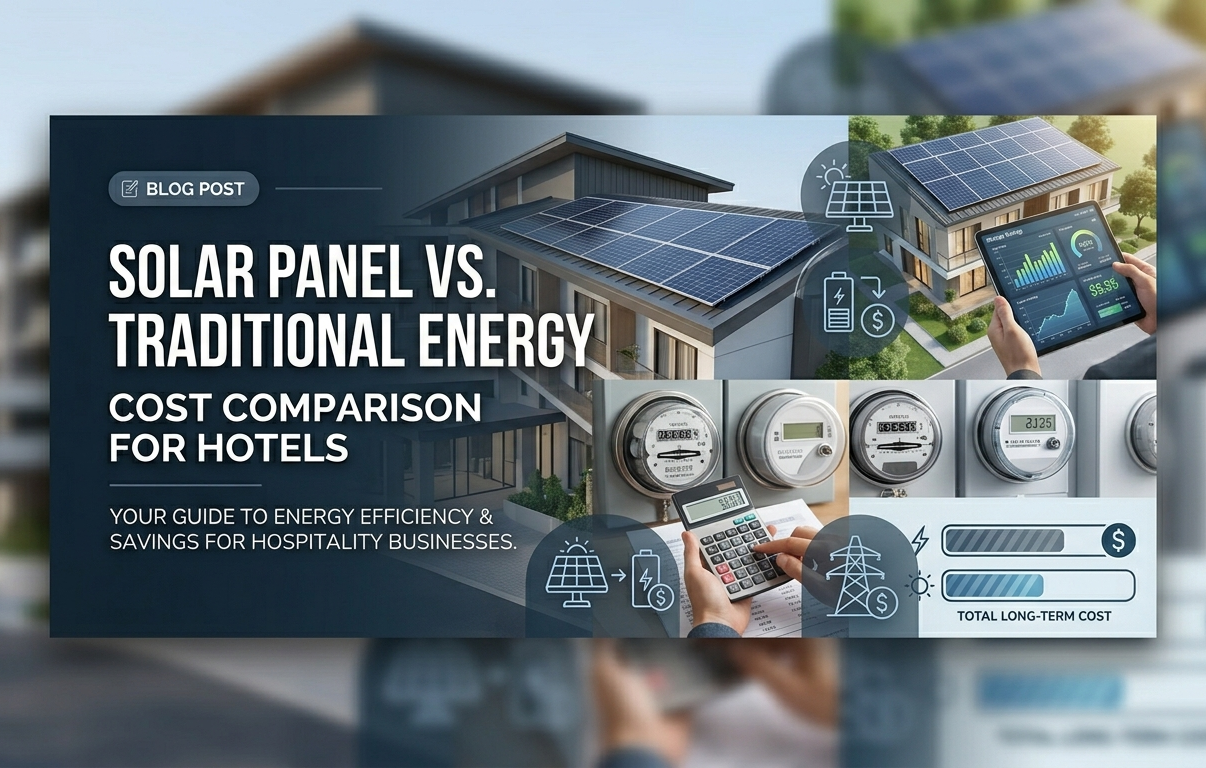
For hotel owners and asset managers in 2026, electricity is no longer a fixed cost you simply accept—it is a controllable operating expense. With the rise of Tier-1 solar technology and high-density storage, the conversation has shifted from “going green” to “protecting margins.“
While traditional grid energy offers simplicity, it exposes hotels to tariff hikes and peak-time penalties. Solar, on the other hand, is a capital investment (CAPEX) that transforms a recurring bill into a predictable asset. Here is a realistic look at how the costs stack up.
Why are hotels uniquely positioned for solar energy?
Unlike office buildings that go dark at 6 PM, hotels run 24/7. However, their peak energy consumption—driven by HVAC, laundry, and kitchen operations—aligns remarkably well with peak solar production hours.
- Load Matching: Solar generates the most power precisely when guest room air conditioning and common area lighting are at their highest demand.
- Infrastructure: Hotels typically have large, unobstructed roof surfaces or expansive parking lots perfect for solar canopies.
- Peak Shaving: By using solar during the day, hotels can avoid “Demand Charges”—the expensive surcharges utilities apply when you hit a high consumption spike.
What is the true “LCOE” of traditional grid energy?
Most hotel managers look at their monthly bill and see a “cents per kWh” rate. But the true Levelized Cost of Energy (LCOE) for grid power is often higher due to hidden factors:
- Time-of-Use (TOU) Rates: Many utilities charge 2x or 3x the standard rate during the afternoon and early evening.
- Infrastructure Fees: You pay for the grid’s maintenance, not just the electrons you consume.
- Inflation Risk: Historically, grid prices rise by 3-5% annually. Over a 10-year horizon, your “cheap” grid power becomes an uncontrolled liability.
How does the solar cost structure compare over 20 years?
When you buy solar, you are essentially pre-paying for 25 years of electricity at a fixed rate.
| Cost Component | Traditional Grid Energy | Tier-1 Solar PV System |
| Upfront Cost | $0 (Standard connection) | High (Panels, Inverters, Mounting) |
| Unit Cost (kWh) | High & Rising | Near-Zero after payback |
| Maintenance | Minimal (Utility handles it) | Periodic cleaning & Inverter swap (Year 10-12) |
| Reliability | Susceptible to grid outages | Hybrid systems provide backup |
| Asset Value | None (Sunk cost) | Increases Property Valuation |
When does the “Payback Period” justify the investment?
A well-designed solar system for a hotel typically reaches its break-even point in 4 to 7 years, depending on local incentives and sunlight. After that point, the electricity generated is essentially free for the remaining 15-20 years of the system’s life.
Solar makes the most sense if:
- Your local utility has high daytime “Peak” rates.
- You own the property or have a long-term lease (10+ years).
- Your roof is in good structural condition (replacing a roof after installing solar is a costly mistake).
What about the “Storage” factor?
In 2026, the cost of LFP (Lithium Iron Phosphate) batteries has dropped enough to make commercial storage viable for many hotels.
- Without Batteries: You use solar as it’s produced. Excess is often sold back to the grid at a low “feed-in” rate.
- With Batteries: You store excess midday sun and use it during the high-tariff evening hours (7 PM – 10 PM) when guests are returning to their rooms and turning on lights and TVs.
Key Takeaways
- Shift from OPEX to CAPEX: Solar turns a monthly bill into a depreciable asset.
- Hedge Against Inflation: Solar locks in your energy price for 20+ years, protecting the hotel from utility price hikes.
- Size Matters: A system that is too large or too small for your “Base Load” will ruin your ROI. Technical sizing is everything.
- Focus on LCOE: Don’t just compare the initial check; compare the total cost per kilowatt over 20 years.
Why Choose HSY Sourcing?
Sourcing a solar system for a commercial hotel project is different than buying a few panels for a house. It requires industrial-grade components and verified technical data.
HSY Sourcing acts as your local technical team in China to ensure your energy investment is secure.
- Tier-1 Only: We only source from Tier-1 manufacturers (like Longi, Jinko, or Trina) to ensure the 25-year warranty actually means something.
- System Compatibility: We ensure that the panels, mounting structures, and inverters (Huawei, Sungrow) are designed to work together as a single high-performance unit.
- Quality Audits: We perform EL (Electroluminescence) testing on panels before they leave the factory to ensure there are no micro-cracks that would reduce efficiency over time.
- Logistics Management: Solar components are fragile and heavy. We manage the specialized packing and shipping to ensure zero breakage upon arrival at your hotel site.
FAQ
Q1: Will solar panels affect the aesthetic of my hotel?
A: Modern “All-Black” modules and sleek mounting systems are very low-profile. For high-end resorts, we can source solar carports for guest parking that provide shade while generating power.
Q2: What is the maintenance schedule for a hotel solar system?
A: Very minimal. It usually involves cleaning the panels 2-4 times a year (depending on dust) and a professional electrical check once a year. The inverter typically needs replacement once every 12-15 years.
Q3: Can HSY Sourcing help calculate the ROI for my specific location?
A: While we are sourcing experts, we can help you collect the technical data sheets and factory production estimates your local engineers need to build an accurate ROI model.
Q4: Is it better to source everything from one factory?
A: Not necessarily. The best panels often come from one specialist, while the best inverters come from another. We coordinate the consolidation so you get the best of both worlds in one shipment.