
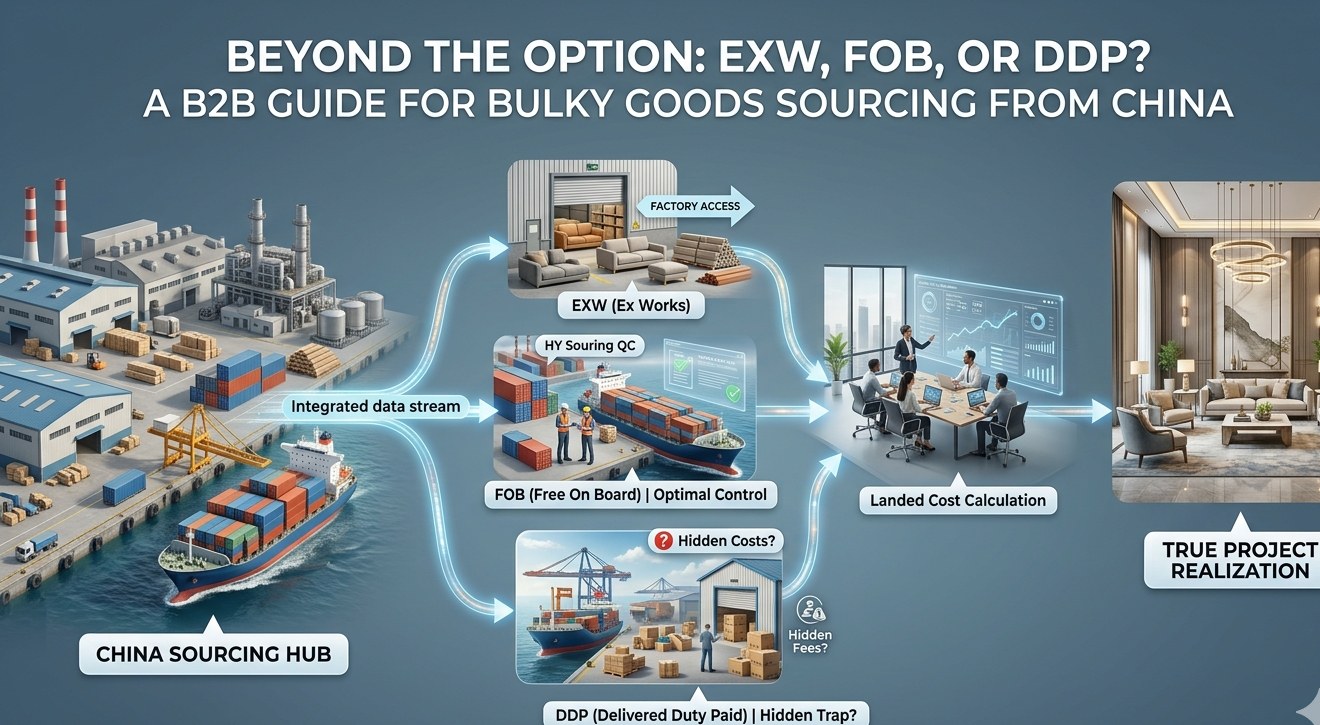
When you are importing heavy, high-volume items like furniture, sintered stone, or architectural lighting, your choice of Incoterms (International Commercial Terms) is just as important as the price of the goods.
A wrong choice doesn’t just mean a higher bill; it means you could be legally responsible for a container that is stuck at a port 5,000 miles away with no way to clear it. For bulky project orders, the “easiest” option is rarely the most cost-effective.
What are the hidden risks of using EXW for bulky project orders?
EXW (Ex Works) means the supplier’s responsibility ends at their factory door. For a buyer, this is a heavy logistical burden.
If you are sourcing from multiple factories in Foshan or Zhongshan, EXW requires you to arrange inland trucking, export documentation, and customs clearance within China for every single vendor. For bulky goods, the “inland trucking” alone can be a major expense if the factory is in a remote industrial zone. Unless you have a highly sophisticated local project management team on the ground, EXW is often more trouble than the “lower” factory price is worth.
Why is FOB often considered the “Sweet Spot” for B2B buyers?
FOB (Free On Board) is the most common and generally recommended term for professional importers. Under FOB, the supplier is responsible for all costs and risks until the goods are loaded onto the vessel at the port of departure (e.g., Nansha or Shenzhen).
Why it works for bulky goods:
- Cost Control: You choose the shipping line and the freight forwarder, giving you leverage over ocean freight rates.
- Local Accountability: The factory handles the China export license and local terminal handling charges (THC).
- Transparency: You see the “clean” factory price and the “clean” freight price, making it easier to audit your Landed Cost.
Is DDP a “convenience trap” for building material shipments?
DDP (Delivered Duty Paid) sounds perfect: the supplier handles everything from their floor to your door, including taxes and duties. However, for bulky building materials, DDP is often an expensive “black box.”
Suppliers rarely handle the logistics themselves; they hire a third-party agent and add a significant “safety margin” to the quote to cover potential customs delays or port exams. Furthermore, if a customs inspection occurs and triggers a “Demurrage” (storage) fee, a DDP supplier may suddenly demand extra payment, leading to a standoff while your goods sit at the port accruing daily fines.
How does consolidation change your choice of Incoterms?
If your project involves sourcing from 15 different factories (e.g., one for tiles, one for sofas, one for vanities), you cannot ship 15 different containers. You need to consolidate.
In this scenario, requesting FOB (Consolidated) or FCA (Free Carrier) is ideal. You want each supplier to deliver their goods to a central warehouse in a hub like Foshan. By doing this, you turn a logistical nightmare into a single, organized Full Container Load (FCL), drastically reducing the “cost per cubic meter.”
Key Takeaways
- Avoid EXW unless you have a dedicated local partner to manage China-side logistics.
- Use FOB for maximum control over shipping costs and destination handling.
- Be Cautious with DDP for large projects; it is usually more expensive and offers the least transparency during customs clearance.
- Think in FCL: For bulky goods, always aim to consolidate multiple suppliers into full containers to minimize the “Landed Cost” per item.
FAQ: Bulky Goods Logistics
Q: Can I change from EXW to FOB after the order is placed?
A: Yes, but the supplier will charge you a “Local Charge” to cover the trucking and export customs. It is always cheaper to negotiate FOB terms at the beginning.
Q: What happens if the goods are damaged during ocean transit under FOB?
A: Under FOB, the risk transfers to you once the goods are on the ship. This is why Marine Insurance is mandatory for bulky, fragile items like stone or glass. It usually costs less than 1% of the cargo value but saves you from total loss.
Q: Is “CIF” a good middle ground?
A: CIF (Cost, Insurance, and Freight) is often a “hidden fee” trap. Suppliers offer low CIF rates but use “low-quality” shipping lines that hit the buyer with massive “destination handling fees” at the arrival port.
Meet the HY Sourcing Team: Your Supply Chain Architects
Navigating Incoterms is about more than just checking boxes; it’s about protecting your project’s bottom line.
At HY Sourcing, we specialize in the logistical “heavy lifting” for hotel and real estate projects. We don’t just find suppliers; we build the bridge between the factory floor and your construction site.
- Strategic Consolidation: We operate central warehouses in China’s manufacturing hubs to consolidate your multi-supplier orders into cost-efficient container loads.
- Logistical Transparency: We help you navigate the complexities of FOB and FCA, ensuring you get the best freight rates without hidden “kickbacks.”
- Project-Grade QC: We inspect every item before it is loaded, ensuring that the goods you are paying to ship are exactly what you ordered.