
When sourcing products from China, many overseas buyers hear about two common quality control services: factory audits and pre-shipment inspections.
At first glance, they may sound similar. Both involve checking something at the supplier’s location. However, they focus on different parts of the sourcing process.
Understanding the difference between a factory audit in China and a pre-shipment inspection in China helps buyers choose the right quality control step at the right time.
For companies importing from China, these services are often part of a broader quality control strategy when sourcing from Chinese factories.
What Is a Factory Audit in China?
A factory audit is an evaluation of the supplier itself rather than the products.
The goal is to understand whether the factory is capable of producing your order consistently.
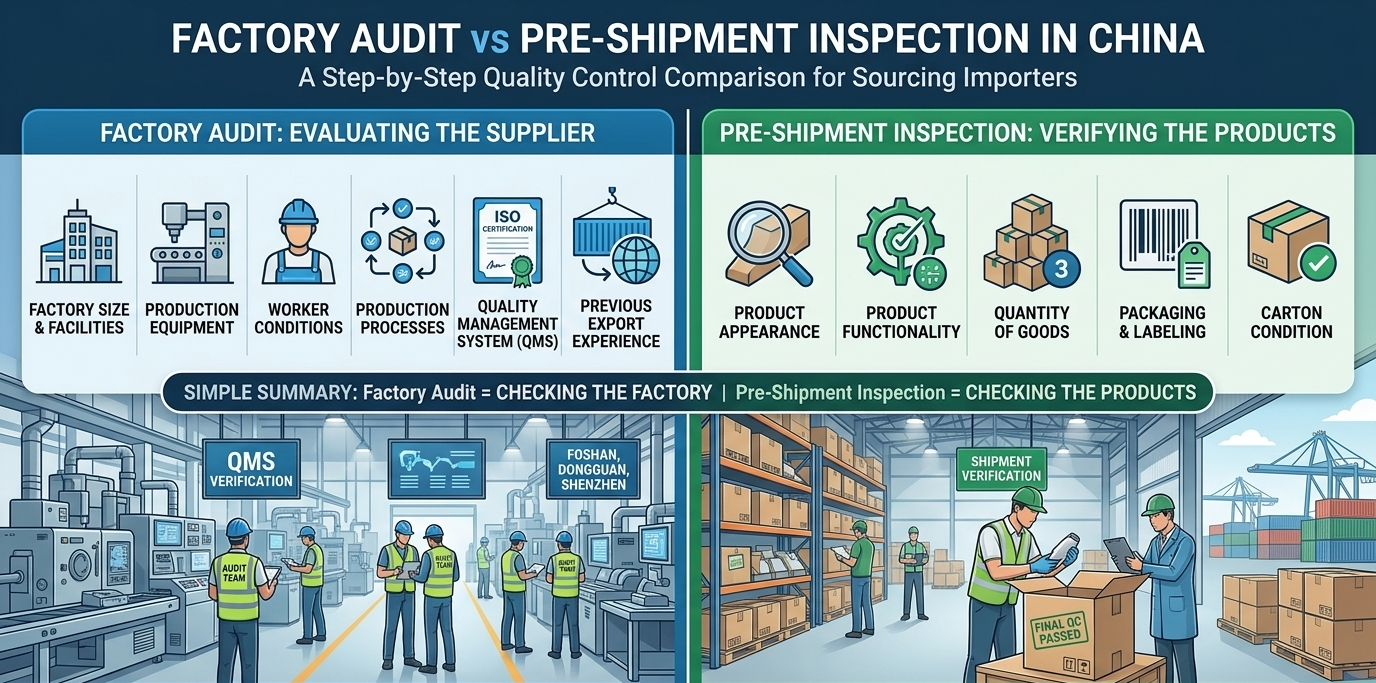
During a factory audit in China, inspectors usually check things such as:
- Factory size and facilities
- Production equipment
- Worker conditions
- Production processes
- Quality management system
- Previous export experience
This type of audit is often done before placing a large order or when working with a new supplier.
For buyers sourcing from manufacturing regions like Foshan, Dongguan, or Shenzhen, a factory audit helps verify that the supplier is a real manufacturing facility rather than just a trading company.
What Is a Pre-Shipment Inspection in China?
A pre-shipment inspection focuses on the finished products rather than the factory itself.
This inspection usually takes place when production is complete and most goods are already packed.
During a pre-shipment inspection service in China, inspectors check:
- Product appearance
- Product functionality
- Quantity of goods
- Packaging and labeling
- Carton condition
The main goal is to confirm that the products meet the agreed specifications before the goods are shipped.
Many importers consider this step one of the most important parts of quality inspection in China.
When Should Buyers Use a Factory Audit?
A factory audit is usually arranged early in the sourcing process.
Importers often use factory audits when:
- Working with a new supplier
- Planning large or long-term orders
- Verifying whether the supplier is a real factory
- Evaluating production capability
For example, if a buyer finds a supplier online through platforms like Alibaba, they may want to arrange a China factory audit service before committing to production.
This step helps reduce the risk of working with unreliable suppliers.
When Should Buyers Use a Pre-Shipment Inspection?
A pre-shipment inspection usually happens near the end of production.
Importers commonly arrange this inspection when:
- Production is completed
- Goods are ready to ship
- Final payment has not been released yet
The inspection helps confirm that the order meets the agreed quality standard.
If problems are discovered during the pre-shipment inspection in China, buyers can request corrections before shipment.
What Are the Main Differences Between Factory Audits and Pre-Shipment Inspections?
Although both are part of the China sourcing quality control process, they serve different purposes.
A factory audit checks the supplier.
A pre-shipment inspection checks the products.
Key differences include:
Factory audit focuses on:
- Factory capability
- Production processes
- Quality management systems
Pre-shipment inspection focuses on:
- Product quality
- Quantity of goods
- Packaging and labeling
In simple terms:
Factory audit = checking the factory
Pre-shipment inspection = checking the products
Do Importers Need Both Services?
Not every order requires both services.
However, many experienced importers use both at different stages of the sourcing process.
For example:
Step 1
Arrange a factory audit in China when selecting a new supplier.
Step 2
Place the production order.
Step 3
Arrange a pre-shipment inspection before shipment.
This approach provides better visibility into both the supplier capability and the final product quality.
Are Factory Audits and Inspections Common in China Sourcing?
Yes, these practices are widely used in international trade.
Buyers who cannot visit factories themselves often rely on third-party inspection services in China or local sourcing agents to help manage these steps.
In many cases, these checks are not about finding small problems. Instead, they help identify major risks before they become costly mistakes.
Final Thoughts
When sourcing products from China, factory audits and pre-shipment inspections play different roles.
A factory audit helps buyers understand whether a supplier has the capability to produce their products.
A pre-shipment inspection helps confirm that the finished goods match the agreed specifications before shipment.
Using the right inspection at the right stage can help importers reduce sourcing risks and make more informed decisions when working with Chinese suppliers.
FAQ: Factory Audit and Pre-Shipment Inspection in China
What is a factory audit in China?
A factory audit is an evaluation of a supplier’s production capability, facilities, and quality management system. It helps buyers understand whether the supplier is able to produce their products reliably.
What is a pre-shipment inspection in China?
A pre-shipment inspection is a product quality check that takes place when production is completed and goods are ready to be shipped. Inspectors check product quality, quantity, packaging, and labeling.
Which is more important: factory audit or pre-shipment inspection?
Both serve different purposes. A factory audit evaluates the supplier, while a pre-shipment inspection checks the finished products before shipment.
Do small orders need factory audits?
Not always. Factory audits are more common for large orders or long-term supplier relationships. For smaller orders, buyers may rely mainly on pre-shipment inspections.