
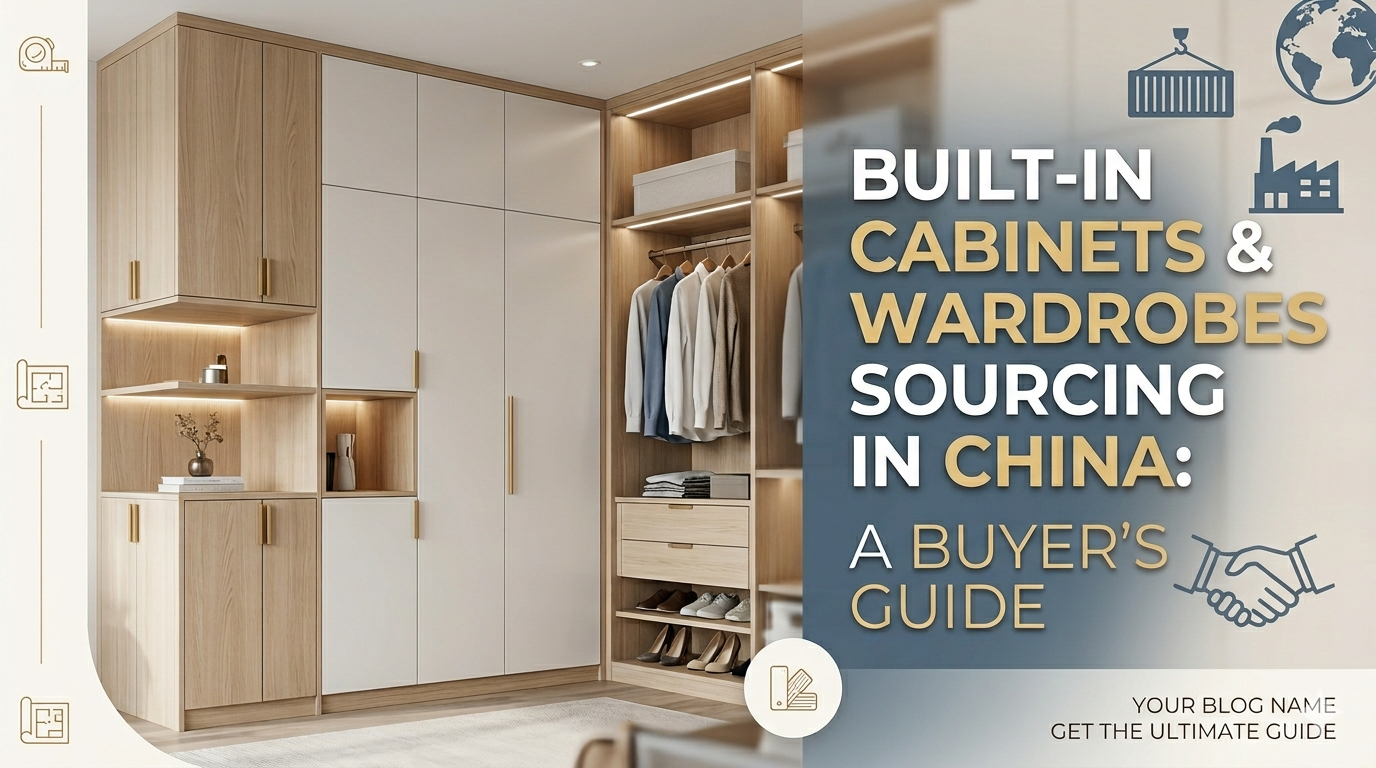
For interior designers, property developers, and furniture wholesalers, sourcing built-in cabinets and custom wardrobes from China is one of the most effective ways to control project budgets. China’s manufacturing infrastructure allows for high-volume, precision-cut cabinetry at a fraction of the cost of domestic carpentry.
However, a cabinet is not just pieces of wood; it is a system of engineered panels, edge banding, hinges, and precise drilling. If one measurement is off, or if the factory uses cheap hardware, the on-site installation will become a nightmare. Successfully sourcing custom storage solutions requires moving past basic catalog pictures and focusing on the engineering and material specifications.
Why is Guangdong the center for custom cabinet manufacturing?
While you can find furniture factories all over China, the supply chain for custom panel furniture is heavily concentrated in Guangdong province, specifically around Foshan and Guangzhou.
This geographic cluster is critical because custom cabinetry relies on a massive supporting ecosystem. A single wardrobe requires MDF or plywood boards, laminates or veneers, CNC machining, edge banding adhesives, and metal hardware. In Foshan, all these component suppliers are located within a 30-mile radius. This density allows local factories to produce highly customized designs with much shorter lead times than factories in isolated regions, making it the ideal hub for project-based sourcing.
How do you specify the right materials and avoid toxic panels?
The biggest mistake overseas buyers make is negotiating price without locking in the core material specifications. If you push a factory too hard on price, they will simply downgrade the invisible core materials.
To ensure durability and legal compliance in your home market, you must clearly specify the following:
- Core Boards: For kitchen base cabinets and bathroom vanities, you must specify Plywood or Moisture-Resistant Particle Board (MRPB) to prevent water damage. Standard MDF (Medium Density Fiberboard) should only be used for wardrobe doors or dry-area shelving because it absorbs moisture easily.
- Emission Standards: This is a non-negotiable legal requirement in many countries. You must explicitly demand that all panels are CARB P2 (California Air Resources Board) or EPA TSCA Title VI compliant. This guarantees that formaldehyde emissions are strictly controlled.
- Surface Finishes: Be specific. Are you paying for standard Melamine, scratch-resistant PET film, or high-end baked Lacquer? Each finish has a drastically different price per square meter.
What separates a premium wardrobe from a cheap one?
If two factories quote you wildly different prices for what looks like the same wardrobe, the difference usually lies in two technical areas: edge banding and hardware.
- Edge Banding Technology: This is how the raw edges of the cut boards are sealed. Cheap factories use traditional EVA glue, which leaves a visible glue line and degrades over time, eventually peeling off. Premium factories use PUR (Polyurethane) edge banding. PUR creates a seamless, highly water-resistant bond. For kitchens and bathrooms, PUR edge banding is mandatory.
- Hardware Selection: The hinges and drawer slides determine the lifespan of the cabinet. Do not accept generic “local hardware.” If you have the budget, specify European brands like Blum or Hettich. If you want a cost-effective alternative that still performs excellently, specify top-tier Chinese domestic brands like DTC or Higold.
How do you manage CAD designs and flat-pack logistics?
Custom cabinetry is a game of millimeters. You cannot simply send a floor plan to a factory and hope for the best.
Before any wood is cut, the factory must produce detailed Shop Drawings (CAD). These drawings must account for your local appliance dimensions (fridges, ovens) and plumbing clearances. You must approve these drawings panel by panel.
Furthermore, built-in cabinets are shipped as RTA (Ready-to-Assemble) or Flat-Pack to save container space. The logistical risk here is damage during transit and chaos during on-site installation.
- Require the factory to use heavy-duty corner protectors inside the cartons.
- Crucial Step: Mandate that every single panel is individually labeled with a sticker that matches the assembly manual (e.g., “Apt 2B – Kitchen – Base Cabinet 3 – Left Side Panel”). Without this, your local installers will spend days just sorting the pieces.
Key Takeaways
- Specify the Core: Never just ask for “wood.” Demand CARB P2 compliant Plywood or MDF depending on the moisture level of the room.
- Demand PUR Edge Banding: This is the industry standard for preventing moisture damage and peeling edges.
- Name Your Hardware: Explicitly require top brands like Blum, Hettich, or DTC in your contract.
- Label Everything: Ensure the factory labels every flat-pack panel clearly for fast, error-free installation on the job site.
FAQ: Sourcing Built-in Cabinets
Q: Can I order just one kitchen for my own house?
A: Yes, many custom cabinet factories in Foshan accept an MOQ (Minimum Order Quantity) of just 1 set. However, shipping a single kitchen via LCL (Less than Container Load) can be expensive. It is most cost-effective for developers ordering multiple units for apartments or hotels.
Q: Are the cabinets shipped assembled or flat-packed?
A: Standard practice for export is flat-packed (RTA) to maximize shipping efficiency. A 40ft container can hold flat-pack cabinets for roughly 20-30 kitchens, but only 5-8 kitchens if fully assembled.
Q: How do I handle measurements?
A: You or your local contractor must provide the exact “finished” wall-to-wall measurements. The Chinese factory’s engineering team will then calculate the cabinet dimensions, leaving the appropriate tolerances for filler panels.
Secure Your Project with HSY Sourcing
Sourcing custom cabinets and wardrobes is highly technical. A single millimeter error on a CAD drawing or a swapped hardware brand can disrupt your entire construction schedule. You need a team on the factory floor to verify the engineering before the container is loaded.
Located in Foshan, the heart of China’s furniture and building materials industry, HSY Sourcing acts as your dedicated project management team.
- Engineering Review: We cross-check your site dimensions with the factory’s CAD shop drawings, ensuring appliance gaps and filler panels are correctly calculated.
- Material Verification: We conduct on-site factory audits during production to verify that the core boards are CARB P2 compliant and that PUR edge banding is actively being used.
- Assembly Testing: Before the bulk order is flat-packed, we require the factory to fully assemble a “Mock-up” unit. We test the hinges, check the gaps, and verify the finish.
- Logistics & Consolidation: We ensure every panel is safely packed and clearly labeled for your contractors. If you are sourcing tiles, windows, and cabinets, we consolidate them all in our Foshan warehouse for efficient shipping.