
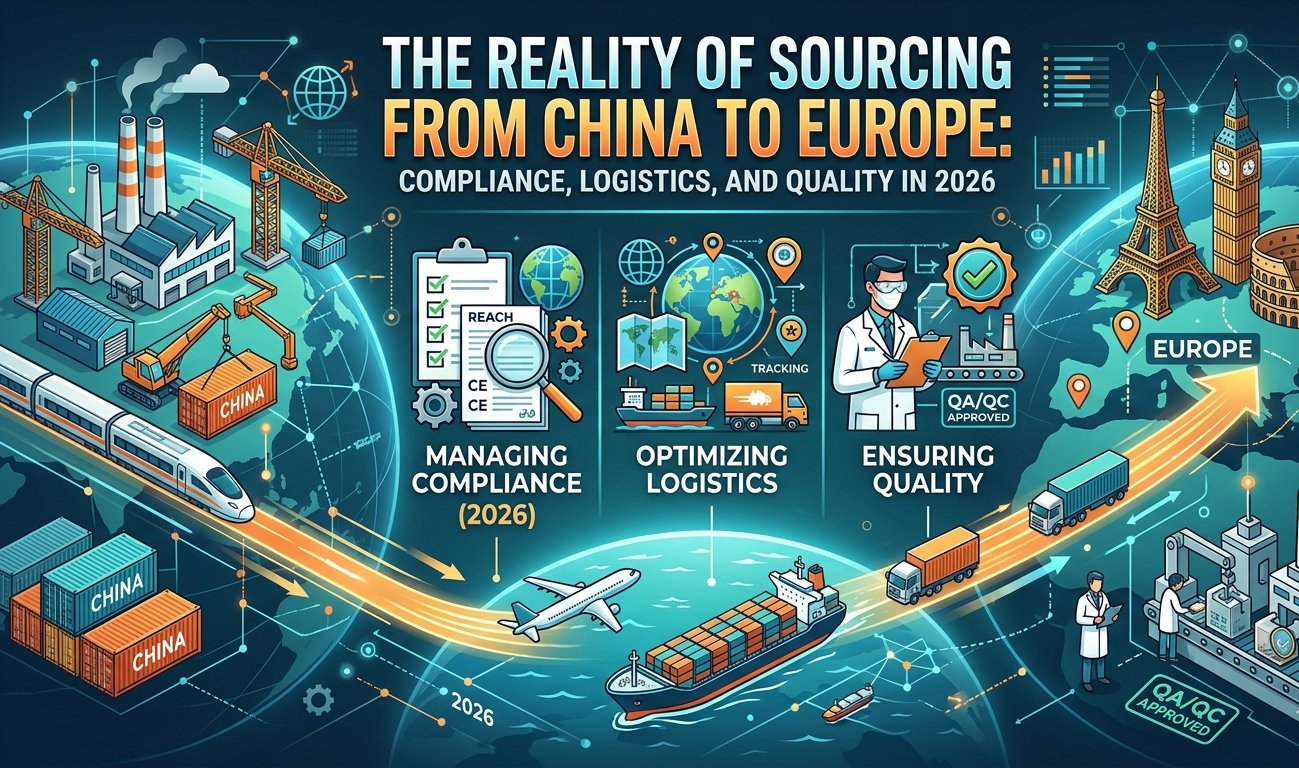
For European importers, the “China Advantage” has shifted from purely low-cost labor to unparalleled supply chain depth. However, shipping goods from a factory in Guangdong to a warehouse in Germany or France involves a gauntlet of regulatory and logistical hurdles that have become increasingly complex in 2026.
Successfully navigating this route requires moving beyond simple price negotiations and focusing on the technical and legal realities of the European single market.
What are the evolving compliance and certification requirements for the European market?
Direct Answer: The EU has transitioned from basic safety standards (CE marking) to a “Life-Cycle” regulatory approach. This includes the new Ecodesign for Sustainable Products Regulation (ESPR) and EPR (Extended Producer Responsibility), which demand that products be traceable, repairable, and sustainably manufactured.
In practice, many Chinese factories—especially mid-sized ones—may not fully grasp the documentation required for the Digital Product Passport (DPP). It is no longer enough to have a “CE certificate” on file; you need the full technical construction file (TCF) and verifiable raw material declarations (REACH/RoHS). If your supplier cannot provide the primary laboratory data, your goods risk being seized at European customs or facing heavy fines under the Corporate Sustainability Due Diligence Directive (CSDDD).
How do current logistics and geopolitical factors impact lead times to Europe?
Direct Answer: Logistics stability remains the single greatest variable. Ongoing shifts in maritime routes, such as the avoidance of the Red Sea/Suez Canal, have added 10 to 15 days to standard transit times and significantly increased freight rates and carbon surcharges.
For a project manager in Europe, “Lead Time” now includes a massive buffer for port congestion and equipment shortages. Relying on “FOB” terms often leaves the buyer with too much risk. The trend in 2026 is moving toward more integrated logistics management, where the buyer has real-time visibility into the container’s location. Sourcing from a hub like Foshan or Guangzhou provides more routing options (such as the China-Europe Railway Express), but even these require careful synchronization to avoid the “bottleneck effect” during peak seasons.
What are the most common quality control gaps between China factories and EU standards?
Direct Answer: The most common gap is “Technical Interpretation.” A factory may produce a product that looks correct but fails to meet the specific durability or chemical safety standards required for the European market because the technical specifications were “lost in translation.”
This is often referred to as “Quality Fade.” Initial samples might be perfect, but during mass production, a factory might swap a component for a lower-grade alternative to save costs. Without a physical presence in the factory during the production run, European buyers have no way of knowing their product has been compromised until the container is opened 10,000 miles away. Managing this requires a shift from “Final Inspection” to “In-Process Audits,” where raw materials are verified before the assembly begins.
Key Takeaways
- Compliance is Non-Negotiable: EU regulations now focus on environmental transparency and chemical safety. Ensure your factory can provide primary data, not just a scan of a certificate.
- Buffer Your Timelines: Geopolitical shifts have made 30-day shipping a rarity. Factor in at least 45–60 days for maritime transit to major European ports like Rotterdam or Hamburg.
- Technical Vetting: Technical specifications must be documented in a signed “Quality Agreement” that references specific EU laboratory standards (e.g., EN standards).
- On-Site Oversight: Given the distance, having a local representative in China is the only way to prevent “Quality Fade” and verify the factory’s ESG (Environmental, Social, and Governance) compliance.
FAQ: Sourcing for the European Market
Q: Does the “China-Europe Railway” save enough time to justify the cost?
A: Usually, yes. The rail route takes 15–20 days compared to 45+ days by sea. For high-value goods like electronics or seasonal building materials, the time saved often outweighs the higher freight cost by improving cash flow.
Q: How do we handle the “Green” requirements of the EU?
A: Start by asking your supplier for their ISO 14001 certification and their carbon footprint data. If they are an export-oriented factory in Guangdong, they are likely already adapting to these requests from larger European retailers.
Q: What is the biggest mistake European buyers make?
A: Assuming “FOB” means the factory handles everything until the ship leaves. In reality, the buyer is still responsible for ensuring the factory has the correct export licenses and that the goods are loaded safely into the container.
Why Partner with HSY Sourcing for Your European Project?
Managing a supply chain from Foshan to Europe is a game of risk management. You don’t need a middleman; you need a Technical Hub on the ground that understands both the manufacturing reality of China and the strict regulatory climate of the EU.
At HSY Sourcing, we act as the bridge that prevents technical and logistical failures. We are based in the heart of Guangdong’s industrial clusters, providing:
- Deep Compliance Knowledge: We understand the documentation needed for EU customs and the ESPR requirements. We don’t just “check” certificates; we verify them.
- On-Site Quality Audits: We enter the factory during production. We check the raw materials, the assembly line, and the final packaging to ensure your goods meet European durability standards.
- Logistics Synchronization: We manage the complex move from the factory floor to the port, coordinating with shipping lines to ensure your containers are prioritized and loaded correctly.
- Radical Honesty: We provide unedited video reports and factual data. If a factory is behind schedule or a material doesn’t meet the spec, you hear it from us immediately—not after the goods have shipped.