

If you’ve ever bought a cheap juicer—or any small kitchen gadget—turned it on, and immediately smelled something like a melting trash can, you aren’t alone. It’s the #1 complaint for budget electronics.
Most people think, “Oh, it’s just because it’s new. The smell will go away.”
The truth is: Sometimes it goes away, but often it’s a sign that your product is slowly dying (or is a fire hazard).
As a sourcing agent here in Shunde, I spend a lot of time inside these factories. I see exactly what goes into a $15 juicer versus a $30 one. The difference isn’t just the brand name; it’s the “guts” of the machine.
Here is the unfiltered reality of why that smell happens and how we make sure it doesn’t happen to our clients’ products.
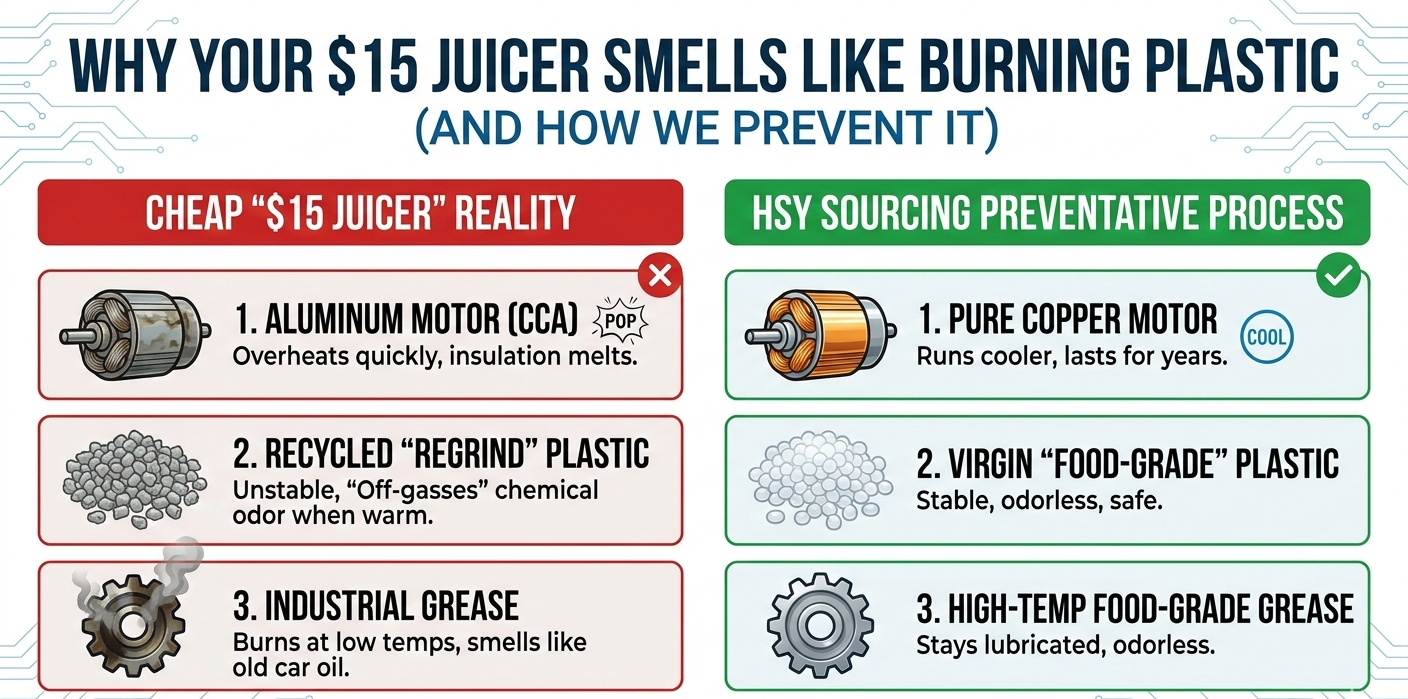
1. The Motor: “Cooking” the Insulation
The most common cause of that burning smell is the motor. In a $15 juicer, the factory is almost certainly using an Aluminum Motor instead of a Pure Copper one.
- The problem: Aluminum doesn’t handle heat well. To keep the wires from short-circuiting, they are coated in a thin “varnish” (insulation). Because aluminum gets hot so fast, that varnish literally starts to cook.
- The Smell: That’s the chemical scent of insulation paint heating up. If it gets too hot, the paint cracks, the wires touch, and pop—the juicer is dead.
2. Recycled Plastic: The “Regrind” Secret
Plastic is expensive. To hit a $15 price point, many factories use a mix of “Virgin” plastic and “Regrind” (recycled scrap).
- The problem: Recycled plastic isn’t stable. It often contains impurities from whatever it used to be (old toys, car parts, etc.). When the motor inside the juicer gets warm, it heats up the plastic frame holding it in place.
- The Smell: This is called “off-gassing.” It’s that toxic, acrid plastic smell. If the factory used the wrong grade of plastic for the parts near the motor, that smell will never truly go away.
3. Cheap Grease on the Gears
Inside every juicer, there are gears that need lubrication.
- The problem: High-quality, food-grade, high-temperature grease costs money. To save a few cents, some workshops use cheap industrial grease.
- The Smell: When the juicer runs at high speed, the friction heats the gears, and the cheap grease starts to smoke or smell like an old car engine.
How We Prevent “The Smell” for Our Clients
When we represent a buyer, we aren’t just looking at the color of the juicer. We are looking at the spec sheet and the assembly line. Here is how we stop the “Burning Plastic” disaster before the container leaves Foshan:
We Demand “Copper-Rich” or Pure Copper Motors
If a client is building a brand, we tell them: Do not buy the cheapest motor. We specify the motor type in the contract. During the inspection, we don’t just look at the machine; we tear one down. We cut the motor wires to verify they are copper all the way through, not just copper-plated aluminum.
The “Burn-In” Test
In a standard factory check, most people just turn the machine on and off. That’s not enough. We perform a “Burn-in” test. We take random units from the production line and run them continuously for 15 to 30 minutes (depending on the product type).
- If the room starts smelling like a tire fire, the batch fails.
- We use infrared thermometers to check if the motor temperature is climbing too fast.
Plastic Grade Verification
We check the “Raw Material” area of the factory. If we see bags of grey, mismatched plastic pellets instead of clean, white virgin resin, we know they are using too much recycled material. For any part that gets hot or touches food, we insist on certified Virgin Grade plastic.
The Realistic Bottom Line
You can absolutely get a great deal on small appliances in Shunde. This is the best place in the world to make them. But you have to remember that factories are businesses. If you squeeze them for a “miracle price,” they will find a “miracle way” to save money—and that usually involves things that smell like burning plastic.
Our job is to find the balance: the best local price, but with the “guts” that will keep your customers happy and your Amazon account safe.
FAQ
Q: Is the smell dangerous?
A: If it’s just a faint “new electronic” smell that disappears after 2 minutes, it’s usually just dust or leftover manufacturing residue. If it’s strong, acrid, and happens every time you use it, yes—it’s a fire hazard and a sign of poor quality.
Q: Can I tell if a juicer is good just by looking at the box?
A: No. Everything looks good on the box. You have to check the wattage and the weight. Heavier juicers usually have better motors with more copper. Light, “flimsy” ones are usually the smell-makers.
Q: How much more does a “good” motor cost?
A: Usually, the difference between a motor that will burn out and a motor that will last 3 years is only $2 to $4 USD. It’s a small price to pay to avoid a 20% return rate.